

How Cassini found worlds beyond Saturn’s clouds
Cassini–Huygens travelled to Saturn as an orbiter and a Titan entry probe. Their investigation reached beyond the planet’s clouds: jets from Enceladus and lakes on Titan showed how different two neighbouring moons could be.
Material escapes from beneath the ice
Cassini observed plumes erupting from fractures near Enceladus’s south pole. The spacecraft sampled gas and ice particles, while other measurements constrained the moon’s interior. The combined evidence supports a global ocean beneath the ice shell. The plume provides access to material that originated below the visible surface. [1]
Sampling a plume is not the same as collecting an undisturbed bottle of ocean water. Freezing, eruption and transport can alter the material before it reaches an instrument. Scientists interpret its composition alongside those processes. The observations establish important ingredients and conditions for habitability; they do not constitute a detection of life. [1]
A moon supplies material to a ring
Enceladus’s escaping icy particles contribute much of the material in Saturn’s diffuse E ring. The moon and ring are therefore parts of one material cycle. Some particles remain near the moon; others spread through the system under gravity and electromagnetic forces. [2]
This connection is visible at a very different scale from the fractures themselves. Close flybys investigate the source, while wider observations show where the material goes. A complete account of a moon includes those exchanges with its surroundings, rather than treating its surface as the boundary of the scientific story. [2]
A familiar cycle with different liquids
Titan has a thick nitrogen-rich atmosphere and surface lakes and seas of liquid hydrocarbons, chiefly methane and ethane. Methane can evaporate, form clouds, fall as rain and flow across the ground. The cycle resembles Earth’s water cycle in its movement of liquid, while operating with different chemistry and at far lower temperatures. [3]
Huygens descended through Titan’s atmosphere and reached its surface in 2005. Cassini’s radar and other instruments supplied the broader orbital context. The probe measured one local path; the orbiter mapped patterns across the moon. Together they connected atmospheric measurements with actual terrain. [3]
Different evidence below the surface
Enceladus exposes material from a global ocean through active plumes. Titan has a dense atmosphere and surface hydrocarbon reservoirs; its deeper structure is less settled. A 2025 reanalysis of Cassini’s tidal measurements favours ice and slush with pockets of liquid water over a continuous buried ocean. That interpretation accounts for Titan’s measured deformation and the energy dissipated under Saturn’s changing pull. [1] [3] [4] [5]
Use the Saturn-system view to connect the planet, rings and moon orbits, then open the satellite records for their individual observations. Cassini’s long tour made repeated comparisons possible. The mission’s importance lies in those measured relationships: where material comes from, how it moves and which environments the observations can actually establish. [1] [3] [4] [5]
Sources & image credits
Related reading and objects
How to read Saturn’s rings
From Earth, Saturn’s rings look like smooth bands. Cassini revealed particles moving at different speeds, waves driven by moons and small objects throwing long shadows. Their patterns explain how a disk of ice can become a measuring instrument.
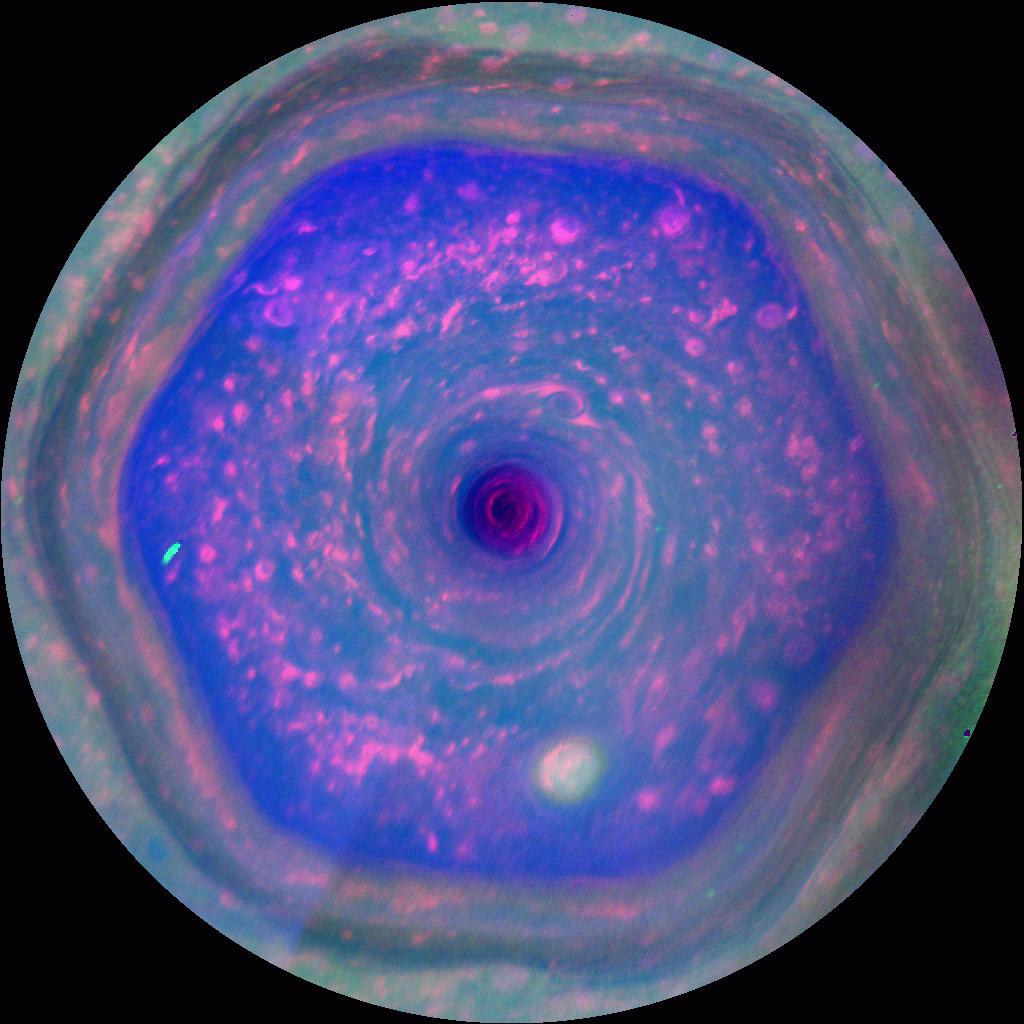
Why a jet stream can have six sides
Cassini followed the six-sided pattern around Saturn’s north pole as northern sunlight returned. The hexagon belongs to an atmospheric jet, with clouds tracing a structure that can persist while the gas itself moves.