

Why does Hyperion tumble instead of turning steadily?
Cassini’s September 2005 encounter revealed deep, closely packed cavities across Hyperion. The moon was unusual in another way: it did not keep one orderly face towards Saturn. Its uneven shape and changing gravitational torques produce chaotic rotation.
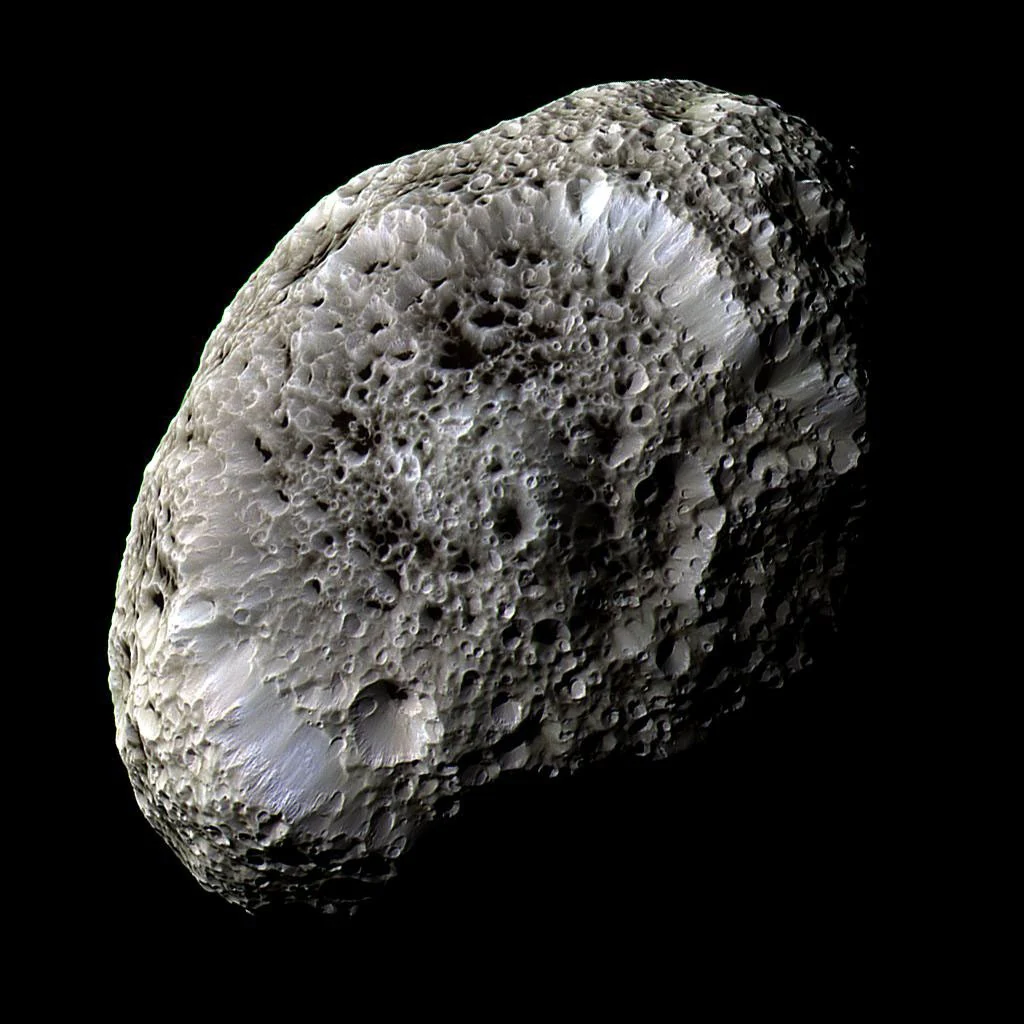
Gravity pulls on a shape, not just a point
Hyperion is approximately 410 by 260 by 220 kilometres along its principal dimensions. It is much too irregular to behave like a uniform sphere. Saturn’s gravitational pull therefore exerts a torque that depends on the moon’s orientation. [1]
As different parts of the elongated body face towards Saturn, the torque changes the rotation. The moon also follows an eccentric orbit, so the distance and strength of the tidal forcing vary during each circuit. [1]
An irregular shape alone does not guarantee chaotic motion in every situation. The combination of shape, orbital forcing and rotational state determines the outcome. Hyperion occupies a regime in which those effects make its long-term orientation highly sensitive to small differences in the starting conditions. [1]
Sensitive does not mean force-free
Chaotic rotation still follows physical laws. The difficulty is that a small error in a measured orientation or rotation rate can grow until predictions of which face will point in a particular direction become unreliable. [1]
That differs from a moon in simple synchronous rotation, where the same hemisphere remains directed towards the planet apart from smaller oscillations. Hyperion tumbles, changing its rotational orientation in a more complicated way. [1]
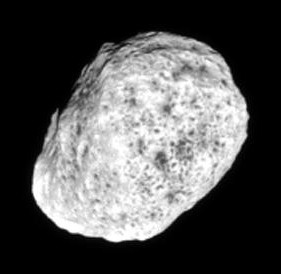
A quoted approximate rotation timescale cannot serve as a permanent clock for the visible face. It describes part of a changing motion, while the orbit around Saturn remains much more orderly. The distinction is why a tidy animation of a steadily spinning Hyperion would misrepresent the real behaviour. [1]
A neighbouring moon maintains the forcing
Hyperion’s orbit is linked to Titan through a 4:3 orbital resonance: Titan completes four orbits while Hyperion completes about three. Repeated gravitational interactions help maintain Hyperion’s eccentricity. [1]
That matters because tides would otherwise tend to smooth aspects of the orbital and rotational evolution over time. The neighbouring moon helps preserve the changing forcing that enters Hyperion’s spin dynamics. A small body’s behaviour therefore depends on the architecture of the wider satellite system. [1]
The cratered surface reveals a different property
Cassini measured a very low bulk density, only a little over half that of liquid water. An icy body with that density must contain substantial empty space unless an implausibly light solid composition is assumed. Researchers inferred porosity exceeding roughly 40 percent. [1] [2]
That is a statement about the bulk body, not a claim that every visible crater is a passage into one connected cavern. Gaps among constituent material can make the interior porous while the surface remains a landscape of impact cavities. [1] [2]
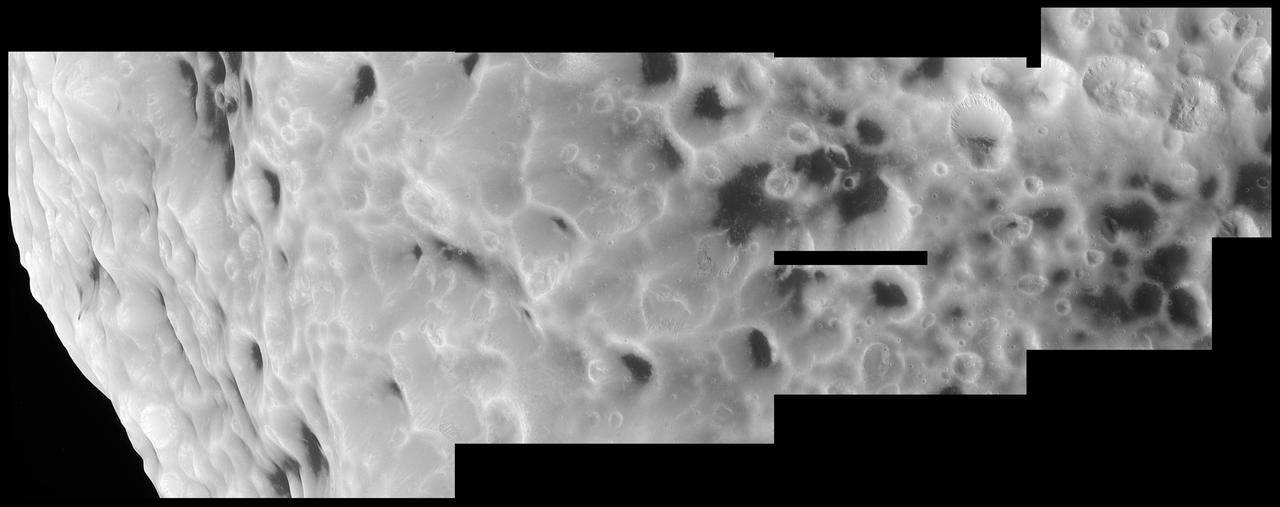
When an impact strikes a porous target, energy can compact material rather than simply excavating a large volume and throwing it outward. Reduced production or retention of ejecta may help preserve neighbouring craters instead of burying them. The 2007 analysis connected this mechanism with Hyperion’s unusually well-preserved, sponge-like appearance. [1] [2]
Why the crater floors look dark
Many crater walls are relatively bright, while the floors contain darker, redder material. Ice loss and the accumulation of less volatile material provide one proposed explanation for that distribution. Enhanced-colour images make such differences easier to see but do not show the colours exactly as a human eye would from nearby. [1]
The close images and the spin measurements answer different questions. Porosity helps explain how impacts shape the ground; gravitational torque explains why the ground does not face Saturn in a predictable cycle. Together they describe a moon whose small size allows both an uncompacted interior and a rotational state very different from its rounded neighbours. [1]
Sources & image credits
Related reading and objects
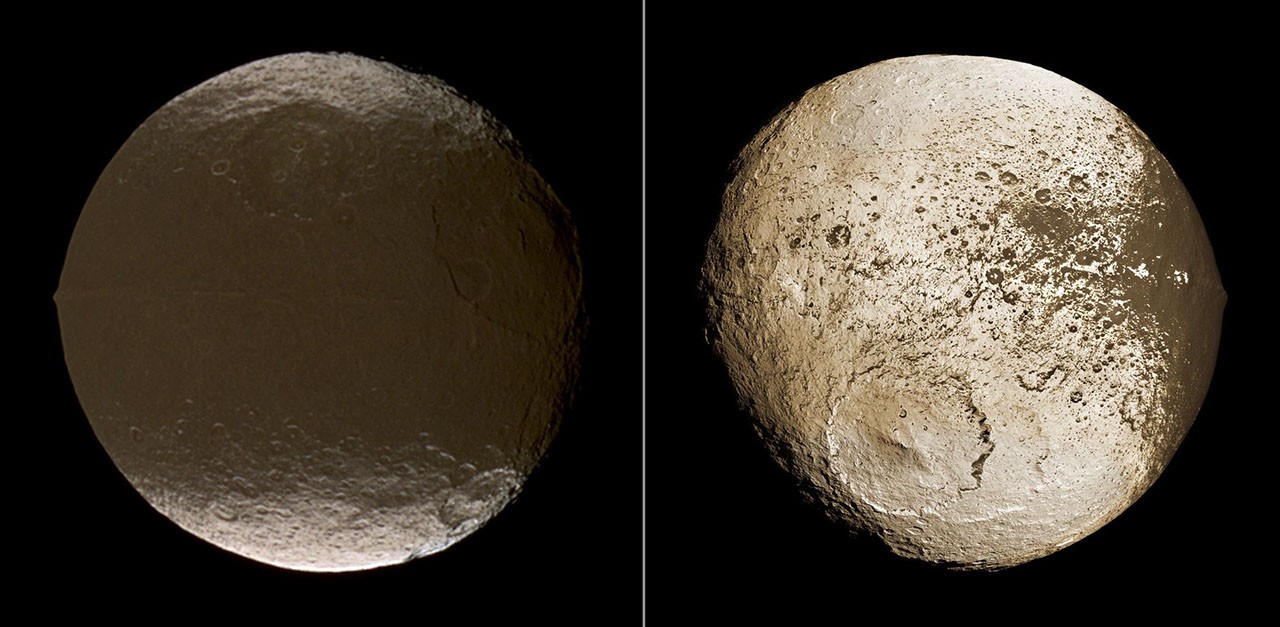
Why is one side of Iapetus so dark?
Cassini’s September 2007 flyby showed an abrupt contrast on Iapetus: dark terrain beside bright ice, with surprisingly little middle ground. Dust can start the difference, but sunlight and the movement of water molecules help explain why it becomes so strong.
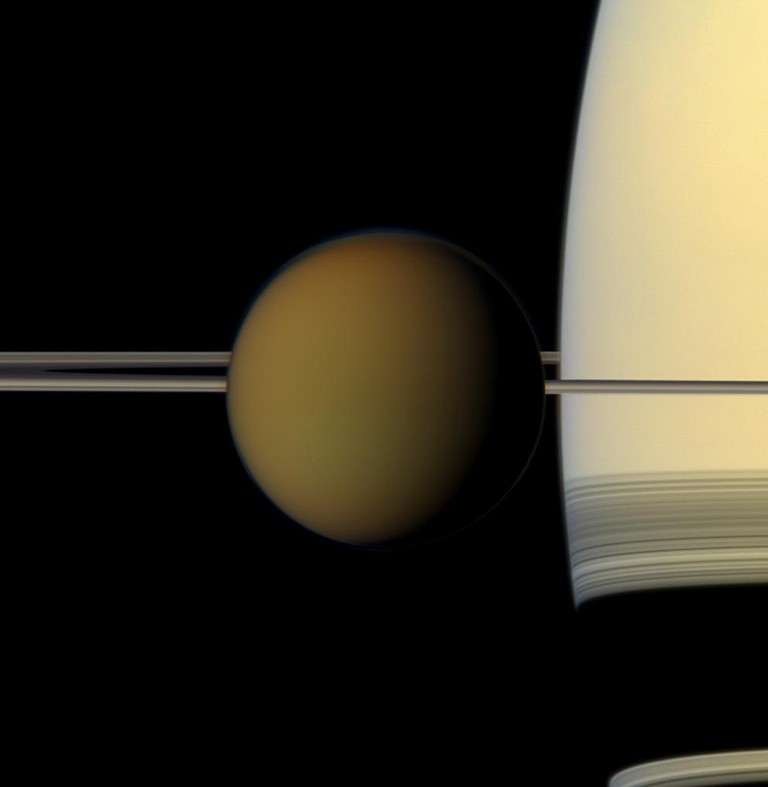
Rain, rivers and ice on Titan
Dragonfly is planned to investigate Titan’s surface chemistry by flying between locations. Cassini and Huygens established the setting: rain, channels and lakes on a moon so cold that water ice acts as bedrock and hydrocarbons supply the liquid weather.