

Saturn
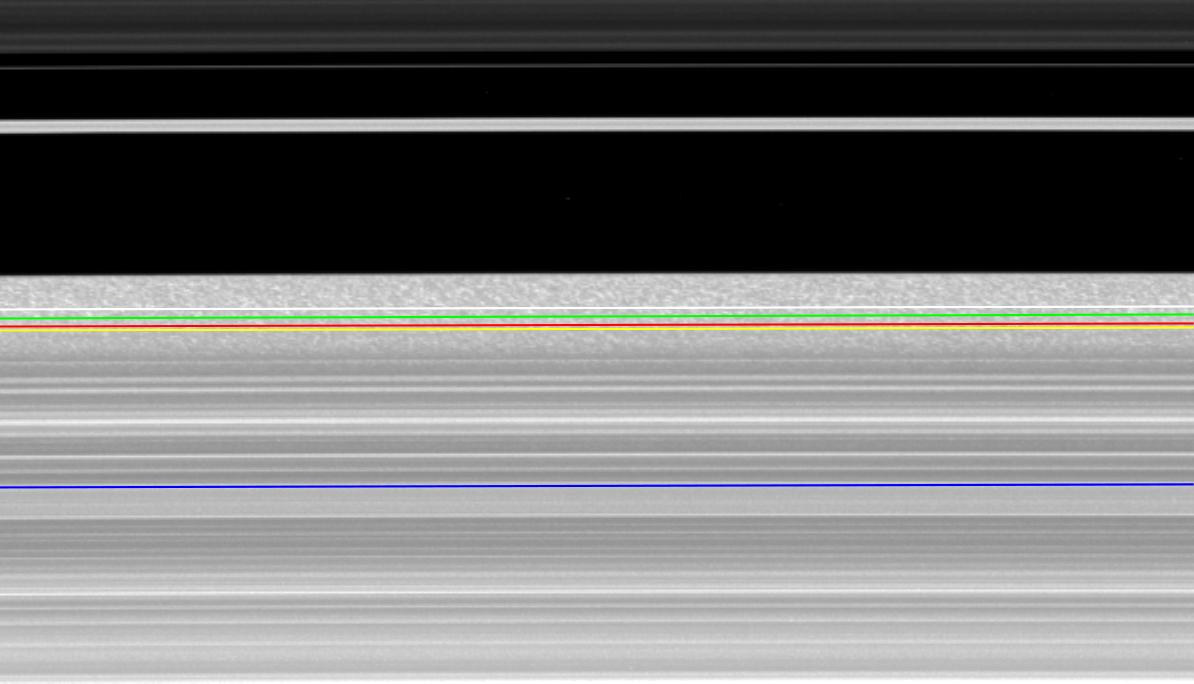
Saturn’s rings consist of enormous numbers of orbiting particles, mostly water ice, rather than a solid sheet. Gaps, waves and sharp boundaries record gravitational interactions with moons and structure within the rings themselves. Cassini observed those patterns from close range and used them to investigate both the ring material and Saturn. The rings’ apparent tilt changes with viewing geometry as Saturn travels around the Sun.
- Mean diameter
- 116,464 km
- Rotation
- About 10.7 h
- Year
- 29.45 Earth years
The rings
Independent orbits, shared patterns
Cassini’s close images and occultations reveal waves, gaps and interactions with moons. Brightness and mass do not always vary together.
The northern hexagon
A six-sided atmospheric wave
A meandering jet stream holds a persistent six-sided pattern around the north pole while gas and cloud features move through it.
Enceladus and Titan
Material moving between worlds
Cassini sampled Enceladus’s plumes and mapped Titan’s methane lakes. Huygens measured a path down through Titan’s atmosphere to the ground.
More investigations
How to read Saturn’s rings
4 min read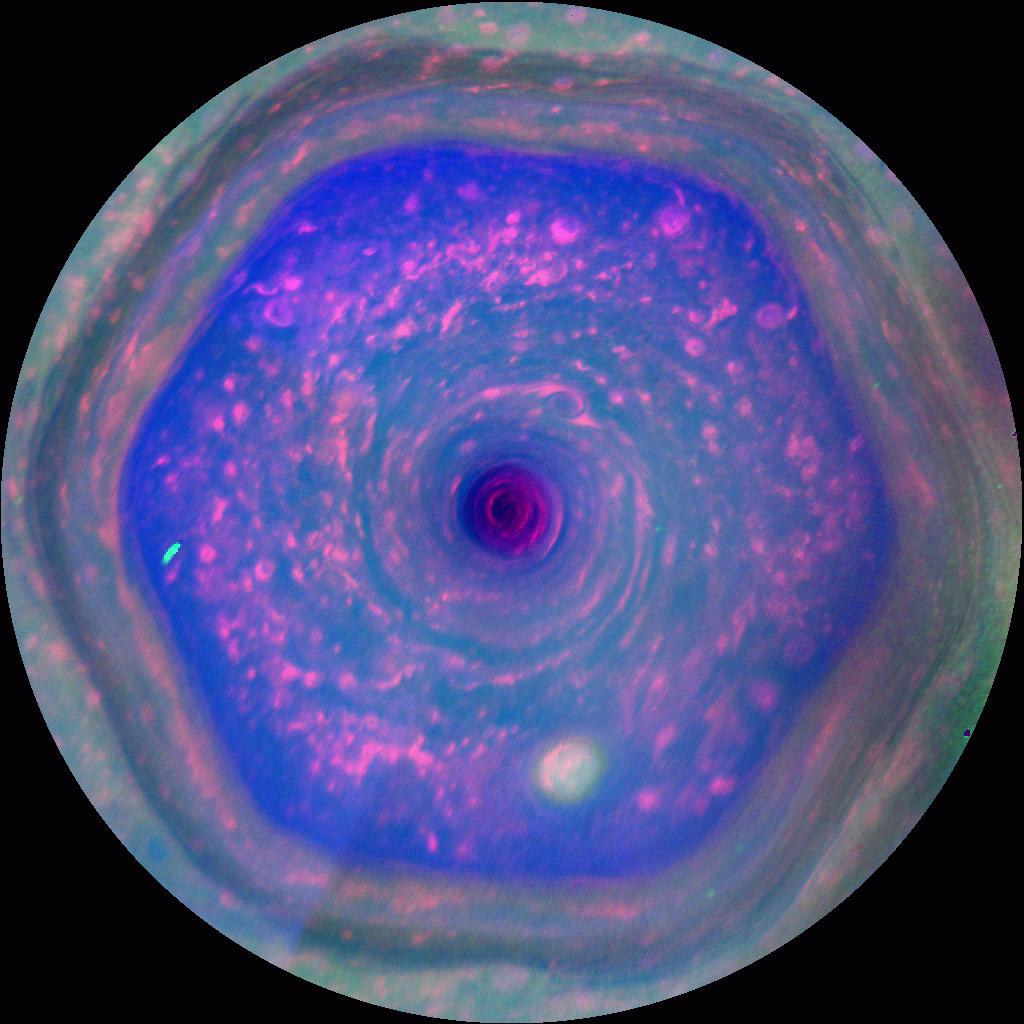
Why a jet stream can have six sides
3 min read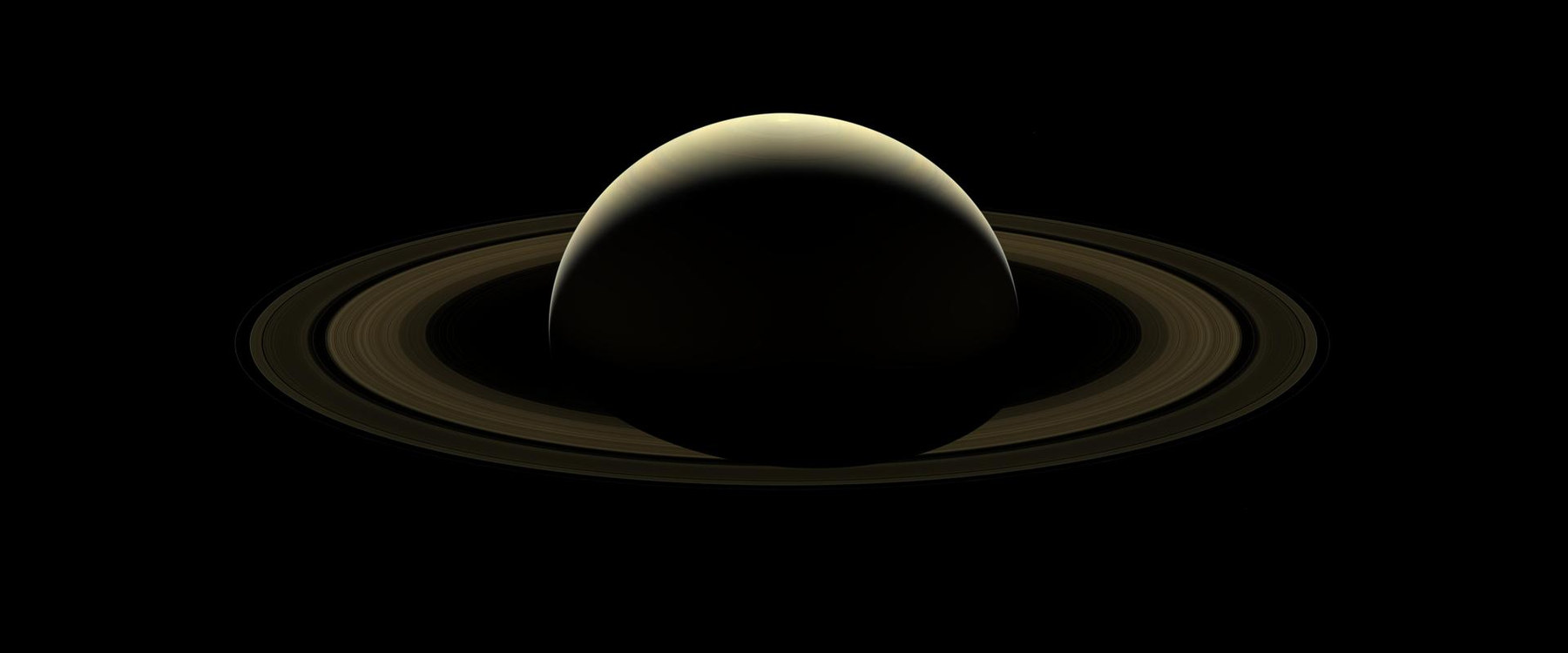
How Cassini found worlds beyond Saturn’s clouds
3 min read
What Enceladus’s plumes reveal about its ocean
4 min read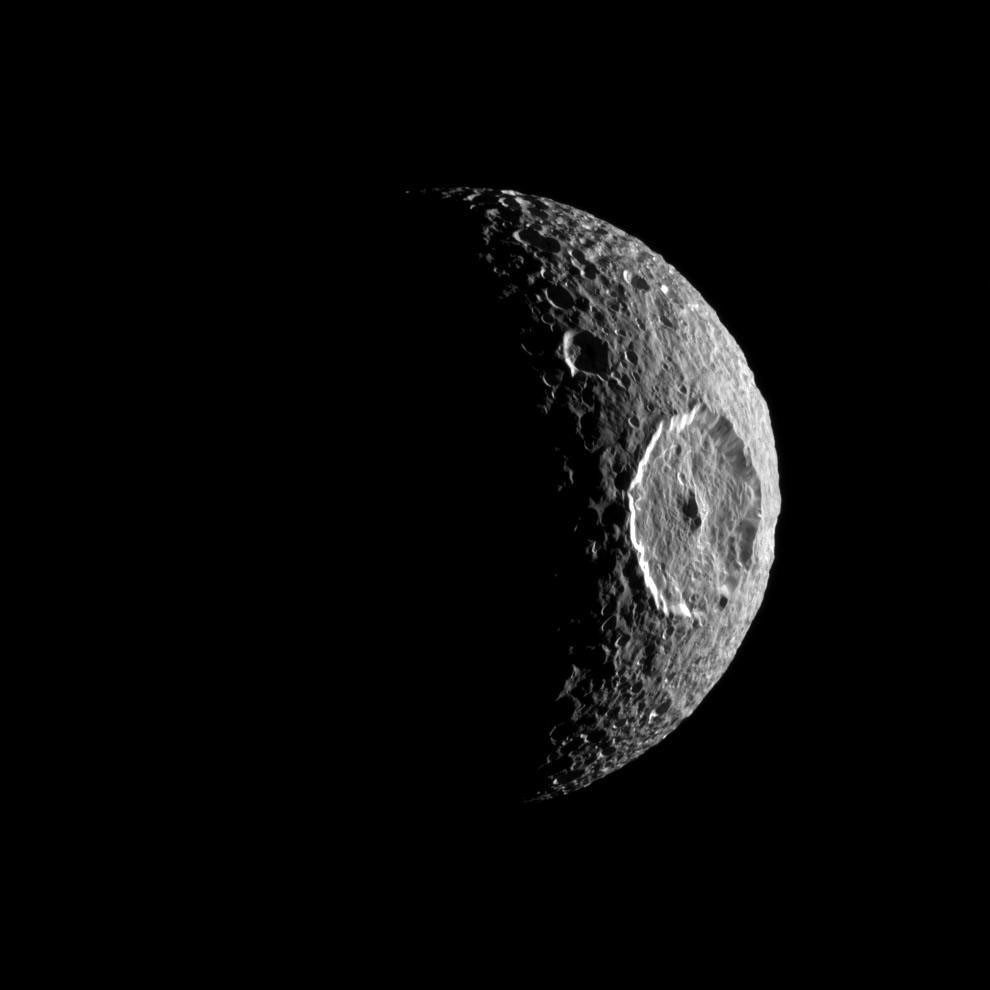
Why can ancient-looking Mimas hide a young ocean?
3 min read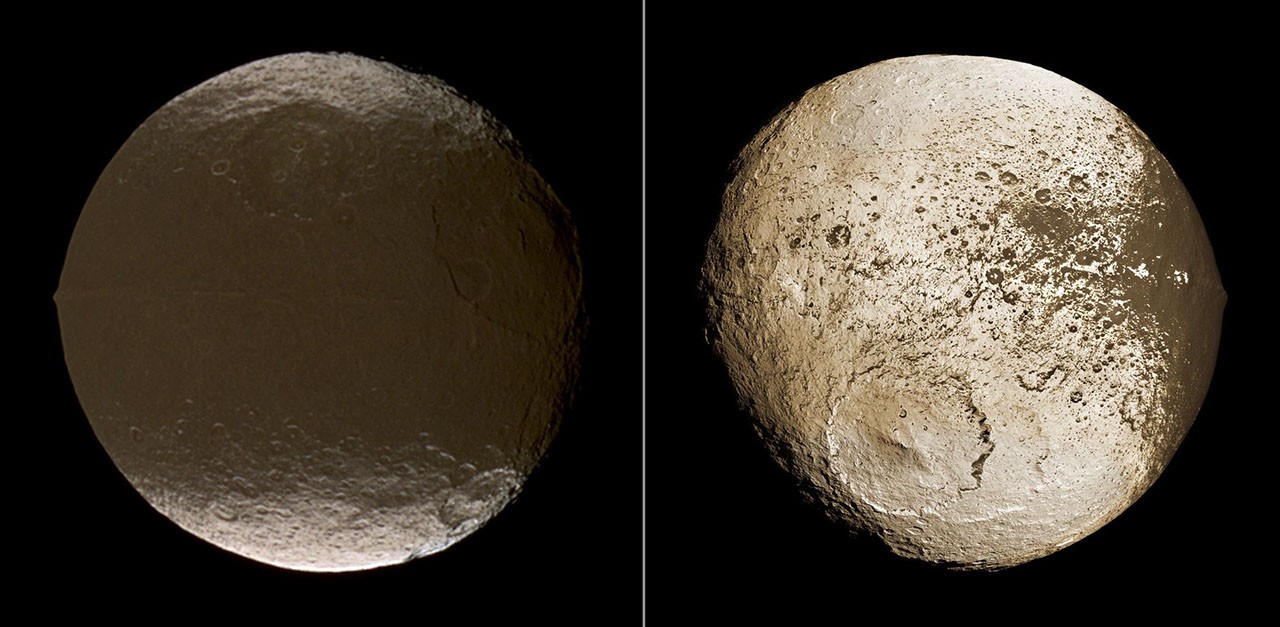
Why is one side of Iapetus so dark?
4 min read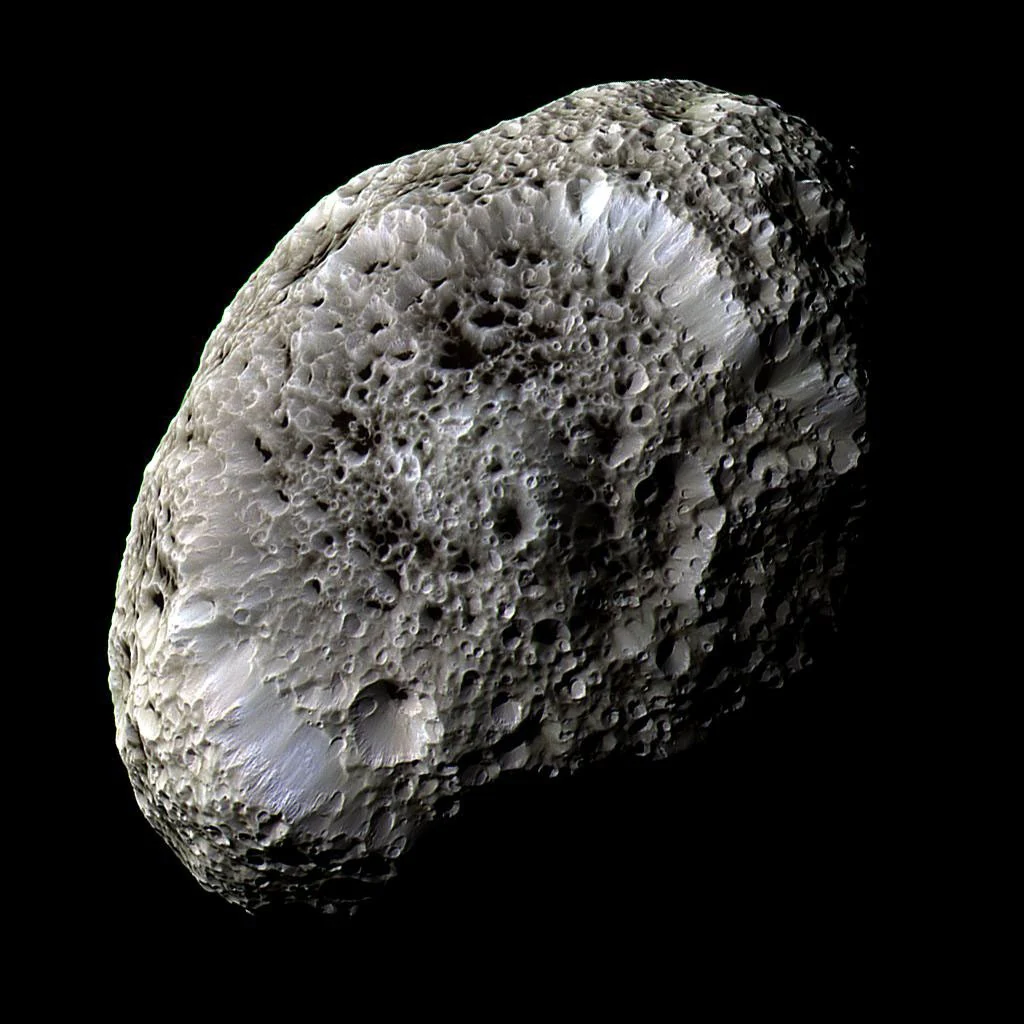
Why does Hyperion tumble instead of turning steadily?
3 min readThrough the instruments
Open an image for the full frame and its source.
Cassini’s last full portrait of Saturn
NASA/JPL-Caltech/Space Science InstituteThe moving edge of the B ring
NASA/JPL/Space Science InstituteSaturn’s northern hexagon
NASA/JPL-Caltech/SSI/Hampton UniversityShadows of Janus and Daphnis crossing Saturn’s A ring near equinox
NASA/JPL/Space Science InstituteBacklit plumes rising above the fractured south polar terrain of Enceladus
NASA/JPL/Space Science InstituteBacklit jets emerging from Enceladus’s south-polar fractures
NASA/JPL/Space Science InstituteInfrared heat measurements overlaid on an Enceladus tiger-stripe fracture
NASA/JPL/GSFC/SWRI/SSIHerschel crater on the illuminated portion of Mimas
NASA/JPL/Space Science InstituteCassini view of Mimas with shadows outlining Herschel crater
NASA/JPL-Caltech/Space Science InstituteFalse-colour close-up of Mimas’s craters and dark wall streaks
NASA/JPL/Space Science InstituteSide-by-side views of Iapetus’s dark leading and brighter trailing hemispheres
NASA/JPL-Caltech/Space Science InstituteCassini view of the bright–dark boundary across Iapetus
NASA/JPL/Space Science InstituteCassini image of Iapetus’s equatorial ridge crossing cratered terrain
NASA/JPL/Space Science InstituteHyperion’s irregular outline and closely packed deep craters
NASA/JPL-Caltech/Space Science InstituteCassini view of Hyperion’s irregular outline in August 2016
NASA/JPL-Caltech/Space Science InstituteCassini close-up of Hyperion’s deep craters and dark floors
NASA/JPL/Space Science InstituteMissions & milestones
5 launch records · 0 linked events
5 related records
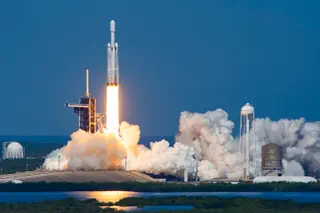
Dragonfly
July 5, 2028 · time to be confirmed
SpaceX · Falcon Heavy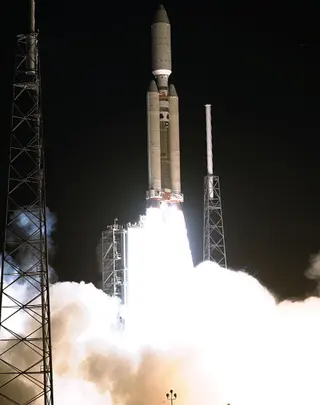
Titan IVB/Centaur | Cassini-Huygens
October 15, 1997 · UTC
Lockheed Martin · Titan IVB/Centaur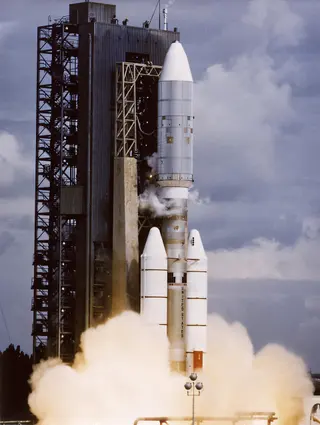
Voyager 1
September 5, 1977 · UTC
Lockheed Martin · Titan IIIEVoyager 2
August 20, 1977 · UTC
Lockheed Martin · Titan IIIE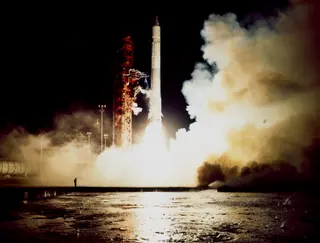
Pioneer 11
April 6, 1973 · UTC
United States Air Force · Atlas SLV-3D CentaurNo records match these filters.
Programs (1)
About these records
The source cohort includes dedicated missions, attempts and reviewed scientific flybys or gravity assists. Launch outcomes describe the recorded flight. They do not establish whether an old spacecraft is operating today. Events show published targets unless the record confirms an outcome.