

Why a jet stream can have six sides
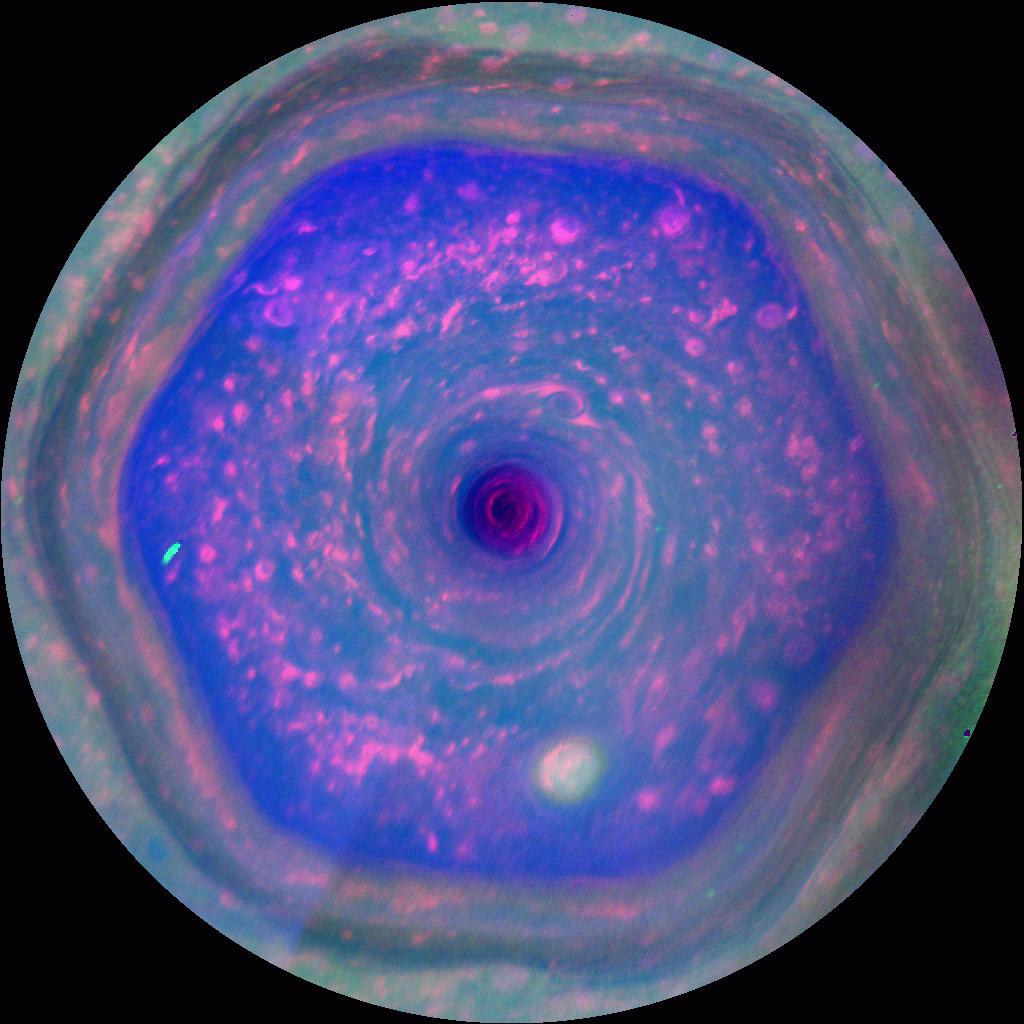
Cassini followed the six-sided pattern around Saturn’s north pole as northern sunlight returned. The hexagon belongs to an atmospheric jet, with clouds tracing a structure that can persist while the gas itself moves.
A shape made by moving gas
Most of Saturn’s cloud bands curve around the planet in roughly circular paths. Near the north pole, an eastward jet follows a meandering path with six large bends. Seen from above, that repeating pattern gives the hexagon its outline. There are no physical walls holding six corners in place. [1]
The shape and the motion of the material must be considered separately. A wave pattern can remain comparatively steady while gas flows along and through it. The same distinction appears in other fluid systems: the visible arrangement of a disturbance need not move at the speed of the material making it visible. [1]
Follow the pole through changing seasons
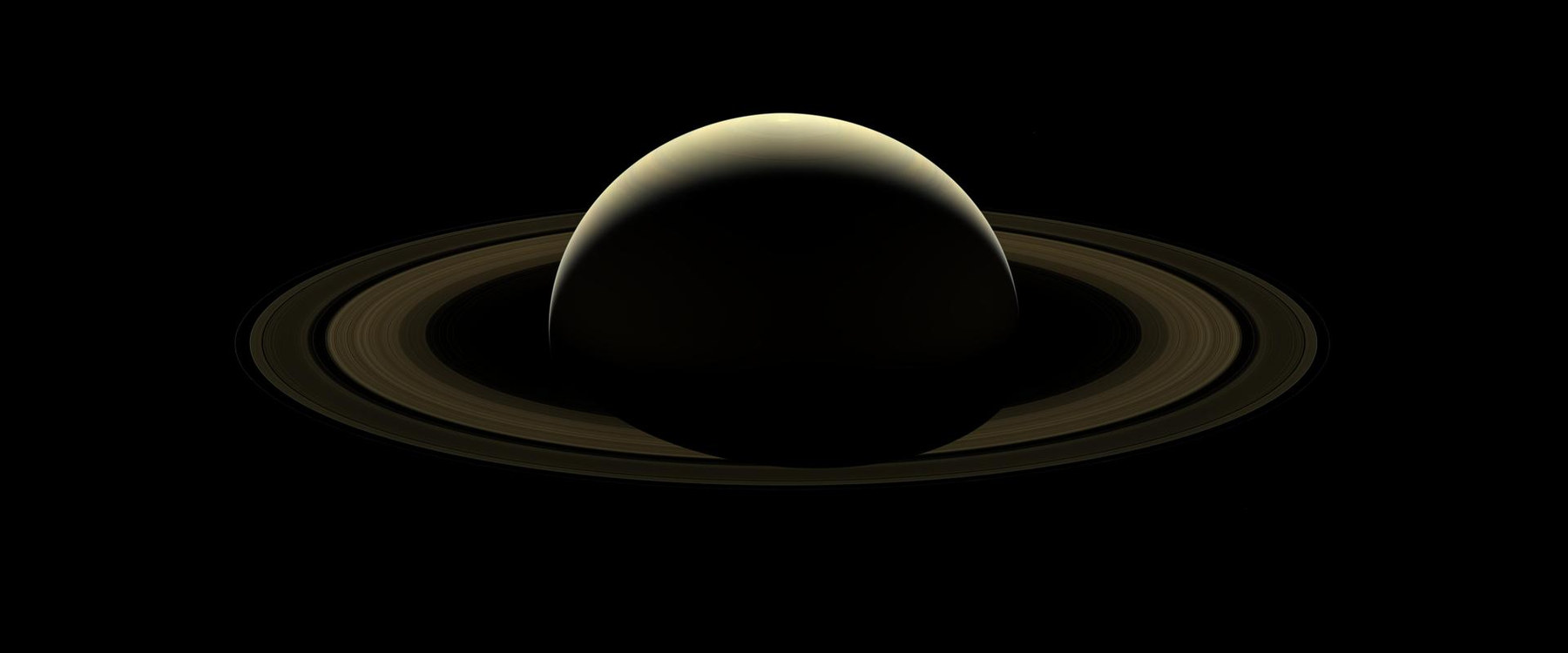
Saturn’s axial tilt produces seasons over its long orbit. At the start of Cassini’s mission, the northern polar region was in winter darkness. Infrared observations could investigate the region before visible-light cameras had a sunlit view. As illumination changed, the mission obtained clearer views of the clouds and their motion. [2] [1]
Different observing conditions are an opportunity as well as a complication. Comparing them helps distinguish a persistent dynamical structure from a pattern visible only under one kind of lighting. The date and wavelength of the photograph matter: they identify which atmosphere and season the instrument actually sampled. [2] [1]
Measure motion across many observations
Long-term analyses compare the hexagon’s position and the speed of its jet through repeated observations. This constrains how the wave interacts with the surrounding flow and how stable it remains as the season changes. A single symmetrical image cannot supply those rates. [3]
The pattern is not a perfect geometric stencil. Cloud details vary, and the observed shape depends on altitude and wavelength. Describing its behaviour requires measurements with uncertainty, rather than fitting a regular polygon over every image and assuming that the match explains the mechanism. [3]
Look above the cloud deck
Cassini images near Saturn’s limb revealed multiple haze layers above the cloud region near the hexagon. Their spacing and optical properties provide another way to study the vertical atmosphere. Researchers have investigated whether upward-propagating waves associated with the jet could contribute to those structures. [4]
That interpretation links a broad horizontal pattern to smaller vertical layers, but it remains a physical model tested against images and radiative-transfer calculations. The hexagon is valuable because it makes atmospheric dynamics unusually visible. Its six sides are the start of the investigation; wind measurements, seasons and haze structure provide the explanation to test. [4]
Sources & image credits
Related reading and objects
How to read Saturn’s rings
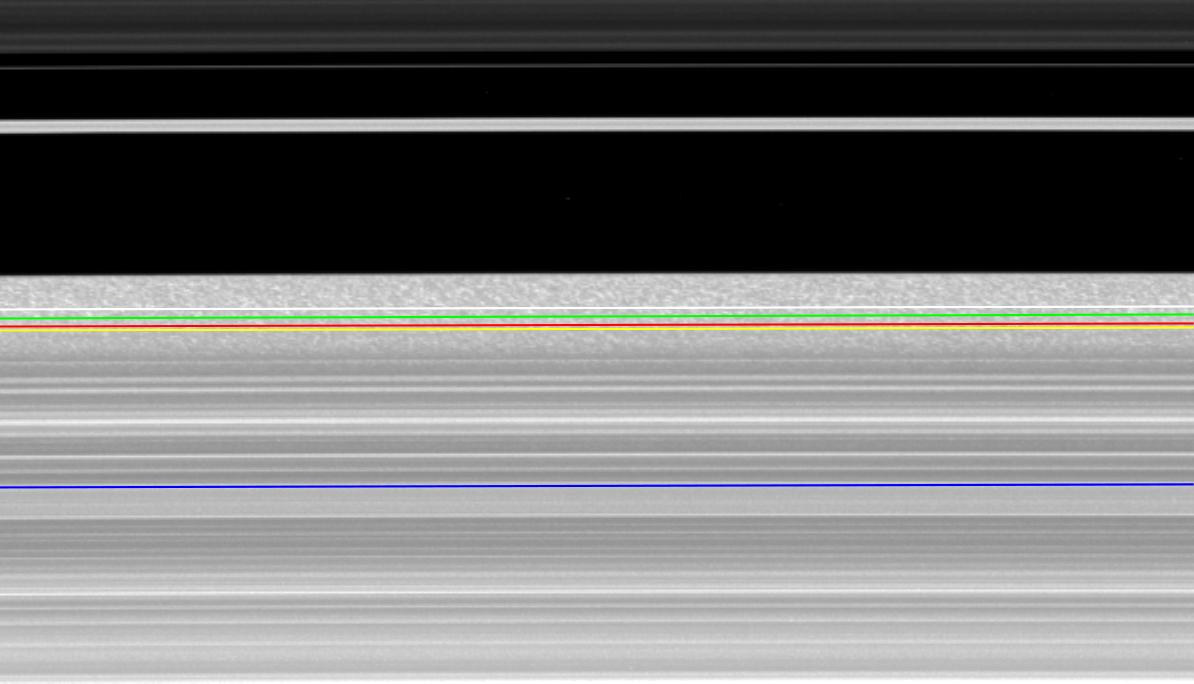
From Earth, Saturn’s rings look like smooth bands. Cassini revealed particles moving at different speeds, waves driven by moons and small objects throwing long shadows. Their patterns explain how a disk of ice can become a measuring instrument.
How Cassini found worlds beyond Saturn’s clouds
Cassini–Huygens travelled to Saturn as an orbiter and a Titan entry probe. Their investigation reached beyond the planet’s clouds: jets from Enceladus and lakes on Titan showed how different two neighbouring moons could be.