

How to read Saturn’s rings
From Earth, Saturn’s rings look like smooth bands. Cassini revealed particles moving at different speeds, waves driven by moons and small objects throwing long shadows. Their patterns explain how a disk of ice can become a measuring instrument.
Every particle follows its own orbit
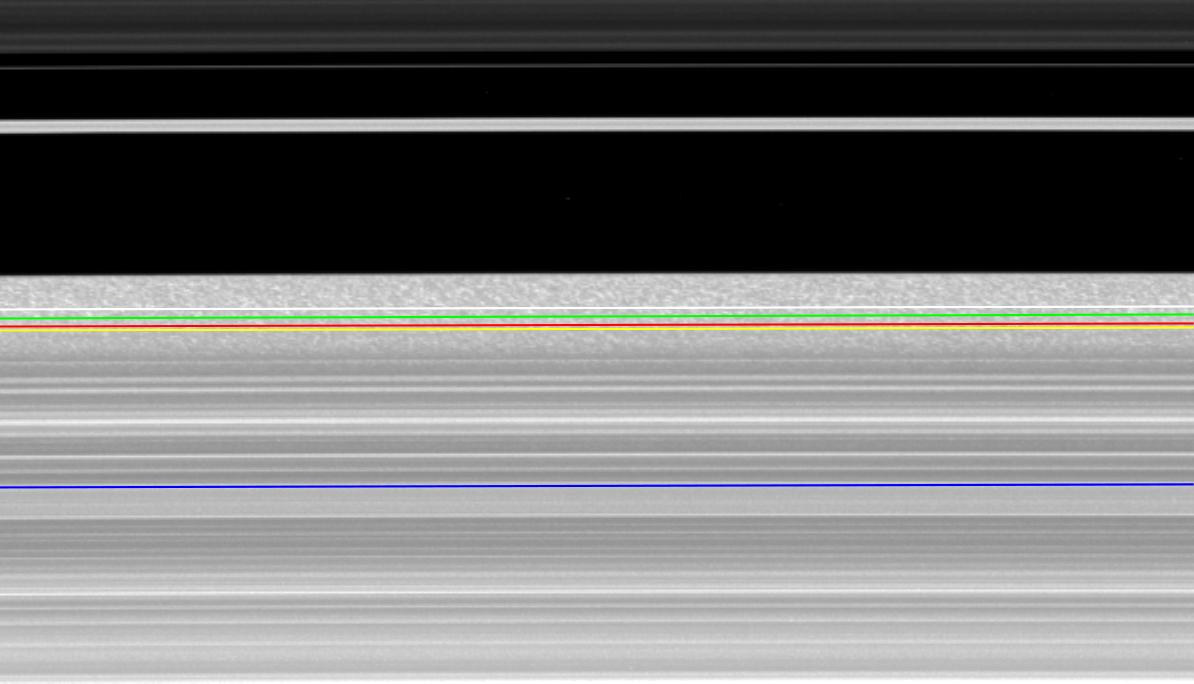
Saturn’s bright main rings consist mostly of water ice, with other material mixed in. Their particles range from tiny grains to much larger chunks. The apparently continuous bands in a photograph combine the light from enormous numbers of individual objects, each travelling around Saturn. [1] [2]
Material closer to the planet completes an orbit faster than material farther out. A straight marking painted across several radii would therefore be stretched by the different speeds. The rings are not a rigid disk turning together, and their persistent patterns need a different explanation. [1] [2]
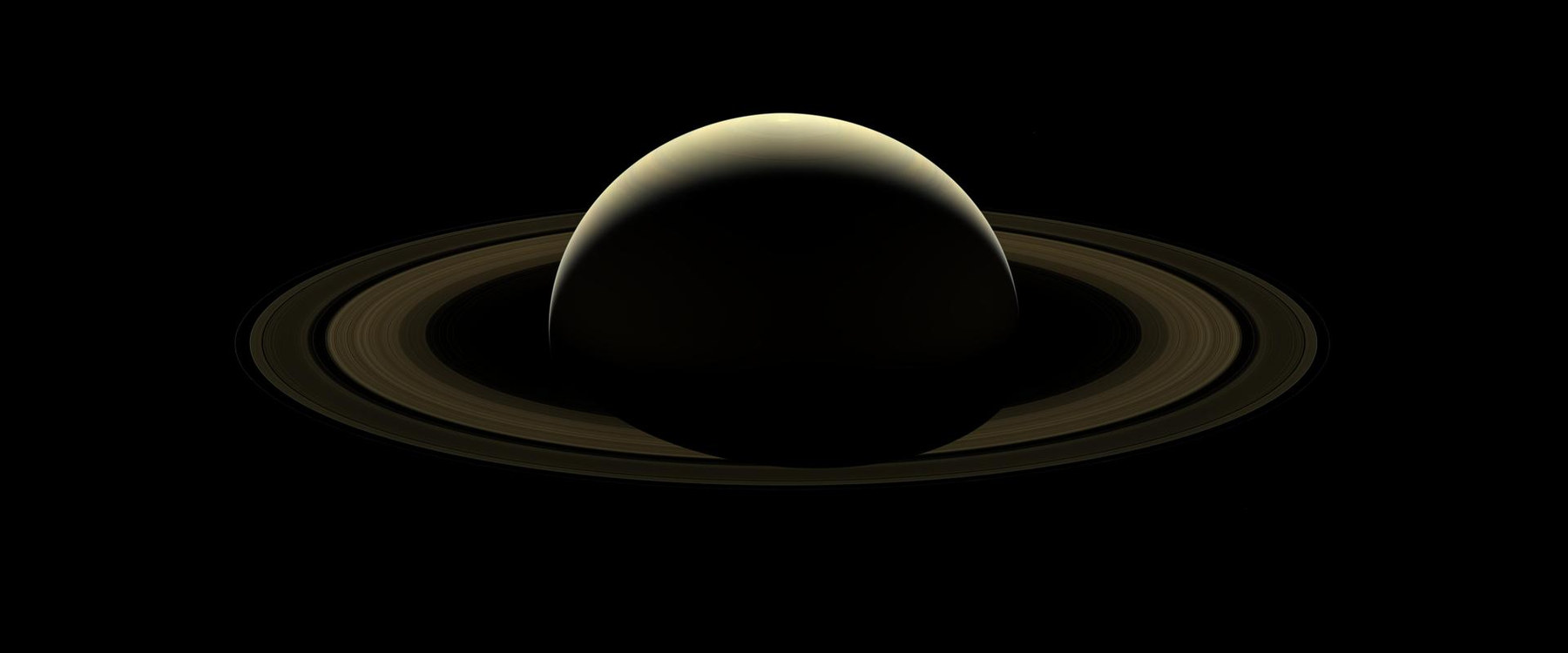
Collisions and gravity continually reorganise the particles. Some structures are maintained by moons; others reveal the behaviour of the ring material itself. The distinction is similar to a traffic pattern: the pattern can persist while the individual vehicles move through it. Following one icy particle would not necessarily keep you inside the same visible feature. [1] [2]
A repeated tug can organise a spiral wave
At certain orbital relationships, a moon’s gravitational influence repeats in an organised way. These resonances can launch spiral density waves, in which the concentration of ring particles varies with distance and position. Other disturbances bend the rings vertically or help shape their edges. [2] [3]
A density wave is therefore a pattern within the moving particles. Its spacing and behaviour depend on both the forcing moon and the local material. By measuring the wave, researchers can infer how much mass is spread over a given ring area, rather than assuming that a brighter band must contain proportionally more ice. [2] [3]
Small embedded moonlets leave another signature: propeller-shaped disturbances. Nearby particles orbit faster on the Saturn-facing side and slower on the opposite side. Their encounters with a moonlet create an extended pattern far larger than the object itself. The propeller does not spin like a machine; it reveals the gravitational interaction of neighbouring orbits. [2] [3]
Put a star or a radio signal behind the rings
An occultation provides a controlled background light. As Cassini watched a star pass behind the rings, changes in the received signal traced the intervening material at successive radii. Radio experiments used transmitted signals at several wavelengths, providing additional information about scattering and particle sizes. [4] [2]
These measurements could distinguish fine radial structure that a broad photograph merged into a narrow band. Repeated observations were especially useful: combining them brought out weak density waves that were not obvious in a single profile. [4] [2]
The mass result could be surprising. A 2016 analysis found large differences in the B ring’s opacity without comparably large differences in its inferred surface mass density. Appearance depends on particle sizes, arrangement and scattering as well as the total amount of material. Counting how much light gets through is a different measurement from weighing the disk. [4] [2]
Low sunlight makes height visible
Saturn’s tilted axis changes the direction from which sunlight reaches the rings over its roughly 29-year orbit. Near equinox, sunlight arrives almost along the ring plane. Even a small object or raised structure can then cast a long shadow across the surrounding ice. [2]
Cassini observed this geometry at the August 2009 equinox. It revealed vertical structures that were difficult to recognise under higher illumination, including features rising kilometres above the surrounding ring material. The broad main rings are generally much thinner than their enormous width might suggest, but they are not perfectly flat at every location. [2]
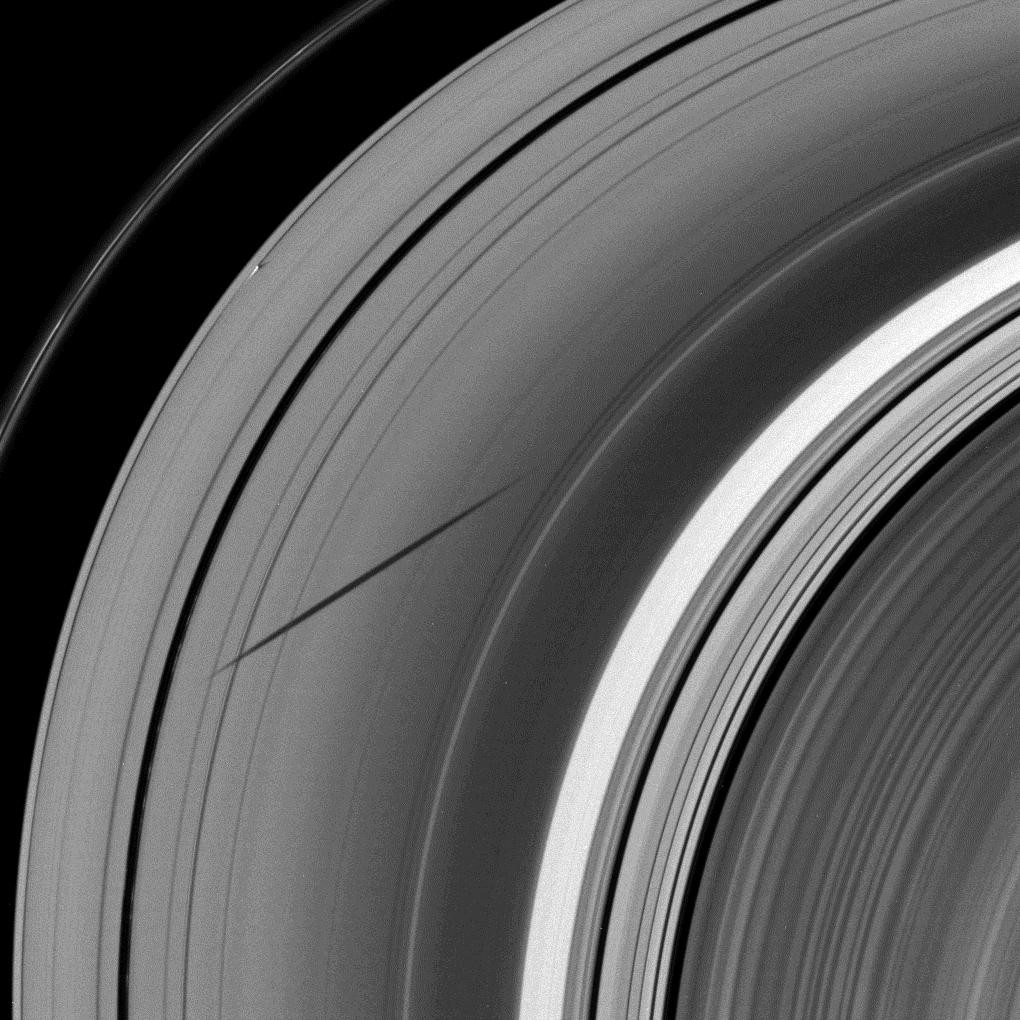
The same geometry helps explain why the rings can appear to disappear when Earth views them nearly edge-on. Their projected area becomes very small; the ice has not vanished. The viewing angle changes what the rings reveal, just as low sunlight changes which heights cast measurable shadows. [2]
A history has to explain a changing disk
The rings exchange material with the moons. Enceladus supplies ice to the diffuse E ring through its plumes, while impacts can release particles from smaller moons. These connections make the rings part of the Saturn system’s ongoing activity. [2] [3]
To reconstruct the origin of the bright main rings, scientists must combine mass, composition, contamination and dynamical evolution. A single beautiful image cannot supply an age. Cassini’s close views made the bands into several distinct records: waves measure the material, occultations probe its distribution, and shadows expose its height. Read together, they reveal a disk in motion rather than a decorative border around Saturn. [2] [3]
Sources & image credits
Related reading and objects
Why a jet stream can have six sides
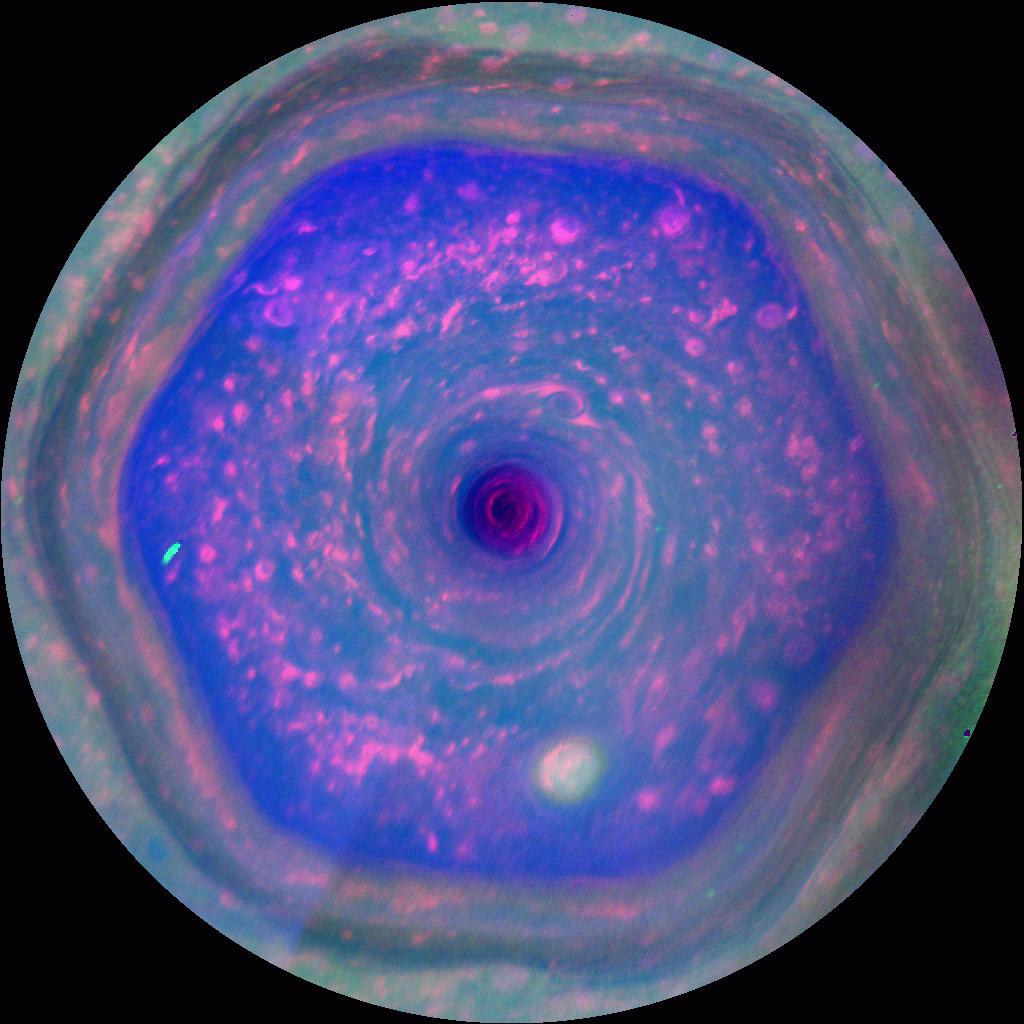
Cassini followed the six-sided pattern around Saturn’s north pole as northern sunlight returned. The hexagon belongs to an atmospheric jet, with clouds tracing a structure that can persist while the gas itself moves.
How Cassini found worlds beyond Saturn’s clouds
Cassini–Huygens travelled to Saturn as an orbiter and a Titan entry probe. Their investigation reached beyond the planet’s clouds: jets from Enceladus and lakes on Titan showed how different two neighbouring moons could be.