

Dwarf planet · 134340
Pluto
Mountains and a nitrogen-ice plain
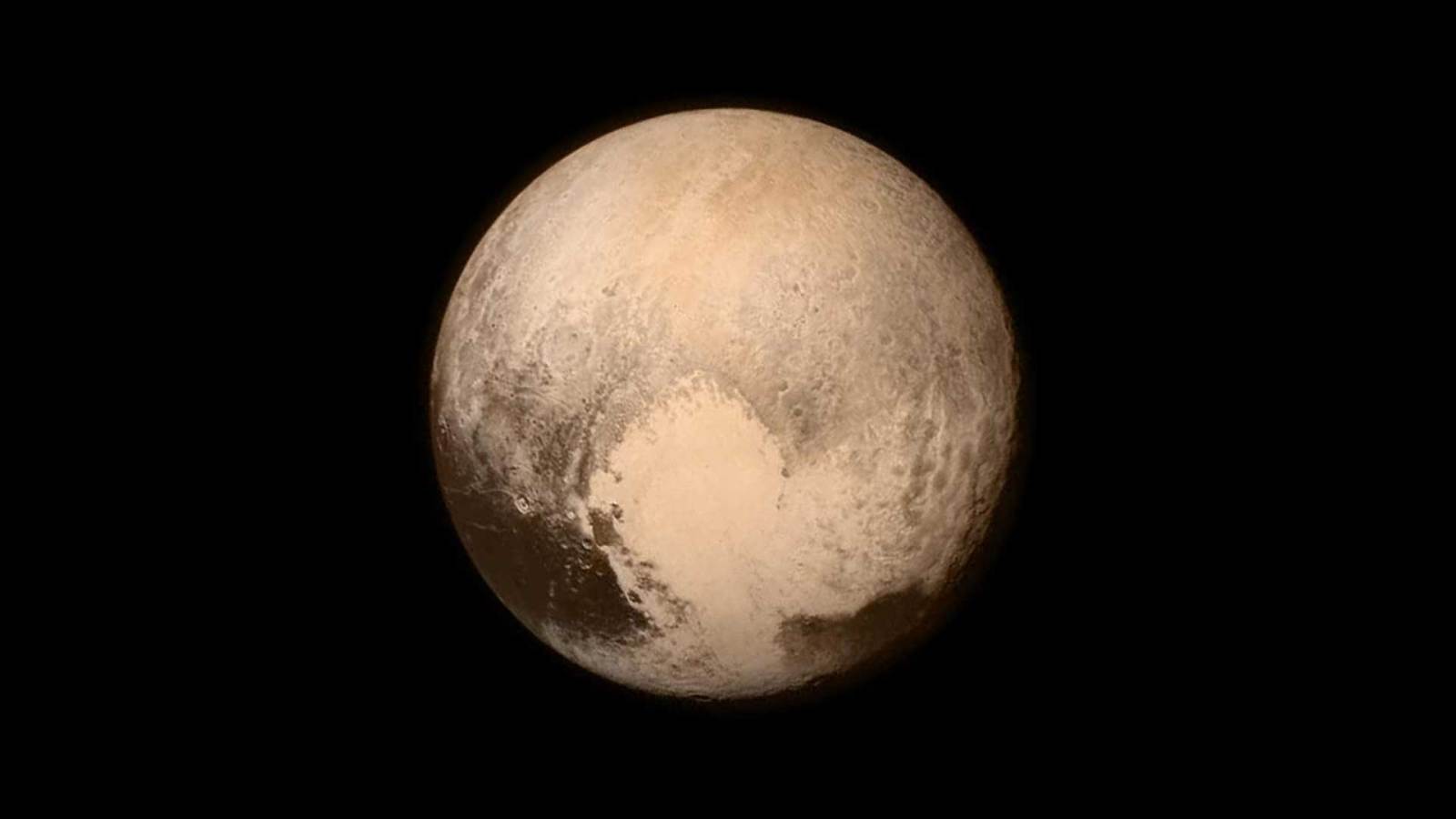
New Horizons photographed Pluto’s mountains, haze layers and Sputnik Planitia during its 2015 flyby. Pluto has five known moons.
Understand this world
The Kuiper Belt is not the Oort CloudSeparate the observed populations beyond Neptune from the much more distant proposed Oort Cloud, and compare what New Horizons learned at two targets. · 3 minMeasurements
- Effective diameter
- 2,376.6 km
- Semimajor axis
- 39.589 AU
- Orbital period
- 90,981.716 Earth days
Orbit, physical values and uncertainties
- eccentricity
- .2518378778576892
- semi-major axis
- 39.58862938517124 au
- perihelion distance
- 29.61871297351516 au
- inclination; angle with respect to x-y ecliptic plane
- 17.14771140999114 deg
- longitude of the ascending node
- 110.2923840543057 deg
- argument of perihelion
- 113.7090015158565 deg
- mean anomaly
- 38.68366347318184 deg
- time of perihelion passage
- 2447812.094159956090 TDB
- sidereal orbital period
- 90981.71647718345 d
- mean motion
- .003956838955553025 deg/d
- aphelion distance
- 49.55854579682732 au
- absolute magnitude
- -0.55
- rotation period
- 153.2935 h
Published JPL orbital elements describe their stated epoch; they are not current positions. Small-body diameters can be effective/model-dependent sizes, not spherical shapes. Missing measurements remain unavailable. Pluto’s diameter uses the New Horizons reference rather than an empty SBDB field. Orbital epoch: JD 2457588.5 TDB.
Object reference ↗Missions & milestones
1 launches · 0 connected events
These are target-related flights and every connected programme record in the production catalogue. A connected event may concern another stage or target of the same journey. Launch outcome does not establish arrival or current operation.
New Horizons
January 19, 2006 · UTC
Complete source cohort: 9,386 records.