

Why a day on Mercury lasts two years
MESSENGER mapped a world whose clocks disagree: one orbit takes about 88 Earth days, one rotation about 59, and sunrise to sunrise about 176. Those three numbers describe different motions. Reading the map means understanding which clock controls the sunlight.
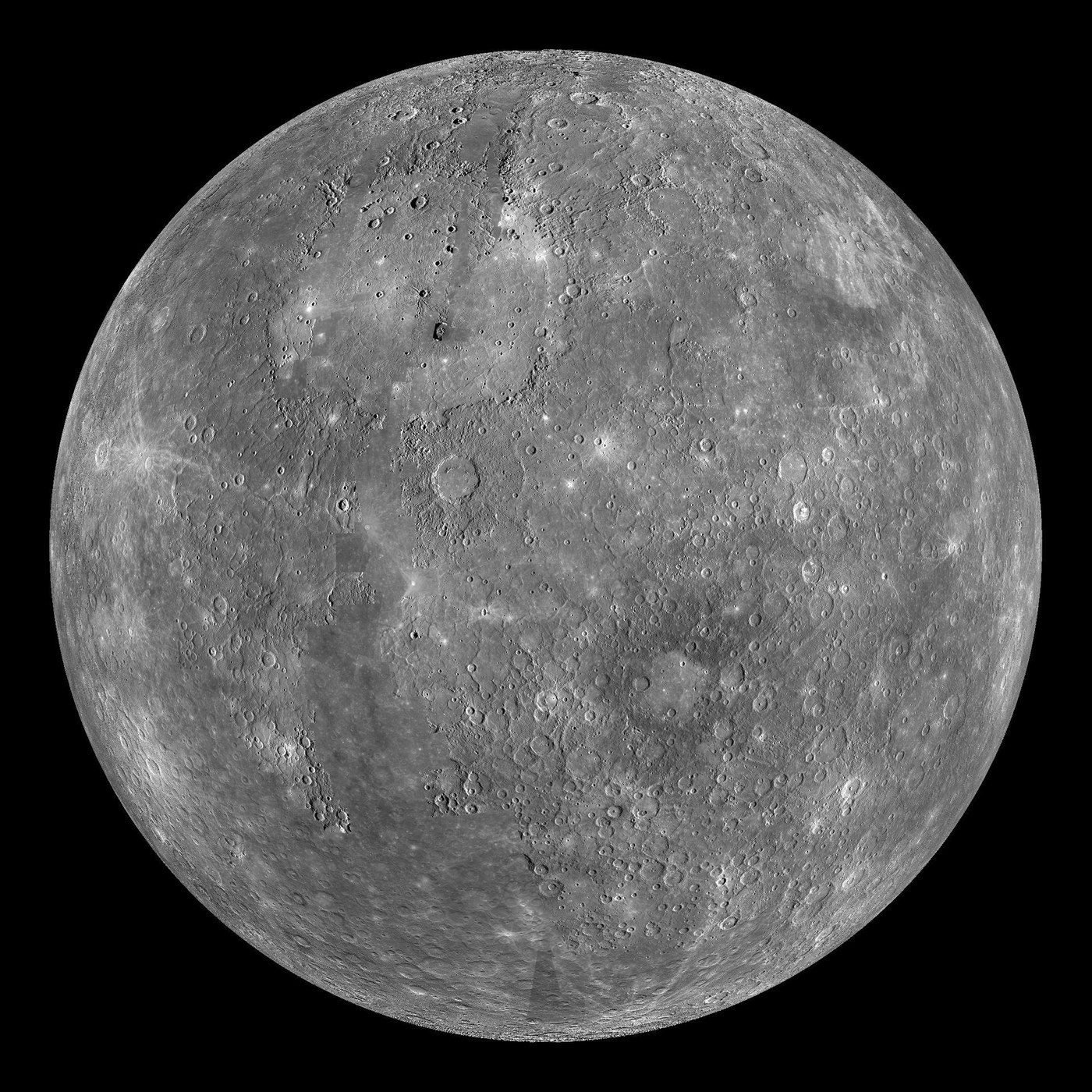
A turning planet on a moving orbit
A rotation is measured against the distant stars. A solar day measures the Sun’s return to the same direction in the local sky. Earth’s familiar 24-hour day makes the distinction easy to overlook, but Mercury exposes it. While a point on the surface turns eastward, the whole planet is also moving around the Sun. One rotation therefore does not restore the original lighting. [1] [2]
Mercury completes three rotations in the time it takes to make two orbits. This is a 3:2 spin–orbit resonance. After one orbit, a different hemisphere faces the Sun at the same orbital location. After the second orbit, the starting orientation returns. A solar day consequently lasts two Mercurian years, or approximately 176 Earth days. [1] [2]
The Sun does not move at a steady pace
Mercury’s orbit is distinctly elliptical. The planet travels faster near its closest approach to the Sun and slower farther away, while its rotation changes much less. The apparent motion of the Sun over the surface depends on the difference between those two rates. Near the fastest part of the orbit, that difference can briefly change sign. [2] [3]
At suitable locations, an observer could see the Sun slow, reverse its apparent direction, then resume its usual progress. The effect follows from the geometry; it does not require Mercury to reverse its spin. It is also why a neat clock face with a uniformly moving Sun would miss something important about a real Mercurian day. [2] [3]
Long daylight, deep cold
A long period of illumination gives the ground time to become intensely hot. Night allows exposed ground to radiate heat into space. Mercury lacks a substantial atmosphere that could distribute that energy around the planet. Sunlit temperatures can reach about 430°C, while the night side can fall near −180°C. Closeness to the Sun alone cannot describe conditions at a particular place. [1]
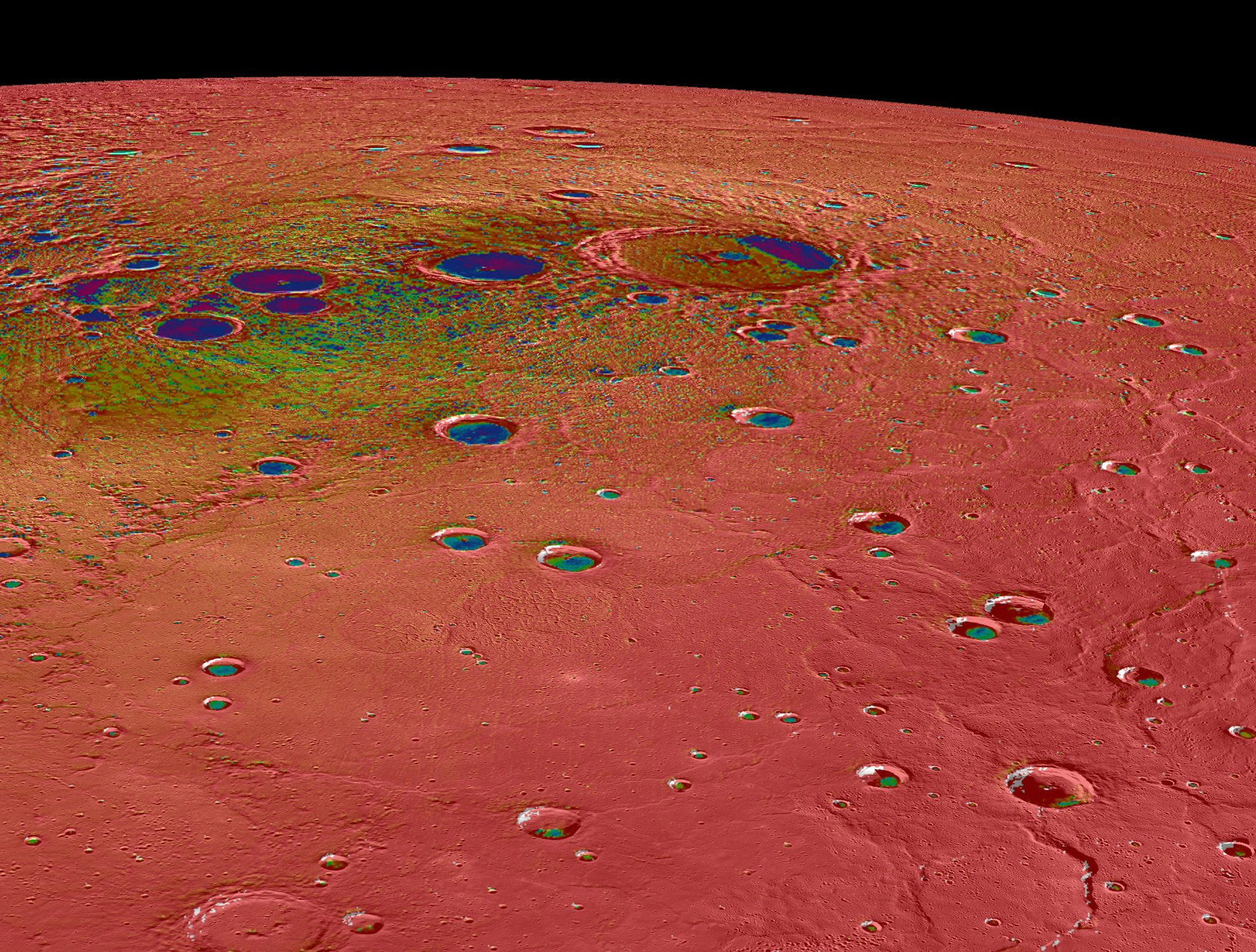
Topography changes the picture again. A crater wall can screen a patch of ground from sunlight even while nearby terrain is heated. Near the poles, the Sun stays low enough that some crater floors never receive direct rays. The hottest planetary neighbourhood in the Solar System can therefore contain persistent cold traps. [1]
What the globe can tell you
MESSENGER’s images and laser measurements separate surface shape from illumination. A bright-looking slope may face the light, contain a more reflective material, or both. Comparing images acquired under different lighting helps distinguish a landform from a temporary shadow. Elevation measurements supply a second kind of evidence when appearance alone is ambiguous. [4] [5]
Use the globe to compare the scale of the large basins with the planet, then open an observation to inspect the actual terrain. Measured shape, the Sun’s path and the properties of the ground together determine the conditions at a location. [4] [5]
Sources & image credits
Related reading and objects
How does water ice survive on Mercury?
In 1991, radar found unusually bright patches near Mercury’s poles. MESSENGER later connected them with polar deposits and permanently shadowed craters, explaining how water ice can survive so close to the Sun.
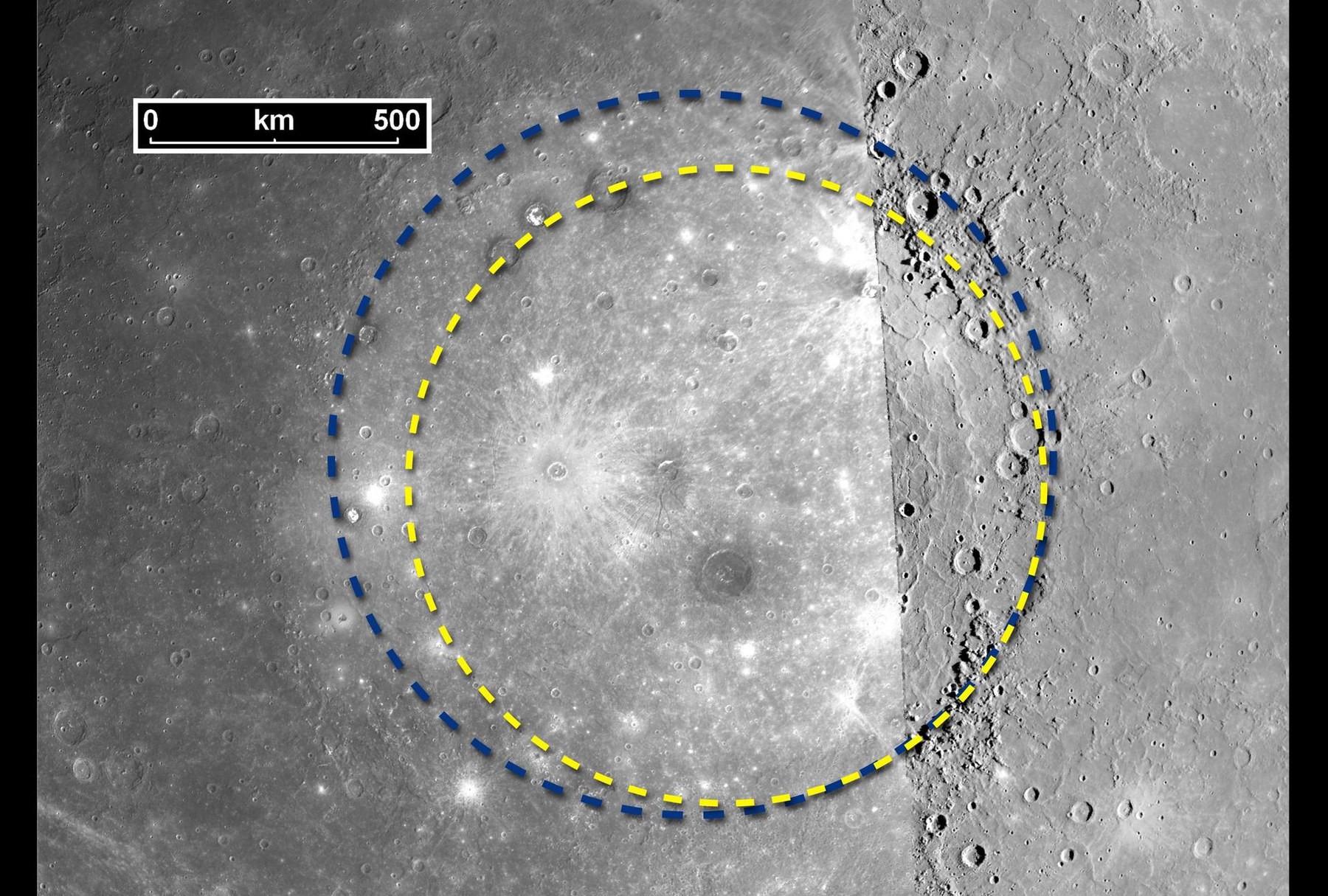
Reading the layers of Caloris
MESSENGER revealed the full extent of Caloris, a basin about 1,550 kilometres across. Its photographs do more than show a large crater: they let geologists reconstruct a sequence in which impact, volcanism and later bombardment changed the same ground.