

How does water ice survive on Mercury?
In 1991, radar found unusually bright patches near Mercury’s poles. MESSENGER later connected them with polar deposits and permanently shadowed craters, explaining how water ice can survive so close to the Sun.
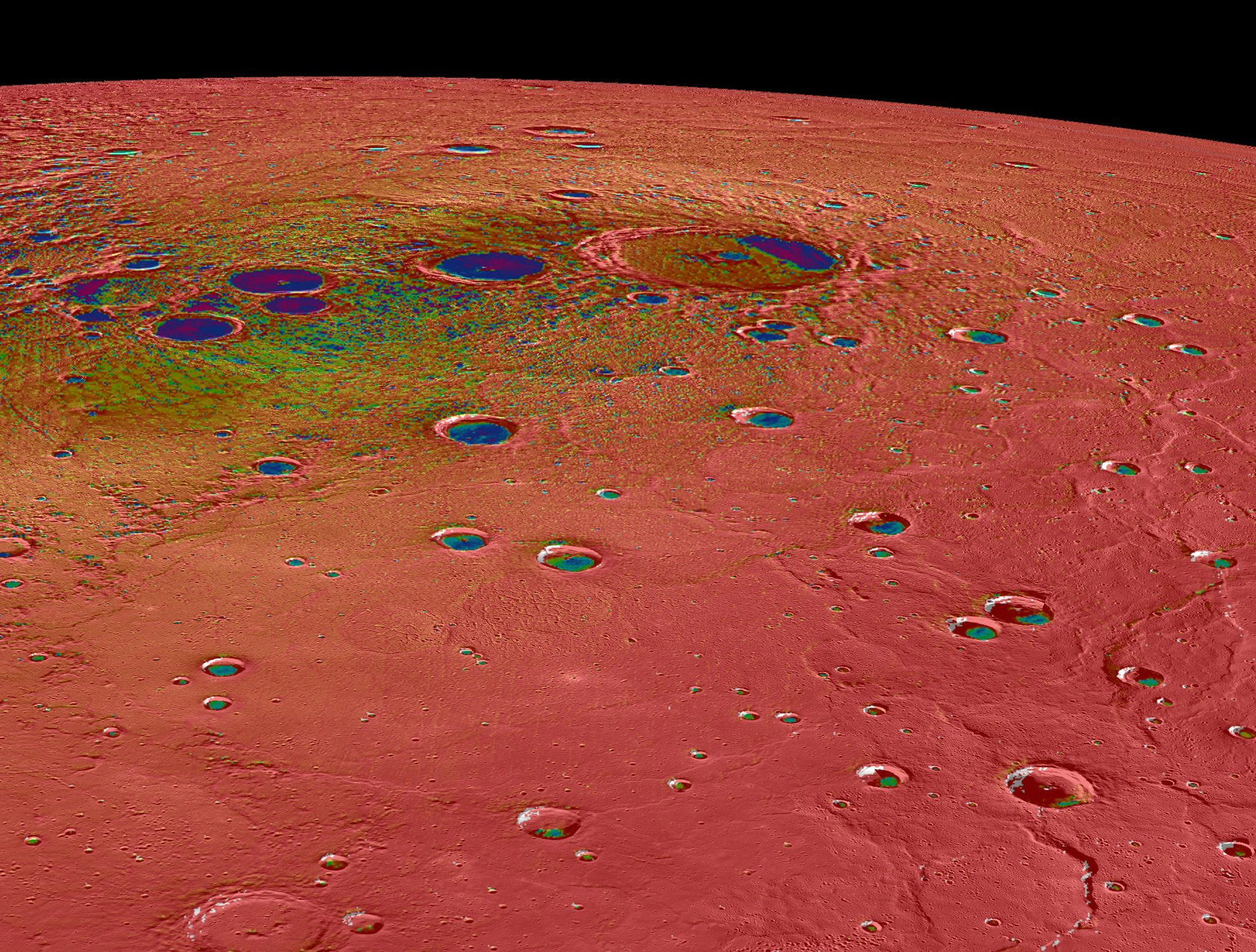
A bright echo is a clue
Mercury’s sunlit ground can reach about 430°C, yet the planet has almost no atmosphere to distribute that heat. Distance from the Sun therefore gives an incomplete picture of its surface. Conditions depend strongly on whether sunlight reaches a place at all, and on how long the ground can radiate energy into space. [1] [2]
Earth-based radar observations in the early 1990s found patches near the poles that reflected radio waves unusually strongly. The returning signal’s polarisation also differed from typical rocky terrain. Similar behaviour from icy bodies made water ice a plausible explanation. The patches were not random: many appeared to coincide with large craters. [1] [2]
There was an immediate difficulty. Mariner 10 had imaged less than half of Mercury, leaving the terrain around some deposits poorly known. A bright echo could suggest a material, but confirming ice also required a map that explained how that material could remain cold. [1] [2]
A crater can keep out the Sun
Mercury’s spin axis is almost perpendicular to its orbital plane. Near the poles, the Sun stays low above the horizon instead of climbing high overhead. A crater wall can block that low sunlight from reaching part of the floor throughout the planet’s long solar day. [2] [3]
A cold trap depends on this permanent geometry. A dark patch in one photograph might simply be experiencing night; it could warm after sunrise. Scientists used MESSENGER’s laser-altimeter measurements to reconstruct crater shapes, then calculated illumination and temperatures through time. Images independently placed the radar-bright deposits in shadowed terrain. [2] [3]
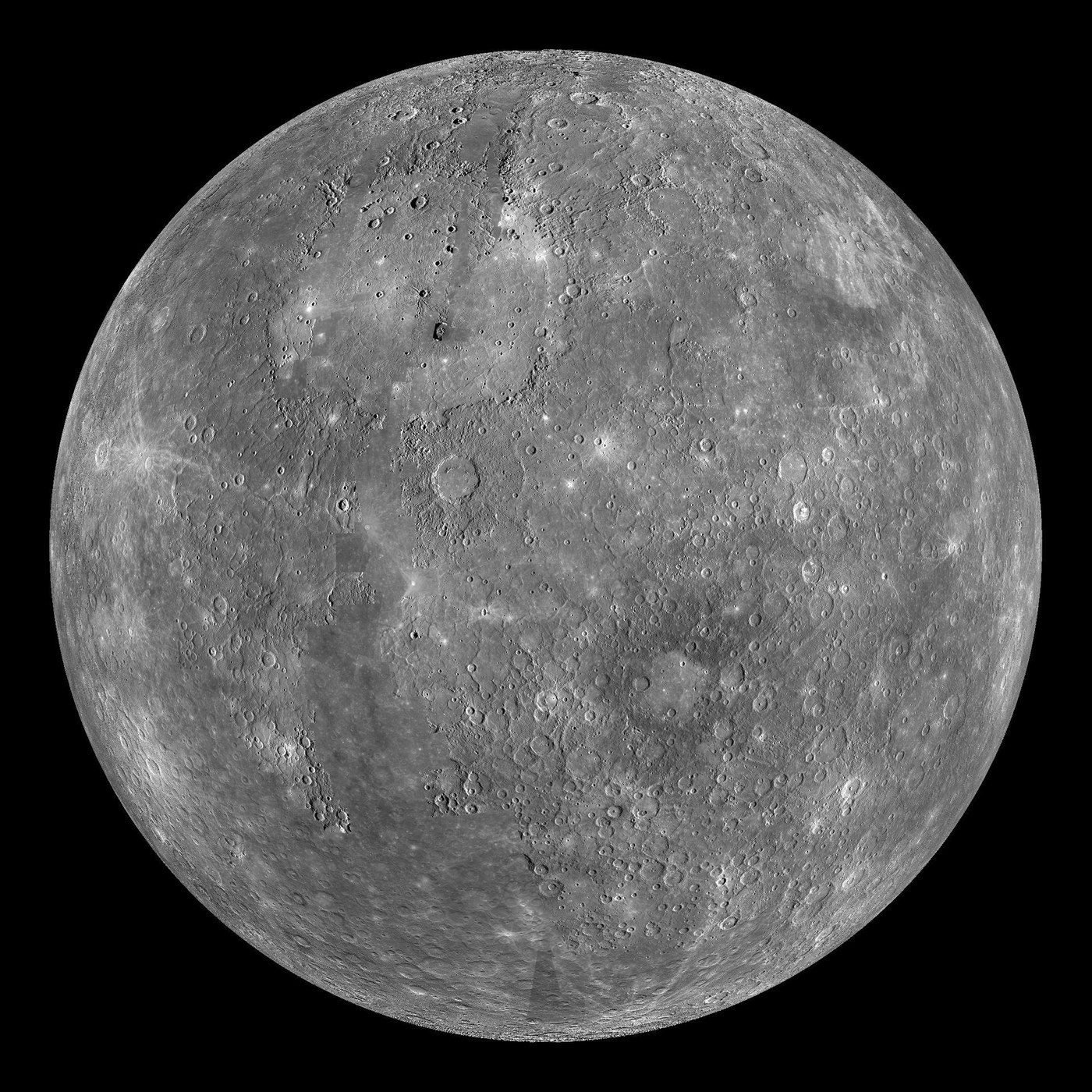
The protected ground still receives energy from scattered light, warm crater walls and the interior. Shade alone does not make it arbitrarily cold. A thermal model has to include those contributions and determine whether ice is stable at the surface, beneath a cover, or neither. Nearby slopes can produce very different answers. [2] [3]
Hydrogen adds another test
Cosmic rays striking the ground generate neutrons. Hydrogen changes how those neutrons lose energy, allowing a neutron spectrometer to detect hydrogen-rich material without needing sunlight to illuminate it. MESSENGER found an excess near the north pole, in the region containing the radar-bright deposits. [4] [5]
Its laser altimeter supplied another test. Besides measuring distance, it measured the brightness of the reflected near-infrared pulse. Some cold locations were bright at this wavelength; other deposits had dark surfaces. When compared with the temperature models, the bright patches matched places where exposed ice could persist. [4] [5]
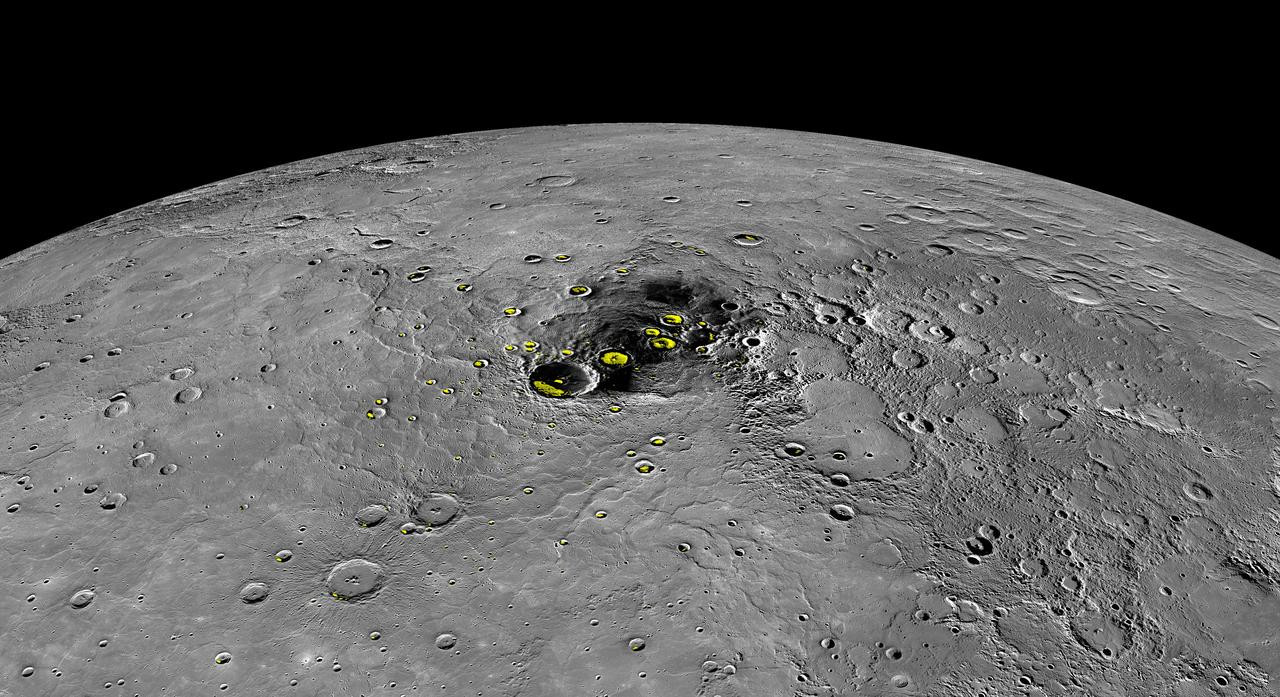
The strength of the result comes from these different measurements agreeing about the same locations. Radar measured scattering, neutrons constrained hydrogen, and topography explained the thermal conditions. None alone did all three jobs. In November 2012 the combined evidence strongly supported water ice as the main constituent of the polar deposits. [4] [5]
A dark surface can protect what lies beneath
At somewhat warmer sites, exposed ice would be lost by sublimation: water can pass directly from solid to gas in a near-vacuum. Burial changes the balance by slowing the transfer of heat and the escape of vapour. The neutron observations were consistent with hydrogen-rich material beneath a less hydrogen-rich surface layer. [4] [2]
Researchers proposed that impacts of comets and volatile-rich asteroids could supply both water and carbon-bearing material. That is an origin hypothesis, distinct from the evidence that the deposits exist. The dark cover’s composition and subsequent chemical changes remain questions for further measurement. [4] [2]
Mercury therefore does not need a cold global climate to keep frozen water. It needs particular places where the Sun never reaches the ground and, at some sites, a protective covering. Its poles show why a planetary average can conceal the environment that matters most: a crater floor only a short distance from intensely heated terrain. [4] [2]
Sources & image credits
Related reading and objects
Why a day on Mercury lasts two years
MESSENGER mapped a world whose clocks disagree: one orbit takes about 88 Earth days, one rotation about 59, and sunrise to sunrise about 176. Those three numbers describe different motions. Reading the map means understanding which clock controls the sunlight.
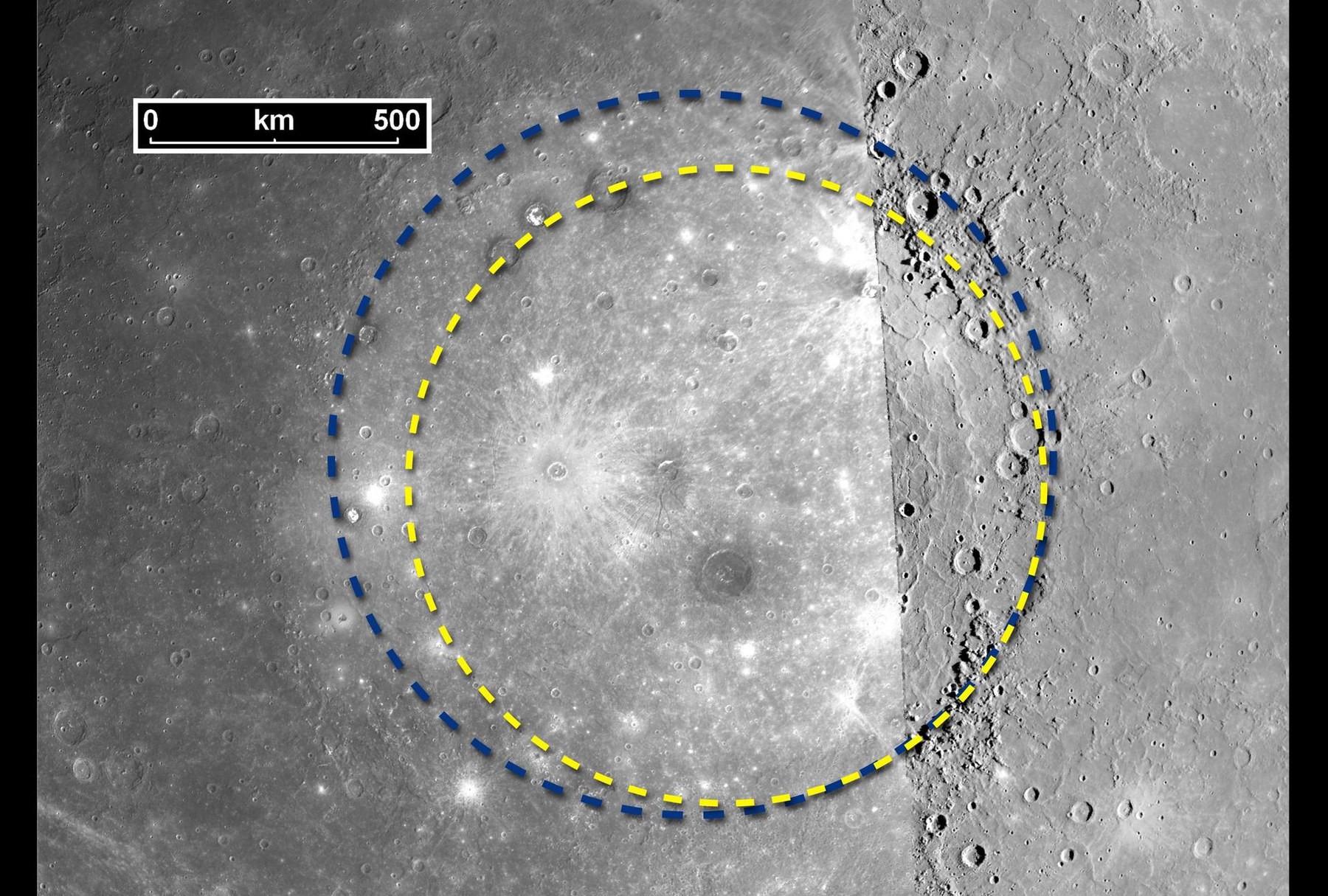
Reading the layers of Caloris
MESSENGER revealed the full extent of Caloris, a basin about 1,550 kilometres across. Its photographs do more than show a large crater: they let geologists reconstruct a sequence in which impact, volcanism and later bombardment changed the same ground.