

Why Neptune’s dark spots come and go
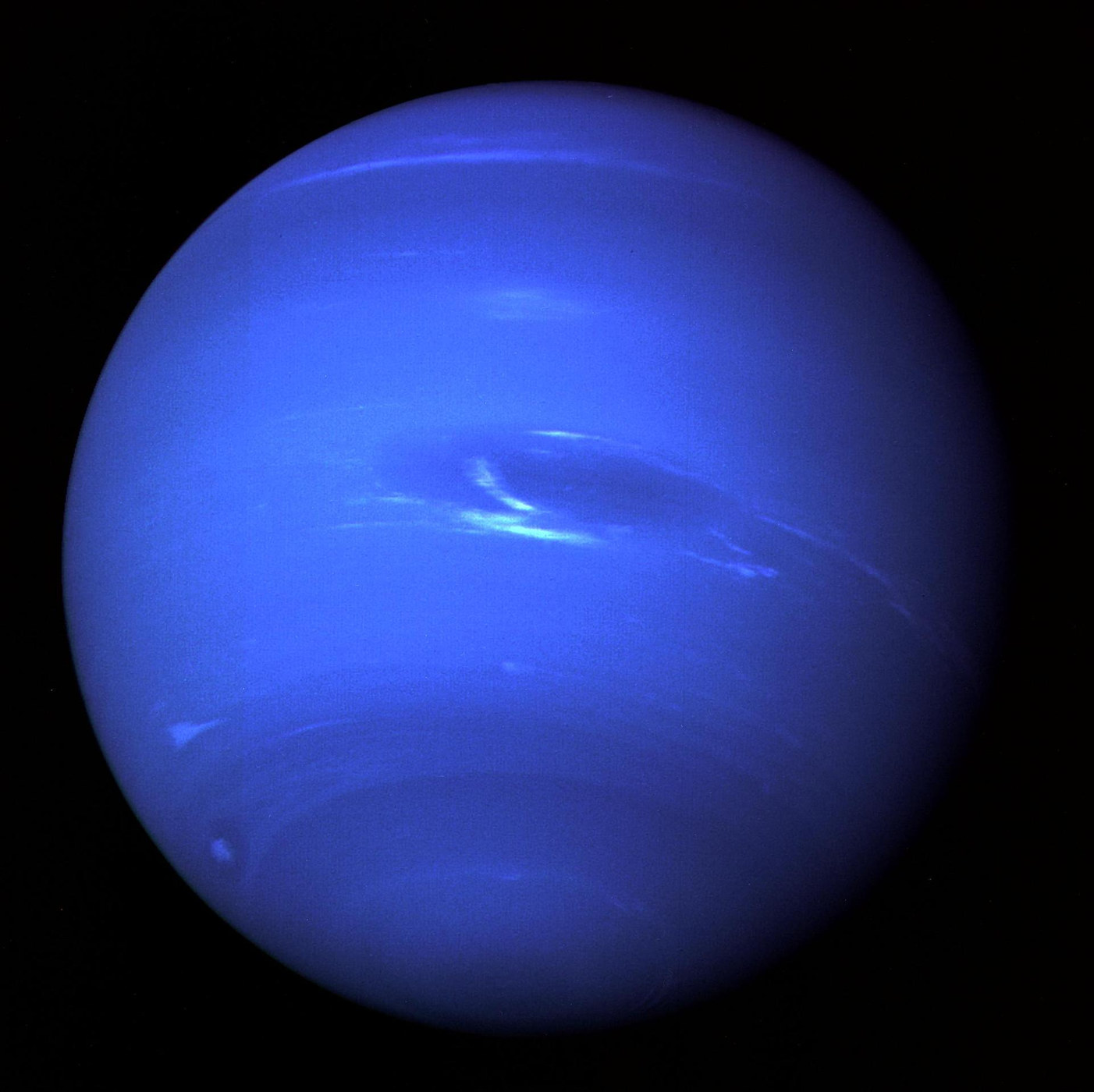
Voyager 2 photographed Neptune’s Great Dark Spot in 1989. Later Hubble observations found that feature gone and other vortices appearing elsewhere. The comparison turns a famous planetary “landmark” into a study of changing weather.
A dark spot is an atmospheric structure
Neptune’s visible markings are clouds, hazes and atmospheric vortices. They do not have the permanence of a crater cut into rock. Voyager’s global images resolved the Great Dark Spot and bright companion clouds during a short approach and encounter. The picture records that atmosphere at that time. [1] [2]
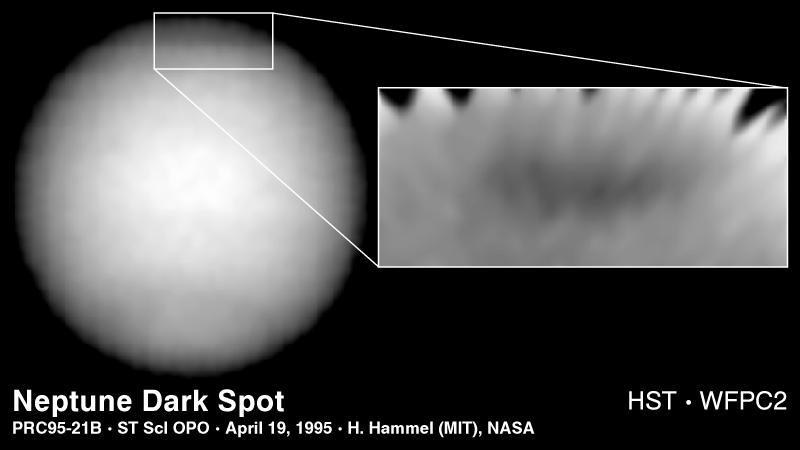
When Hubble later looked at Neptune, the 1989 spot was no longer visible. Other dark features were detected in subsequent years. This is why a representative 3D texture should not be read as the planet’s current weather map. The real investigation follows dated observations and measures how individual structures evolve. [1] [2]
Repeat images reveal a trajectory
A vortex detected in 2018 drifted toward the equator, where researchers expected it might weaken. Instead, Hubble observations showed it reversing direction. A smaller dark feature appeared nearby around the same period, prompting investigation of whether material had separated from the larger vortex. [3]
Those interpretations depend on matching features between observations. The data provide positions, apparent size and brightness at particular times. A model then tests possible motions and interactions. The reversal was surprising because it challenged an expected path, not because a dark marking had somehow moved across a solid surface. [3]
A bright cloud can mark flow around a hidden feature
Bright clouds can form when atmospheric flow associated with a vortex lifts gas to conditions where methane condenses. Their presence can make a dark system easier to recognise, but cloud and vortex need not have identical outlines. A bright companion is evidence about the surrounding circulation rather than a painted border around the storm. [4]
Observations at multiple wavelengths constrain the levels involved. Differences in opacity affect which layers are visible. Repeated imaging helps separate a persistent circulation from clouds that form and disappear within it. This makes a time sequence more informative than a single image with its contrast turned up. [4]
A long record adds a different scale of change
A study of observations from 1994 to 2022 followed broader variations in Neptune’s cloud activity using Hubble and ground-based telescopes. Such records include changing coverage, instruments and wavelengths, all of which have to be accounted for when comparing the planet’s appearance through time. [5]
Weather on Neptune can therefore be studied on several scales: a cloud feature moving over hours, a vortex changing over years and broad activity varying across decades. Voyager supplied close spatial detail. Telescopes supply the repetition. Combining those strengths gives a much better account of the atmosphere than treating the 1989 portrait as a permanent face. [5]
Sources & image credits
Related reading and objects
Where Neptune gets its weather energy
Voyager 2 found a cold Neptune with fast winds and enormous storms in 1989. At about 30 times Earth’s distance from the Sun, the planet receives little sunlight. Its atmosphere also draws on energy escaping from a deep interior.
Why does Triton orbit Neptune backwards?
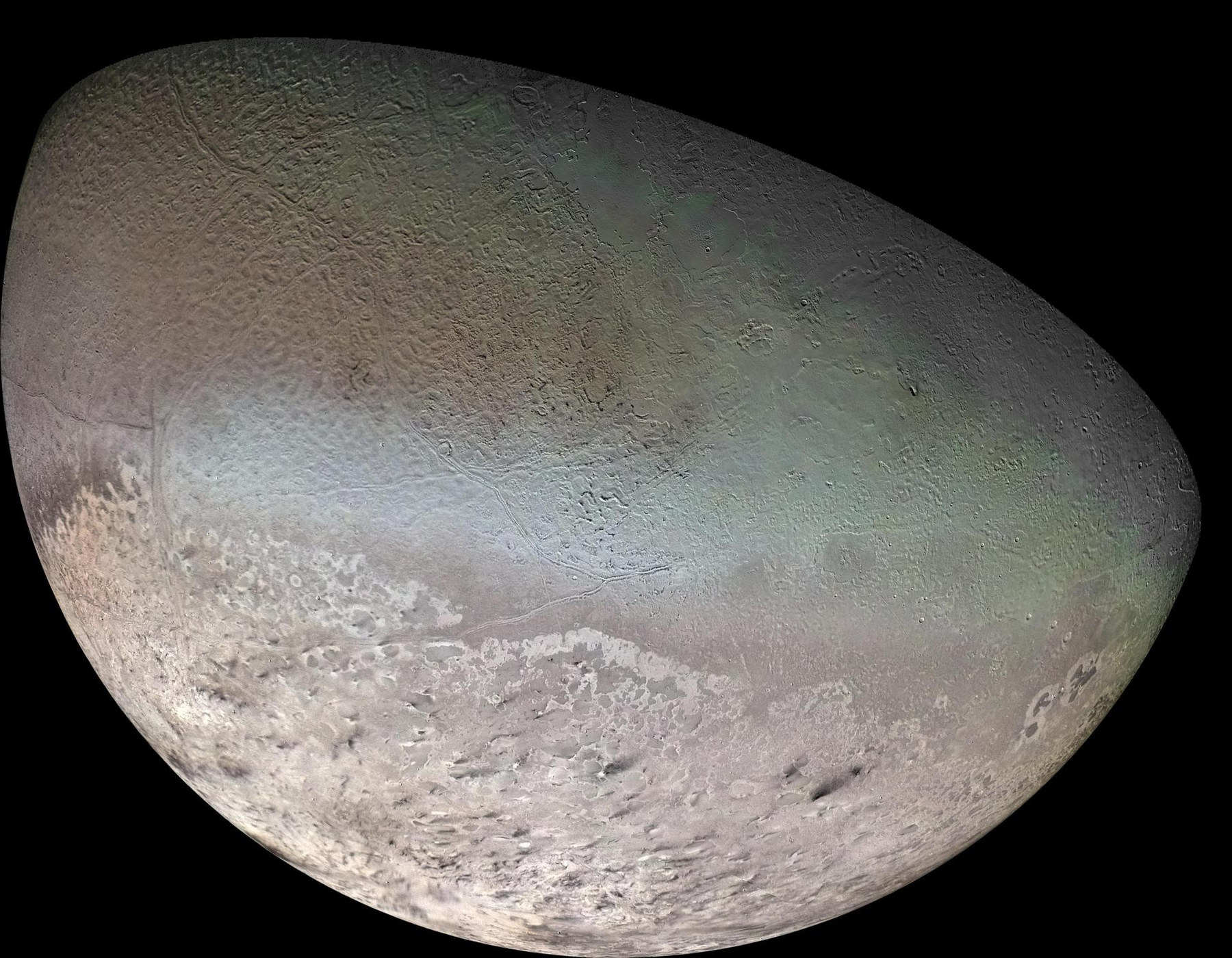
Voyager 2 reached Triton in August 1989 and photographed an unexpectedly active, icy world. Its orbit had already supplied a different clue: Neptune’s largest moon travels around the planet in the opposite direction to the planet’s rotation.