

Saturn · natural satellite
Titan
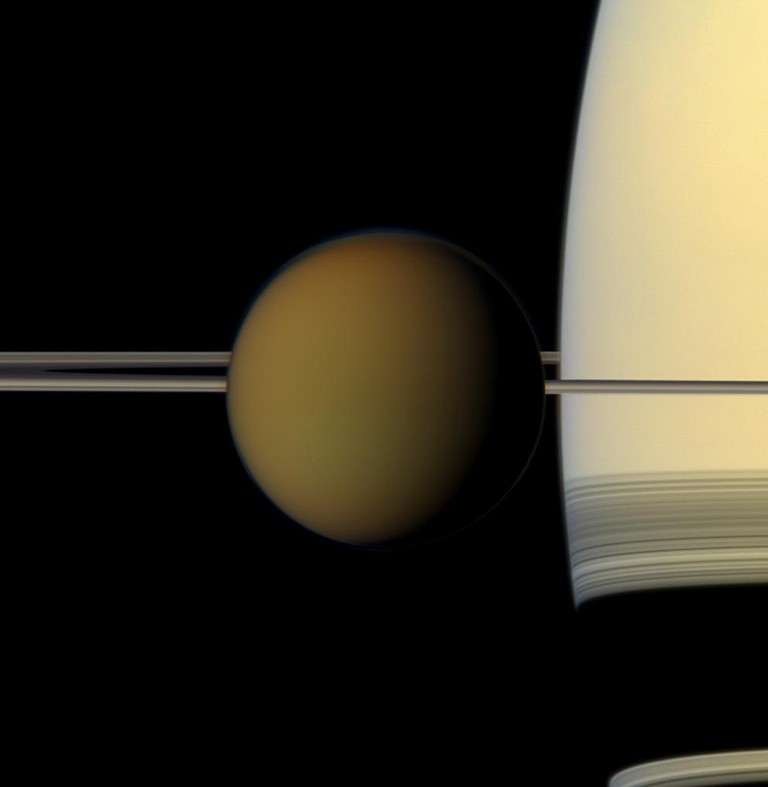
Lakes beneath a thick atmosphere
Titan has a dense nitrogen atmosphere, dunes and lakes of liquid hydrocarbons. Huygens reached the surface; Dragonfly is designed to explore it with a rotorcraft.
- Mean diameter
- 5,149.52 km
- Mean orbital distance
- 1,221,900 km from centre
- Orbital period
- 15.945 Earth days
Understand this world
Methane weather and organic chemistryFollow methane through Titan’s atmosphere and surface, and understand why Dragonfly will sample different geological settings. · 3 minCompared with our Moon
One diameter scale. Circle shapes compare volume-equivalent diameters; irregular moons are not spheres.
Orbit & discovery
- Surface gravity
- 1.354 m/s²
- Discovery
- 1655
- Discoverer / team
- C. Huygens
- Provisional designation
- —
- JPL satellite ID
- 606
- Orbital eccentricity
- 0.029
- Inclination
- 0.3 degrees
Inclination reference: Laplace. Mean-element epoch: 2000-01-01.5 TDB · SAT441.
Diameters use volume-equivalent mean radii, including for irregular bodies. Mean orbital elements describe an orbit; they are not live positions. Missing physical measurements remain unavailable.
Physical measurements & uncertainties
- Mean radius · km
- 2574.76 ±0.02 [1]
- GM · km³/s²
- 8978.13710 ±0.00025 [SAT441]
- Density · g/cm³
- 1.8814 ±0.0001 [*]
Missions in the Saturn system · 5 records
5 launches · 0 linked events
These records cover the planetary system. A system mission did not necessarily visit this moon. Dedicated targets are marked separately; programme events include the journey and briefings. Launch outcomes do not establish arrival, landing success or present spacecraft operation.
Dragonfly
July 5, 2028 · time to be confirmed
SpaceX · Falcon Heavy
Titan IVB/Centaur | Cassini-Huygens
October 15, 1997 · UTC
Lockheed Martin · Titan IVB/Centaur
Voyager 1
September 5, 1977 · UTC
Lockheed Martin · Titan IIIE
Voyager 2
August 20, 1977 · UTC
Lockheed Martin · Titan IIIE
Pioneer 11
April 6, 1973 · UTC
United States Air Force · Atlas SLV-3D Centaur
No dedicated-target flight is recorded for this moon.
5 records from the complete 9,386‑record production catalogue.
Sources & measurements
- JPL · IAU-recognized satellite discoveries ↗
- JPL · physical parameters and uncertainties ↗
- JPL · mean orbital elements ↗
- NASA NSSDCA · Jovian sidereal orbital periods ↗
- NASA · planetary exploration history ↗
- NASA · Voyager encounters ↗
- NASA · Galileo ↗
- NASA · Juno ↗
- NASA · Cassini–Huygens ↗
- NASA · New Horizons ↗
- ESA · Juice targets ↗
- NASA · Europa Clipper ↗
- NASA · Dragonfly ↗
- JAXA · MMX ↗