

What did Rosetta learn by living beside a comet?
Rosetta reached comet 67P/Churyumov–Gerasimenko in August 2014 and stayed as it approached the Sun and moved away again. That long encounter let scientists connect a changing surface with the dust and gases escaping from it.
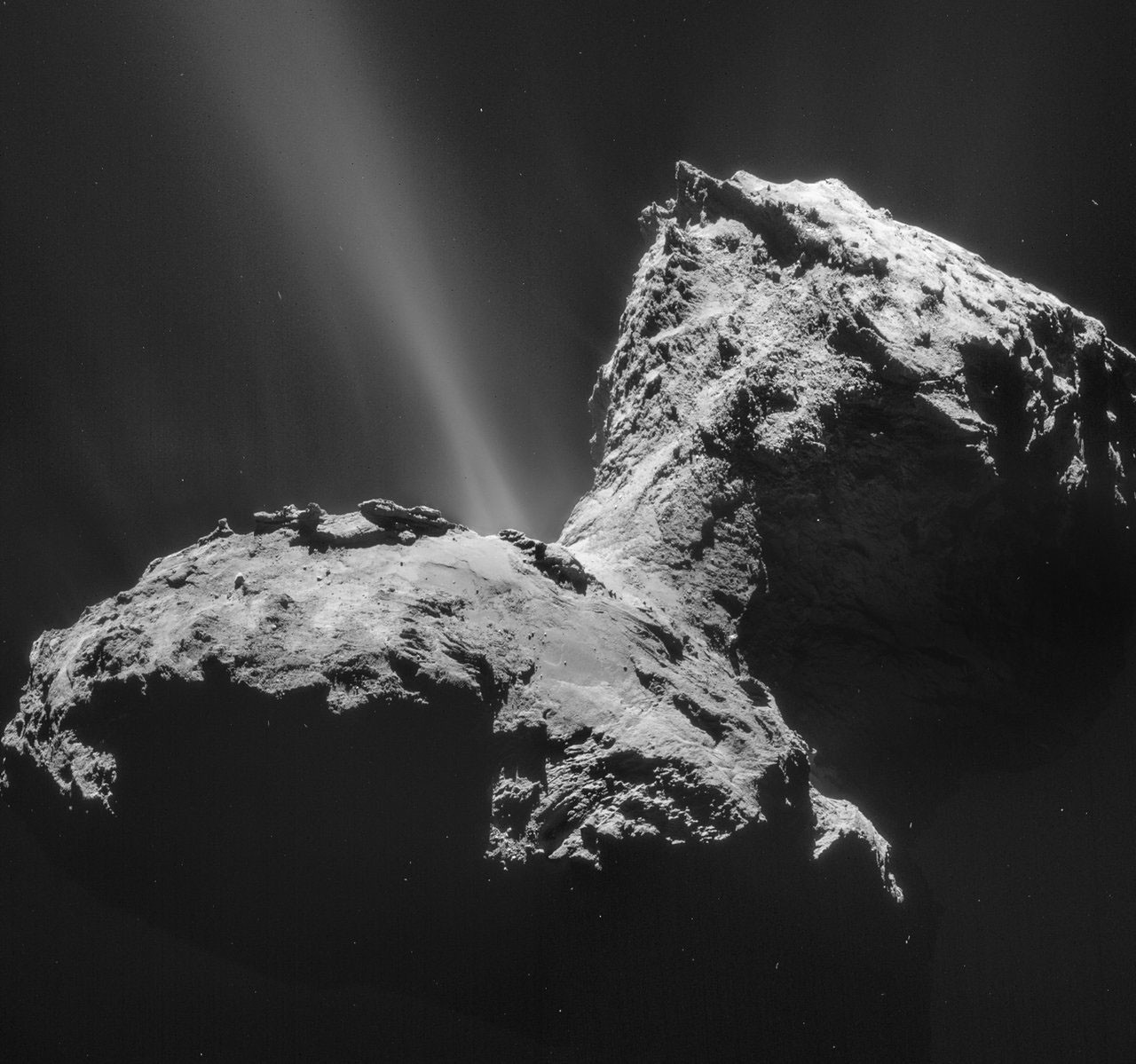
Begin with the body supplying the coma
Rosetta’s images revealed an irregular nucleus with two lobes joined by a narrow neck. Cliffs, pits, boulders and smoother deposits varied across the dark surface. The shape and terrain provided a setting for interpreting the escaping material. [1]
A comet’s bright coma can conceal the small nucleus from a distant telescope. Close imaging separates the solid body from the surrounding dust, allowing researchers to ask which regions are active and how illumination changes as the nucleus rotates. [1]
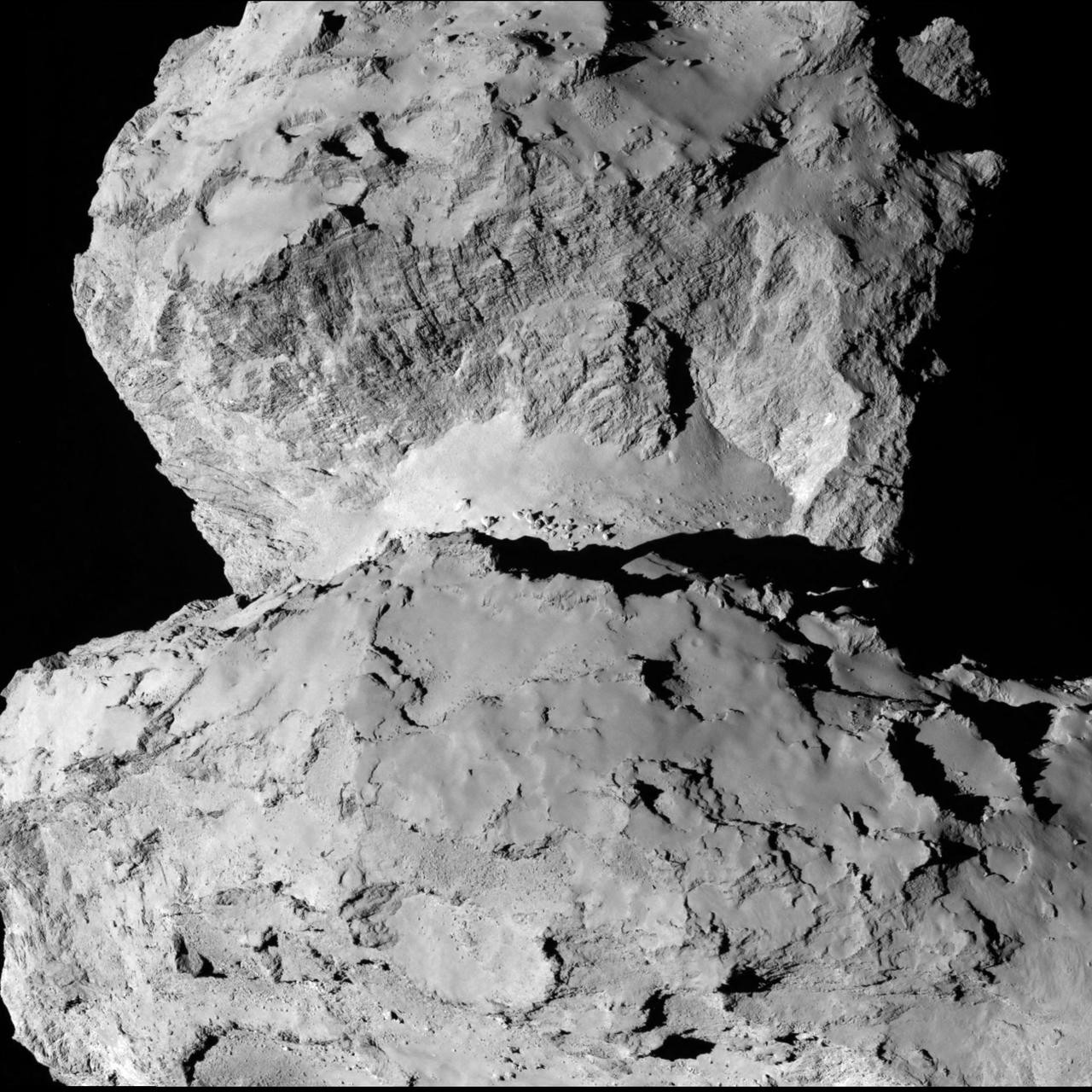
The nucleus is also highly porous. Its low bulk density means that solid material occupies only part of its volume, affecting heat transfer, mechanical strength and the routes through which gas can escape. [1]
Following the seasons changes the experiment
A brief flyby records one moment under one set of conditions. Rosetta instead observed 67P over more than two years, including its 2015 perihelion. Changing sunlight altered which regions warmed and how much gas and dust entered the coma. [1] [2]
The spacecraft could compare repeated observations rather than infer every process from a single active plume. Images showed the terrain, while instruments measured surrounding neutral gas, charged particles and dust. Connecting those records helped distinguish local changes from the broader rise and fall of activity. [1] [2]
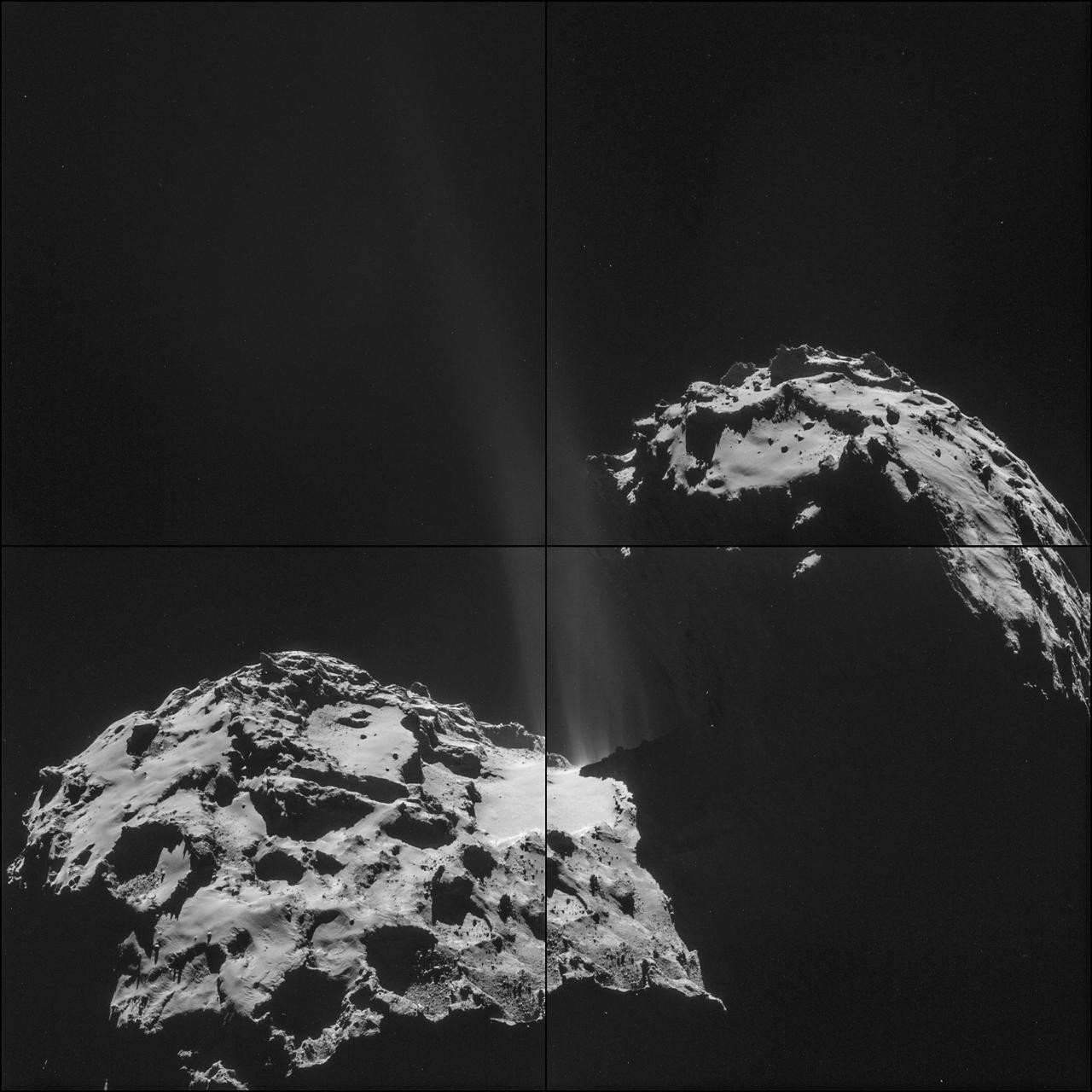
The mission ended in a controlled descent to the surface on 30 September 2016. Its long record remains useful because later analyses can revisit material collected across different distances and illumination conditions. [1] [2]
A reactive molecule preserved an early clue
Rosetta’s ROSINA instrument detected molecular oxygen, O2, in gas released by the comet. Oxygen atoms are common, but free O2 is reactive and can be incorporated into other molecules, making its abundance an important constraint on chemical history. [2]
The 2015 analysis used thousands of samples collected between September 2014 and March 2015. Oxygen production tracked water more closely than some other volatile species, suggesting a connection in how the two were stored or released. [2]
The researchers examined whether irradiation or later chemistry could explain the observations. Their interpretation favoured oxygen incorporated during the comet’s formation. This was a question about preserved chemistry; O2 in an extraterrestrial environment does not on its own establish biological activity. [2]
The gas supplied more than water
Rosetta also identified a varied chemical inventory, including the amino acid glycine and phosphorus. Those ingredients participate in terrestrial biochemistry, but they can exist through non-biological processes and do not amount to organisms in the comet. [1] [3]
Measuring material around the nucleus requires attention to how it was released. A gas abundance in the coma reflects illumination, volatility, transport and the region contributing at that moment, as well as the original material. A sample of the coma is therefore not automatically a uniform census of the entire nucleus. [1] [3]
The long mission helped investigate those dependencies by measuring changing conditions repeatedly. Chemistry became part of a time-dependent geological picture rather than a list detached from its source. [1] [3]
The comet’s present environment has a history too
Gravitational encounters with Jupiter brought 67P onto a path reaching closer to the Sun, with a particularly important encounter in 1959. Its current activity therefore occurs under conditions shaped by earlier orbital changes. [1]
The comet preserves ancient ingredients while also being modified each time it warms. Rosetta’s achievement was to observe both sides of that history together: old chemical material entering space from a surface responding to sunlight now. Living beside the comet made it possible to follow the connection as it changed. [1]
Sources & image credits
Related reading and objects
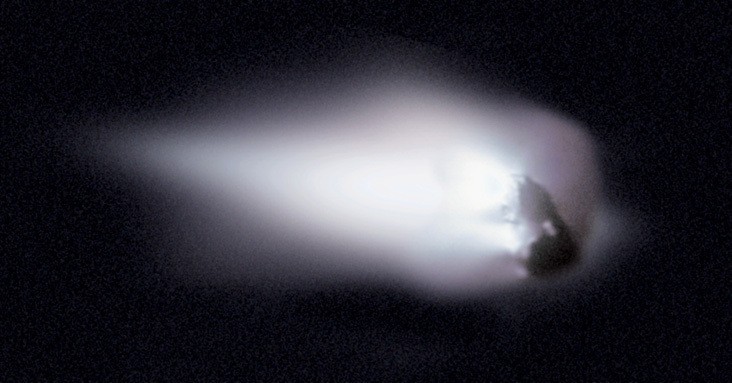
Why does Halley’s Comet return?
Giotto photographed Halley’s dark nucleus in March 1986, surrounded by escaping material. The comet’s next close passage by the Sun is expected in 2061. Its long absence from bright evening skies follows from the shape of its orbit, rather than a disappearance from the Solar System.
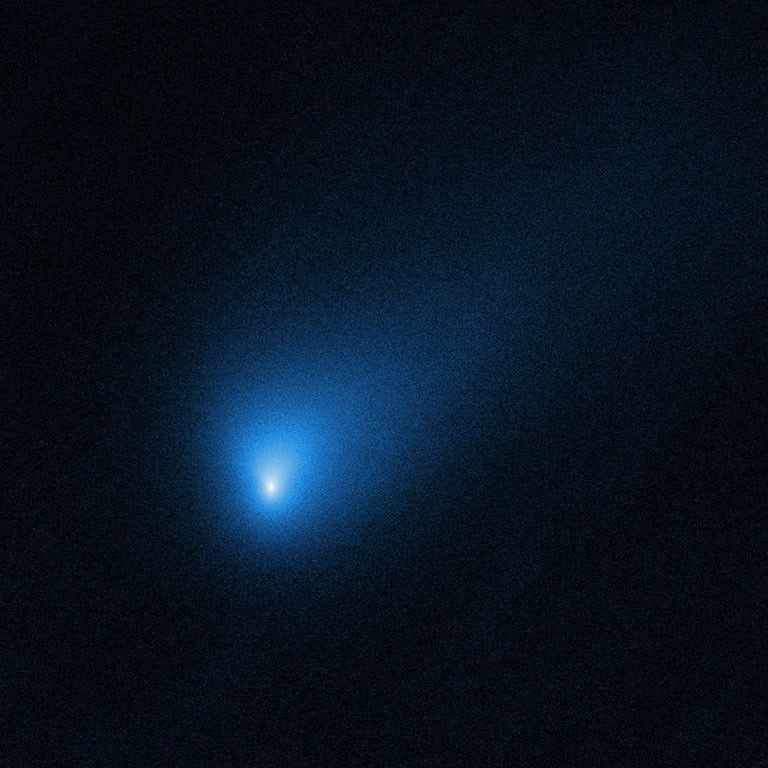
What made Borisov an interstellar comet?
Gennady Borisov discovered the object now called 2I/Borisov on 30 August 2019. Unlike ʻOumuamua, it displayed a dusty coma. Its trajectory established an interstellar journey, while the escaping gas allowed astronomers to investigate material formed around another star.