

Why Starship needs another fill after reaching orbit
NASA’s revised Starship lunar-lander option still relies on gathering propellant in Earth orbit. Reaching orbit spends propellant; departing for the Moon needs more. The difficult part is delivering, storing and moving enough cold liquid to make that next burn possible.
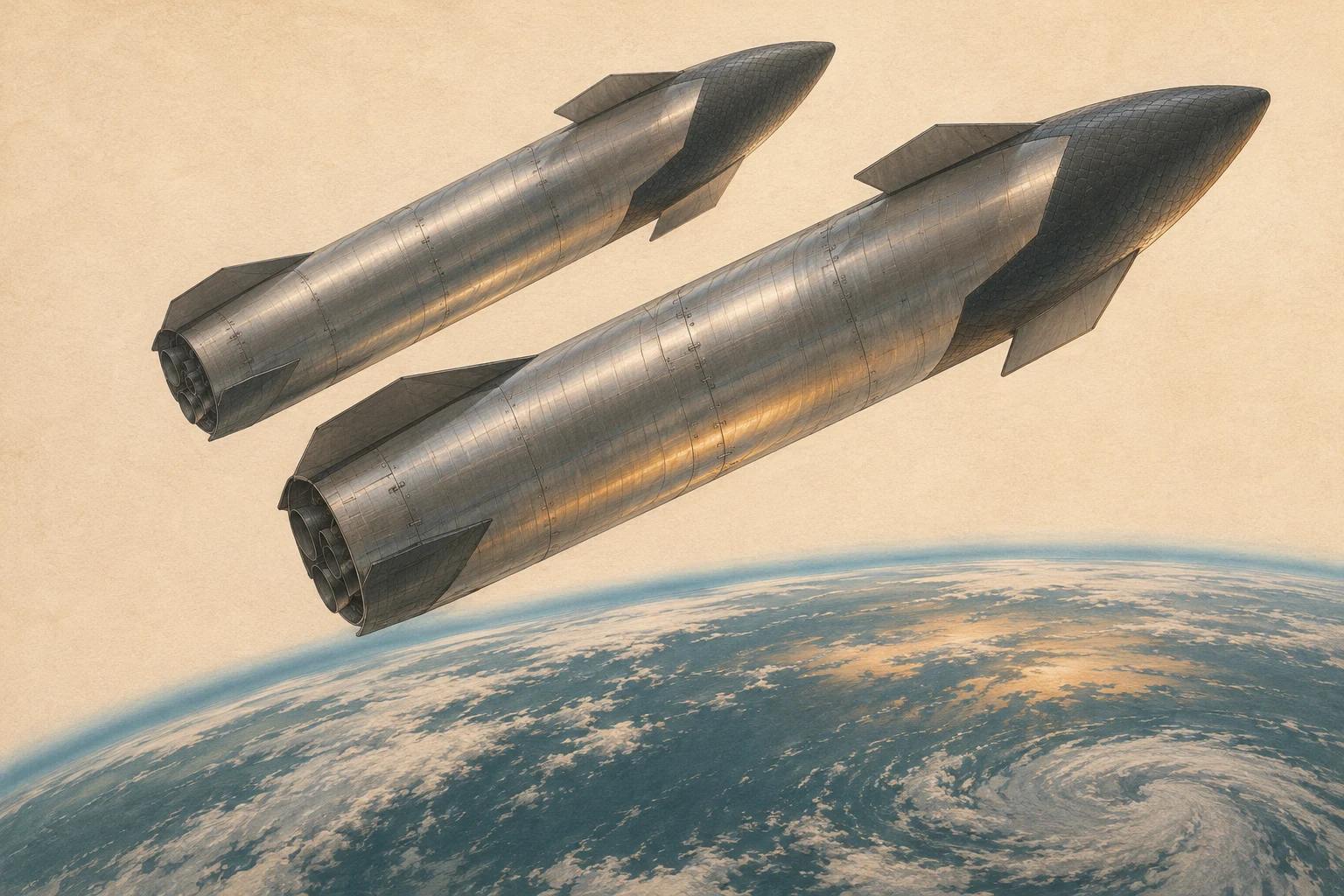
Orbit is a starting point for the next burn
Artemis IV is a planned lunar surface mission, with NASA developing commercial lander options for its return to the Moon. In the Starship option described in October 2026, tanker vehicles deliver propellant to an orbital depot, which supplies the lander. NASA has not assigned either provider to a specific lunar landing mission, so this is a development path rather than a settled provider selection. [1]
A launcher uses a large fraction of its starting propellant to accelerate out of the atmosphere and reach orbital speed. Once in orbit, a spacecraft still needs a further change in velocity to leave for the Moon, then enough propellant for its later manoeuvres. Refilling lets that later departure begin with propellant delivered by other launches.
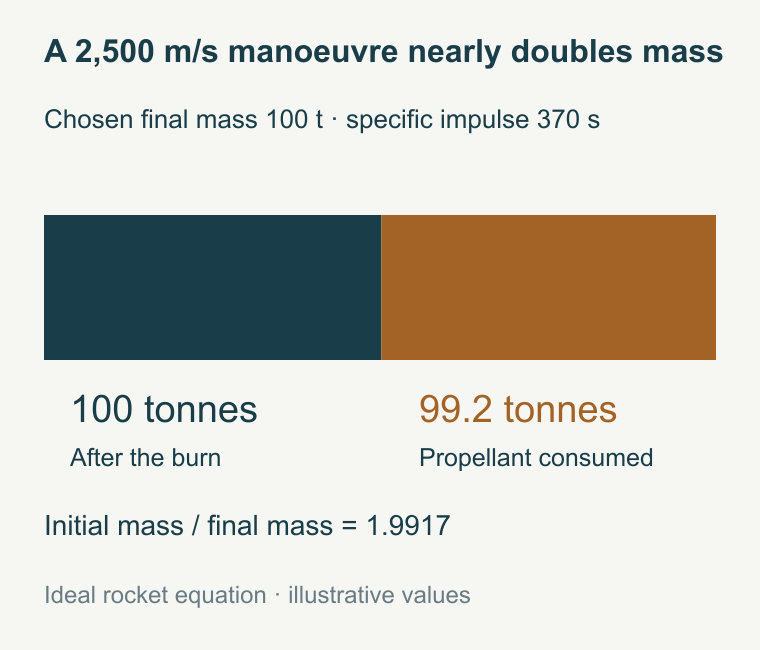
The benefit is easier to see by holding the mass after a burn fixed. In the ideal rocket equation, the initial-to-final mass ratio grows exponentially with the required change in velocity. Moving some propellant delivery into orbit changes where the mission assembles that initial mass. [2]
Change the manoeuvre. Watch the propellant requirement grow.
Keep the final mass fixed, then ask what extra velocity costs in an ideal rocket-equation example.
- Required propellant
- 99.2 tonnes
- Initial / final mass
- 1.99
Ideal example: Δv = g₀ Isp ln(initial mass / final mass). The chosen values are teaching inputs, not Starship flight specifications or a tanker-launch forecast.
Enable JavaScript to explore the model.
Almost another vehicle’s worth of mass can be propellant
For a chosen final mass of 100 tonnes, specific impulse of 370 seconds and ideal change in velocity of 2,500 metres per second, the initial mass is about 199.2 tonnes. About 99.2 tonnes are consumed.
Set the velocity change to zero and the ideal required propellant becomes zero. Increase it to 5,000 metres per second while keeping the other values fixed, and the mass ratio rises to about 3.97. The second 2,500 metres per second is more expensive because the rocket must initially accelerate propellant that it will burn later.
The “final mass” includes everything still aboard after this particular burn: structure, payload and any propellant reserved for subsequent operations. Calling it final mass avoids treating a multi-burn spacecraft as an empty shell. The calculation omits gravity and drag losses, reserves, transfer losses and changing engine performance.
Three roles solve three different delivery jobs
In the current published concept, tanker Starships transport propellant from the ground. The depot accumulates it over several deliveries. The lander receives the amount it needs for its later operations. Those roles separate the work of hauling propellant into orbit from the work of carrying a crew toward and onto the Moon. [1]
Aggregation also separates two schedules. An individual tanker launch does not have to occur at the instant the crew is ready to leave. But that flexibility creates a storage problem: propellant waiting in the depot must remain usable throughout the campaign.
The revised October 2026 concept places the Starship lander’s rendezvous with Orion in Earth orbit and sends the joined stack toward low lunar orbit. Older descriptions that assume the previous rendezvous orbit or a fixed original mission assignment therefore need a date attached. The route changes the required propellant budget. [1]
Vacuum does not keep a tank cold for free
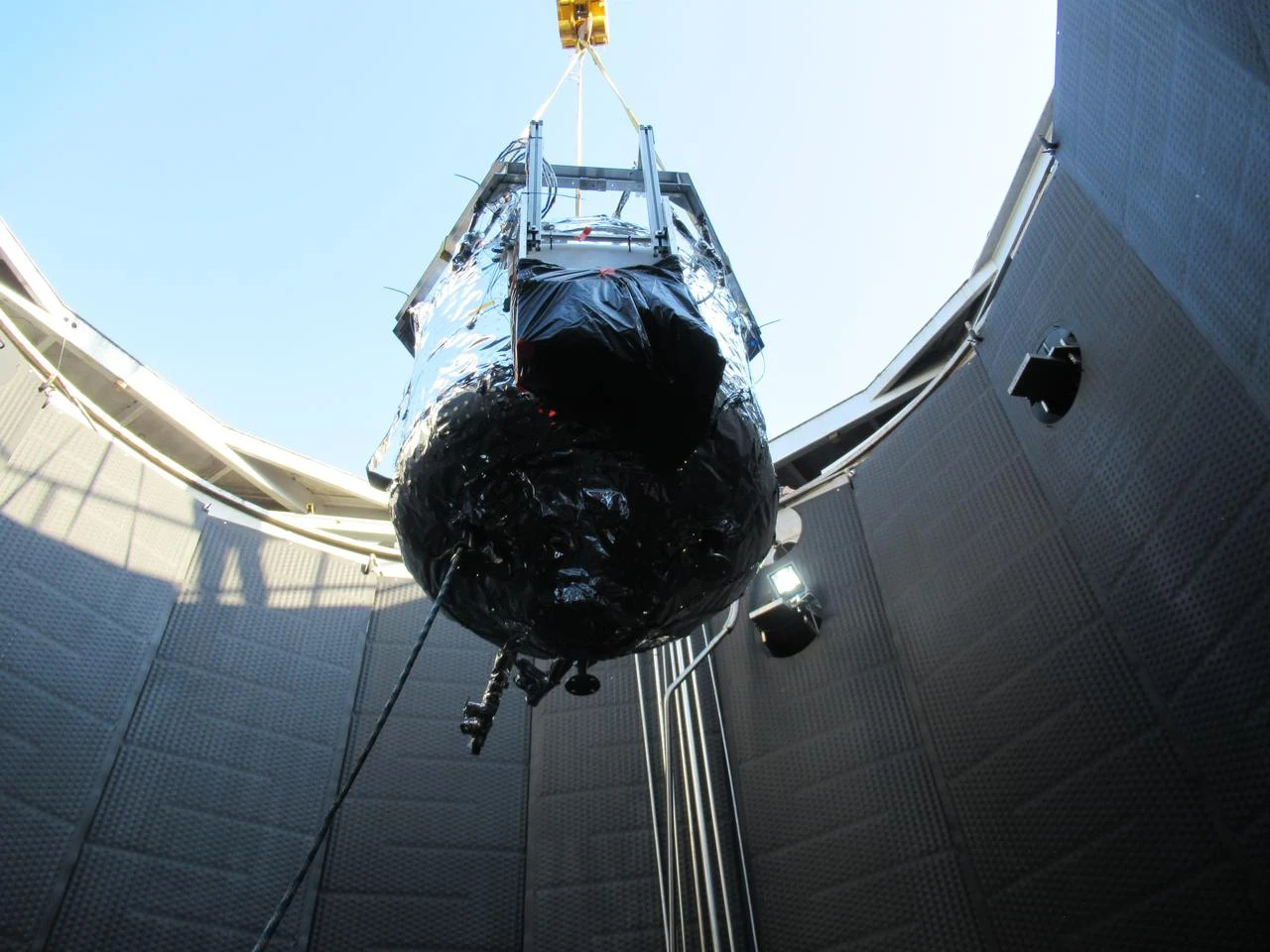
Cryogenic propellants are liquids maintained at very low temperatures. Sunlight, warm hardware and conducted heat can add energy to the tank. Some liquid can vaporize, increasing pressure; venting that vapour removes material that will no longer be available for an engine burn. Insulation and active thermal management address different parts of this problem. [3] [4]
A NASA ground experiment makes the problem tangible. The tank in the photograph was prepared for two-stage active cooling tests using liquid hydrogen. Its insulated exterior and cooling arrangements are hardware built to manage incoming heat. Hydrogen is a different propellant from Starship’s methane and oxygen, but the experiment shows why storage is an engineering task rather than an empty wait. [4]
Before useful liquid arrives, warm plumbing has to cool
Connecting two spacecraft is only the start. A transfer path must admit the intended liquid, manage pressure and deliver it into a receiver whose condition is known. In microgravity, the liquid and vapour do not simply arrange themselves as a pool and a free surface at the bottom and top of a ground tank. [5]
A warm line can boil the first incoming cryogen while the hardware cools. Researchers call this chilldown. The heat initially stored in the line has to go somewhere, so a complete transfer budget includes the material used to condition the path as well as the liquid ultimately retained in the receiver. Microgravity experiments investigate how that cooling proceeds. [5]
An internal tank-to-tank test and a vehicle-to-vehicle demonstration establish different capabilities. NASA’s March 2026 inspector-general report distinguished the earlier internal demonstration from the larger spacecraft-to-spacecraft milestone. A useful demonstration must show an end-to-end result: connection, fluid management, quantity transferred and usable propellant afterwards. [6]
Why a single tanker count is not the answer
The number of deliveries depends on the mission’s required usable propellant and the usable amount each tanker actually leaves behind. Transfer losses, storage duration, boiloff, reserves and vehicle performance all enter that accounting. Dividing a nominal tank capacity by a nominal tanker capacity skips those conditions.
NASA’s October architecture update changes the route and says it reduces the aggregation requirement. A tanker count from an earlier route can therefore remain arithmetically correct for its original assumptions while no longer describing the current concept. Check the dated architecture before treating a quoted count as a specification. [1]
The central idea survives those changes. Refilling assembles departure mass after Earth orbit has been reached. Its success depends on how much usable propellant is left in the right vehicle when the next burn begins. That is the quantity the launch campaign, storage system and transfer operation must deliver together.
Sources & image credits
- NASA · Revised lander concepts of operations, October 2026 ↗
- NASA Glenn · Ideal rocket equation ↗
- NASA · Cryogenic fluid management ↗
- NASA · Two-stage cryogenic storage test, July 2025 ↗
- Hartwig and colleagues · Transfer-line chilldown experiments in microgravity ↗
- NASA Office of Inspector General · Human Landing System contracts, March 2026 ↗
Related reading and objects
What stops Super Heavy before the tower catches it?
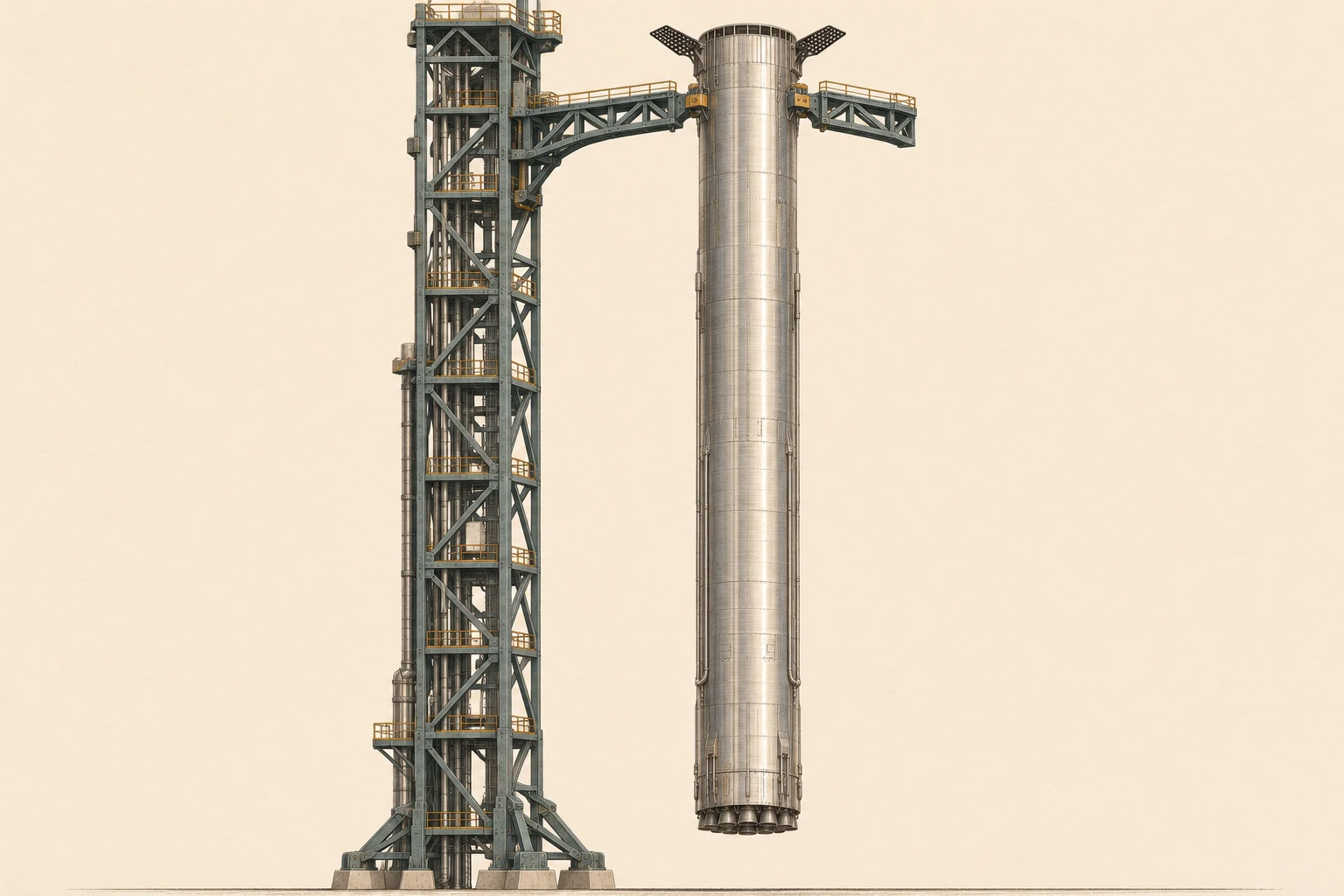
As Starship Flight 15 approaches, the recovery question is easier to read in three parts: guide the booster home, remove its downward speed, then support its weight. SpaceX first completed a Super Heavy tower catch on 13 October 2024. The arms were the last part of that chain.
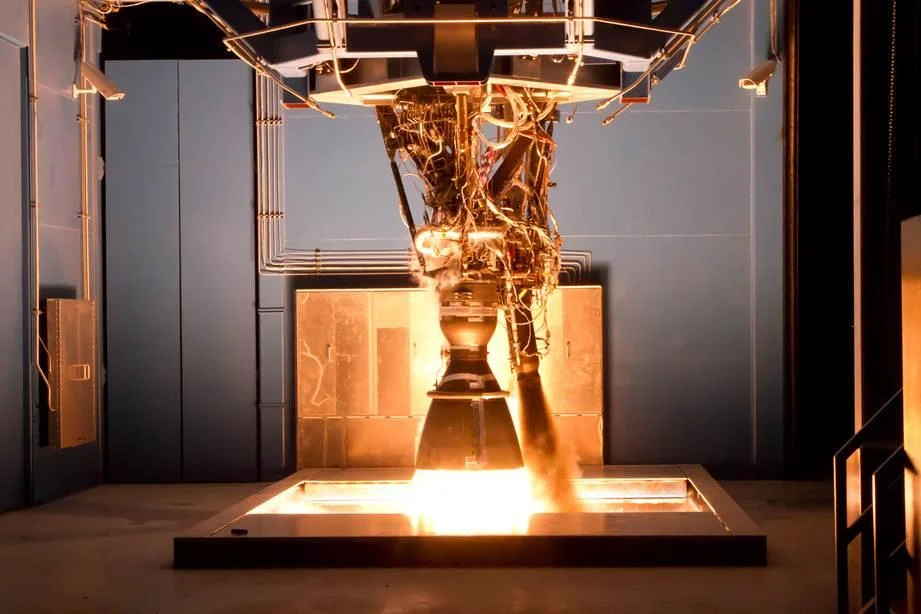
How rocket engines work: from liquid to liftoff
Two liquids go in. A supersonic stream comes out. Between them sits a machine that must make heat, move heat and turn pressure into speed.
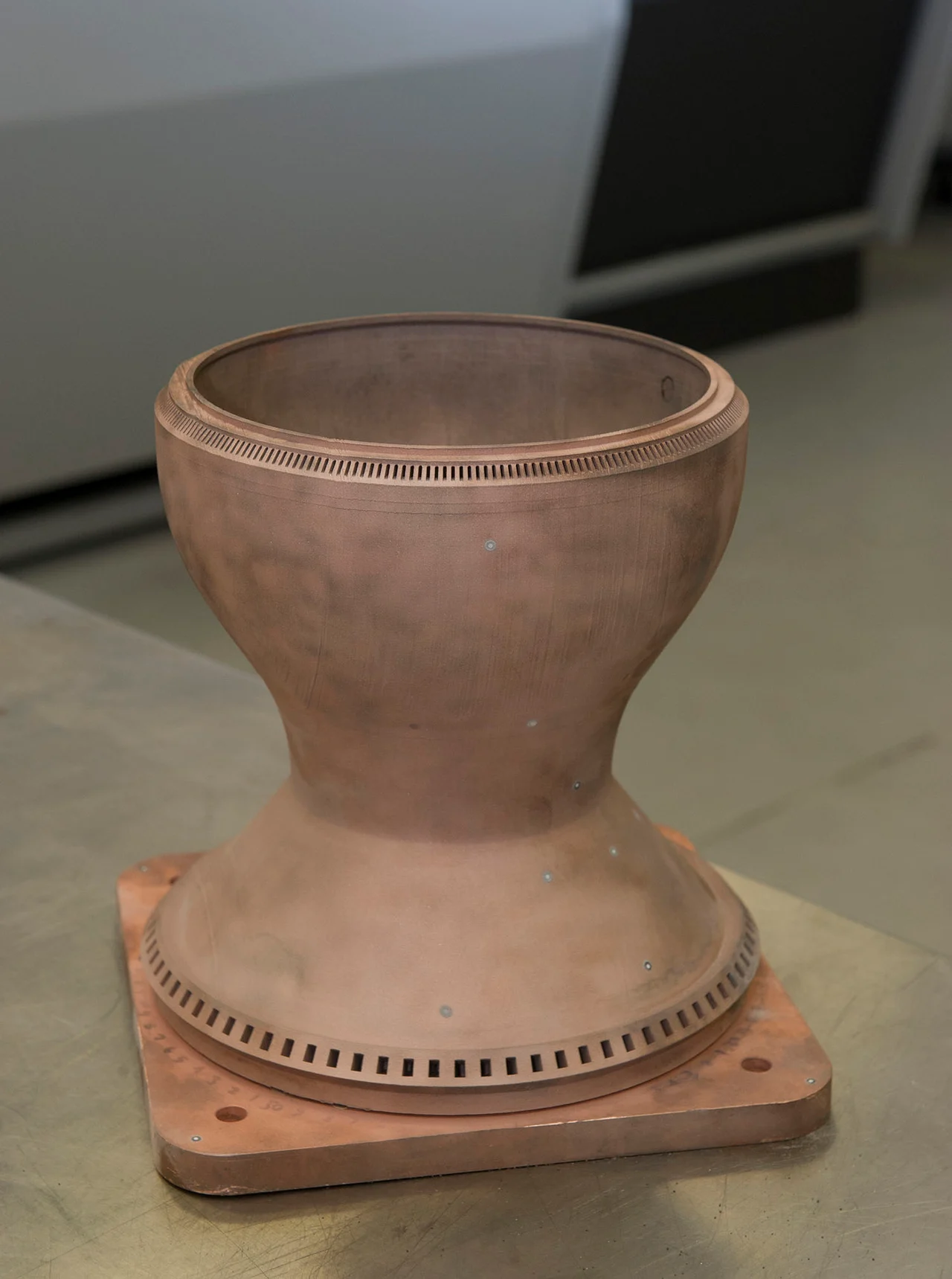
The fuel takes the heat before it burns
The small openings around this copper chamber are part of its survival system. Before propellant feeds the fire, it can carry heat away from the metal holding that fire in place.
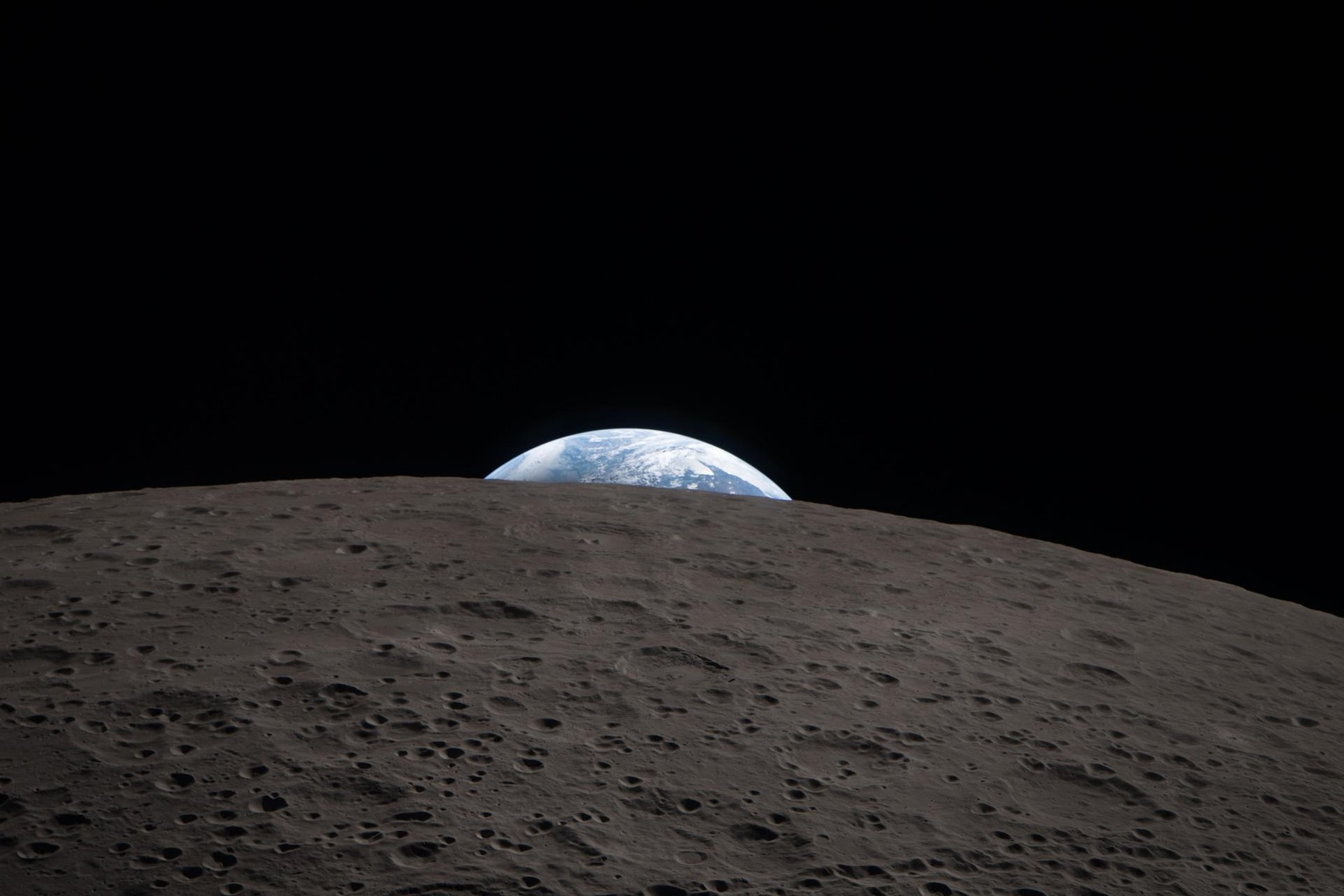
Put the Moon at its real distance
Artemis IV’s planned surface crew will work hundreds of thousands of kilometres from Earth. A radio signal can cross that distance in a little over a second, yet direct contact still depends on where the spacecraft and terrain are. Start by putting both worlds on the same physical scale.