

What stops Super Heavy before the tower catches it?
As Starship Flight 15 approaches, the recovery question is easier to read in three parts: guide the booster home, remove its downward speed, then support its weight. SpaceX first completed a Super Heavy tower catch on 13 October 2024. The arms were the last part of that chain.
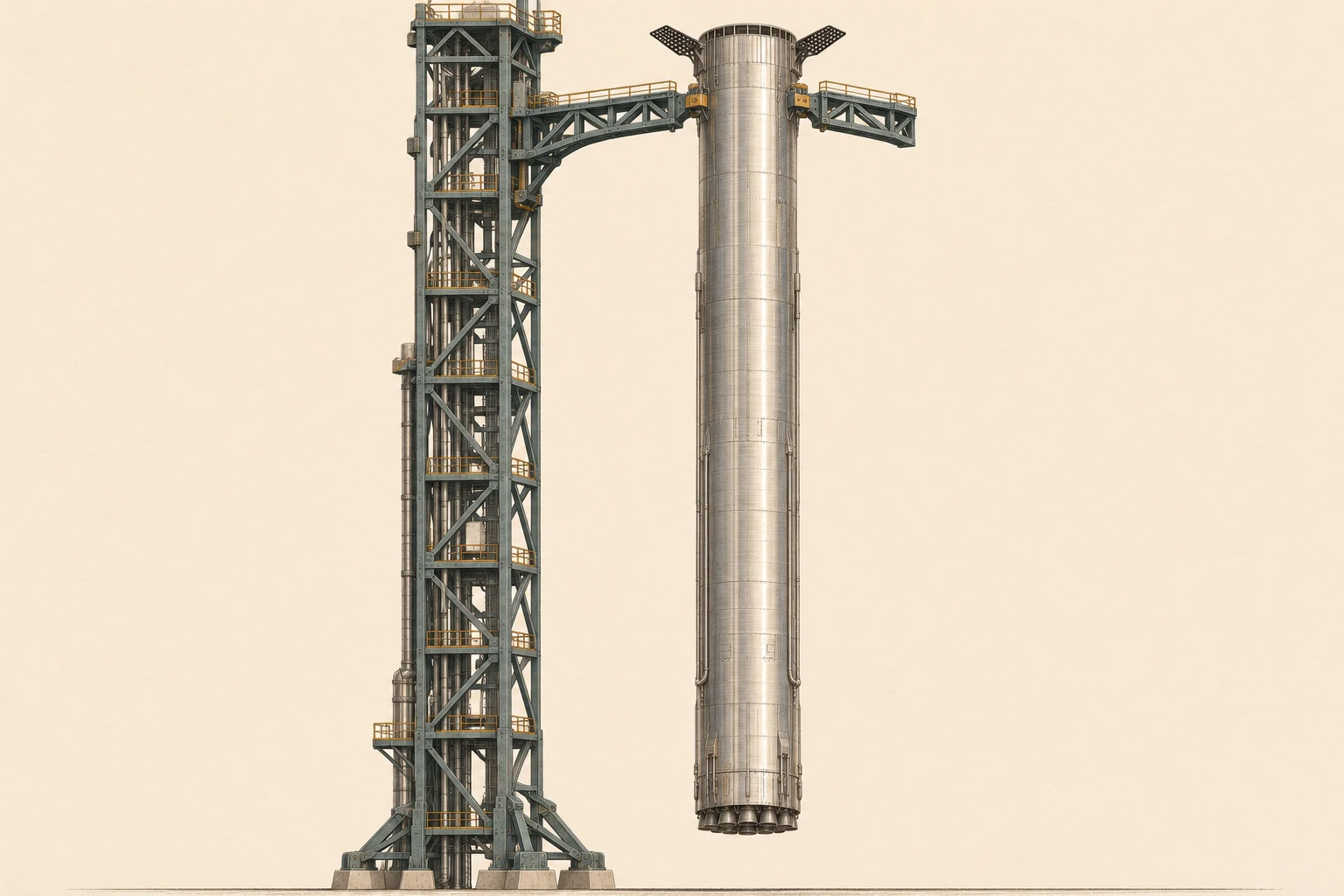
The catch begins long before the arms touch
Starship Flight 15 belongs to the same two-stage development programme. The established booster technique is clearest in the earlier Flight 5 result: after ascent, separation, boostback and coast, Super Heavy performed a landing burn and was caught at Starbase. That sequence gives the mechanism its meaning. [1]
Guidance decides where the returning booster is going. Aerodynamic control and engine burns shape how it gets there. Mechanical support is the final handover of load to the tower. Confusing those jobs makes the catch seem like a giant net intercepting a falling object.
Use the three phases below to keep the jobs separate. The booster has to arrive in a recoverable position and condition before the support phase can succeed.
Follow the handover from engines to tower
Select a phase to separate guidance, braking and mechanical support.
Qualitative sequence; positions and timing are not reconstructed flight telemetry.
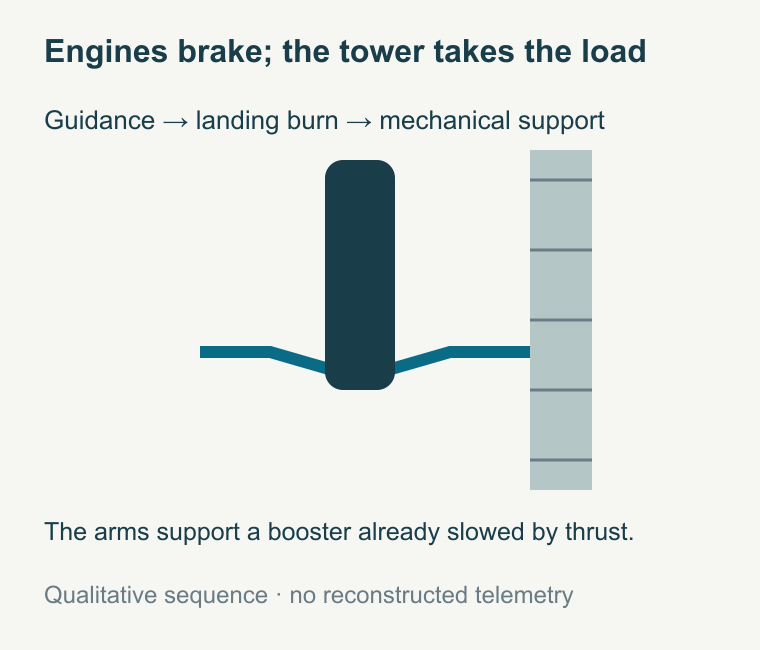
Enable JavaScript to explore the model.
A tall vehicle still has to fly through the atmosphere
During atmospheric return, the shape and attitude of the booster affect its forces and motion. Grid fins provide aerodynamic control when there is enough air flow. They are one part of the return system; they do not turn the final landing into a purely aerodynamic manoeuvre. [3]
NASA and SpaceX tested a 1.2-percent-scale Super Heavy Version 3 model at Ames to measure steady and unsteady aerodynamic effects. Loads that vary with time can produce vibration as well as change the average path. Measured forces help the team analyse the structure and guide the vehicle through that environment. [3]
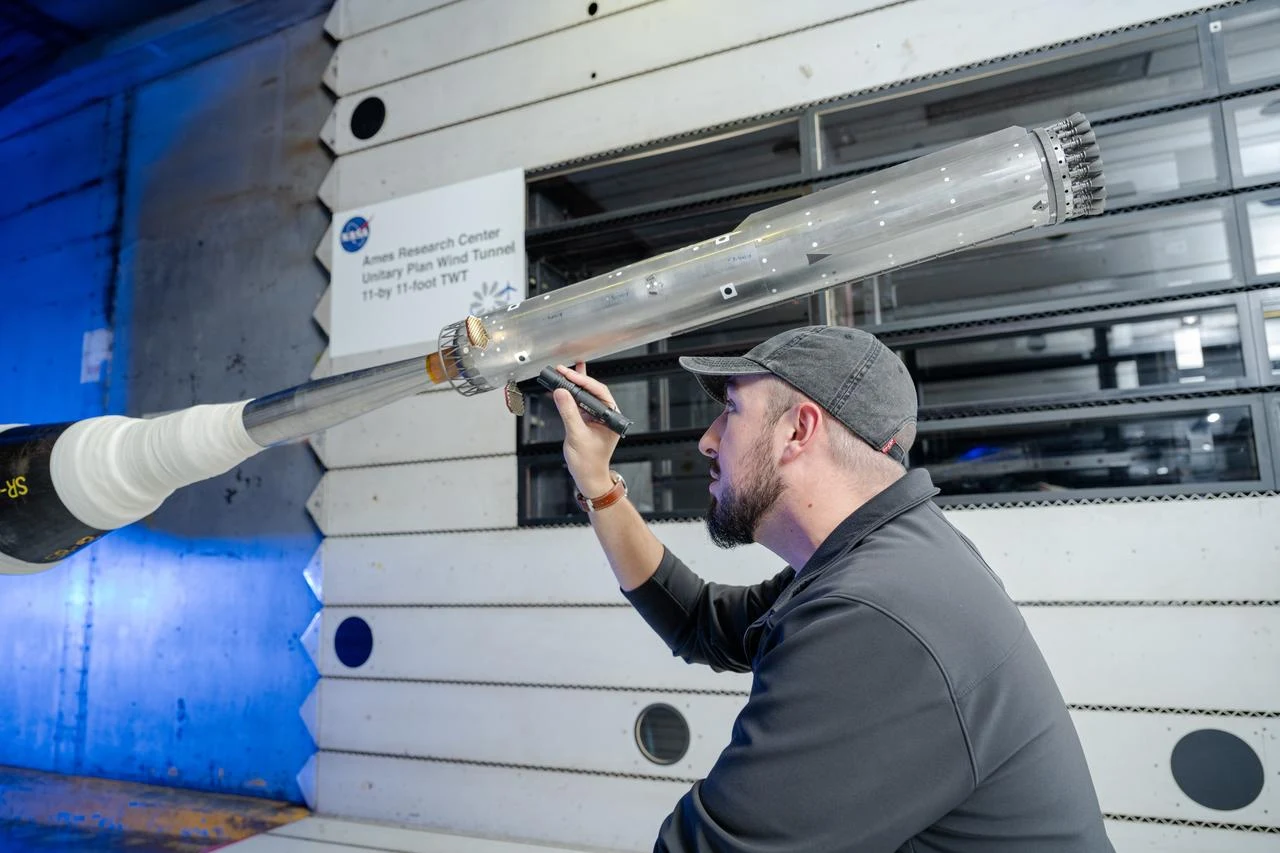
The small model matters because the real booster cannot be treated as a point mass. Its long structure, appendages and engine region experience the flow differently. A guidance solution and a survivable load environment have to work together.
The landing engines remove the remaining descent speed
The landing burn is what slows and positions the booster for capture. The tower arms must meet a vehicle whose final motion is controlled by thrust, rather than absorb the kinetic energy of an otherwise unbraked descent. SpaceX’s Flight 5 account explicitly places the landing burn before the successful catch. [1]
This is a basic distinction between braking and supporting. A parked vehicle needs a structure that carries its weight. A moving vehicle also has kinetic energy proportional to the square of speed. Leaving twice as much residual speed would leave four times as much kinetic energy to manage at the same mass. Reducing speed before contact changes the problem fundamentally.
The final motion includes lateral alignment and attitude as well as downward speed. A booster that is slow but displaced from the intended contact region has not solved the same problem. The approach, arms and support points must meet within the operating limits of the system.
After contact, the tower becomes the support structure
The arms provide mechanical support at the booster’s upper catch region. Once the support points are seated and thrust is removed, the load is carried into the tower and its foundation. This is why the relevant structure is more than the two visible arms: joints, moving machinery and the tower form a load path.
Recovering at the launch site brings the vehicle back to ground infrastructure already used to handle it. That is useful to the larger goal of reusability. A successful catch nevertheless establishes a recovery result for that flight; inspection, refurbishment, propellant loading and another launch are additional operations. [4]
The practical question after recovery is what condition the hardware is in. Reaching the arms and being ready to fly again are different milestones. Read a reflight claim against an actual subsequent flight record rather than inferring it from the catch image alone.
The tower has to be ready as well as the booster
SpaceX described thousands of vehicle and pad criteria for the first catch attempt. That makes the ground system an active part of the decision. The booster can be flying while a tower issue makes a return to that tower undesirable. [1]
Flight 6 supplies a useful comparison: the booster did not attempt the same tower catch and instead completed a controlled splashdown. A test programme can gather return data without repeating every recovery operation on every flight. A change in recovery path needs its own flight account to explain it. [2]
This is why the guide does not turn a phase drawing into a promise about a forthcoming flight. For Flight 15’s current target and objectives, use the related mission record below; for what happened, use the operator’s postflight account when it exists.
Catching Super Heavy and catching Ship are separate tests
Super Heavy is the first-stage booster. Starship is also the name used for the upper-stage spacecraft and for the complete launch system. A headline about “catching Starship” can blur which piece is returning. The first-stage booster catch discussed here does not by itself establish an upper-stage catch. [3]
The upper stage follows a different flight and returns from a much more energetic trajectory. Its condition after re-entry and its own final approach therefore have to be demonstrated in their own right. Keep the vehicle name attached to each test result.
The answer to the opening question is a sequence, not a miraculous impact absorber. The booster flies toward the tower, engines bring its motion under control, and the arms take over support. Each job makes the next one possible.
Sources & image credits
Related reading and objects
Why Starship needs another fill after reaching orbit
NASA’s revised Starship lunar-lander option still relies on gathering propellant in Earth orbit. Reaching orbit spends propellant; departing for the Moon needs more. The difficult part is delivering, storing and moving enough cold liquid to make that next burn possible.
How rocket engines work: from liquid to liftoff
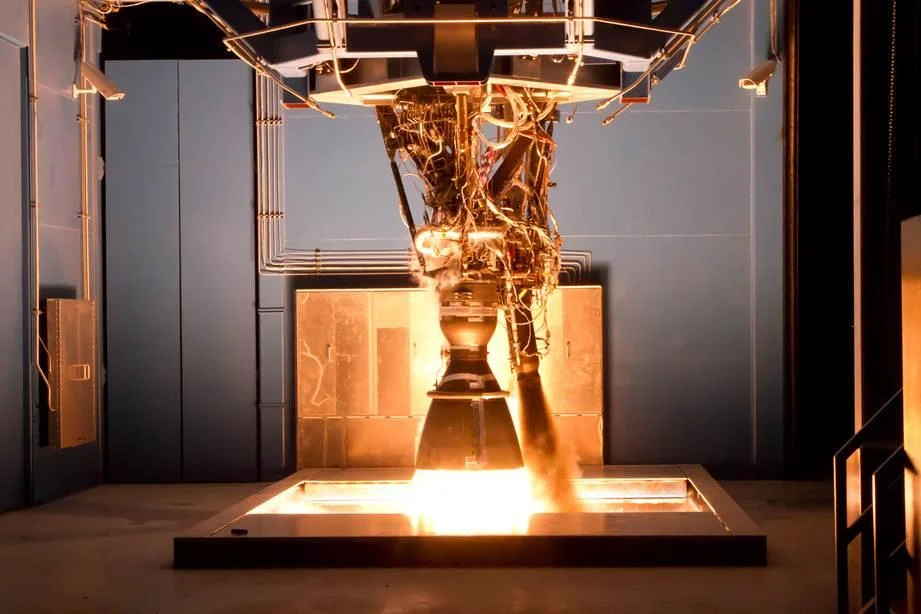
Two liquids go in. A supersonic stream comes out. Between them sits a machine that must make heat, move heat and turn pressure into speed.
The fuel takes the heat before it burns
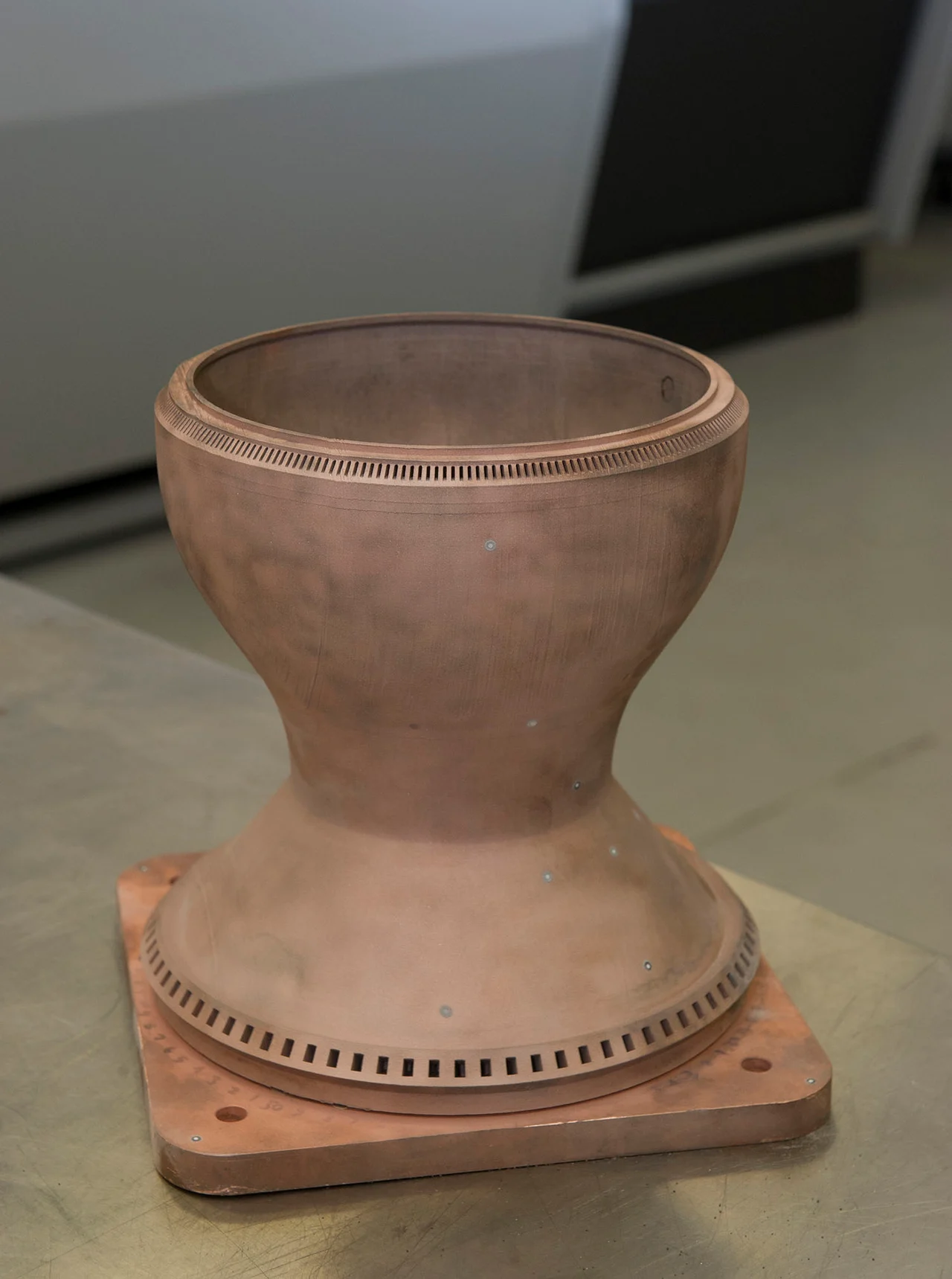
The small openings around this copper chamber are part of its survival system. Before propellant feeds the fire, it can carry heat away from the metal holding that fire in place.
Rocket nozzles: why bigger works better in space
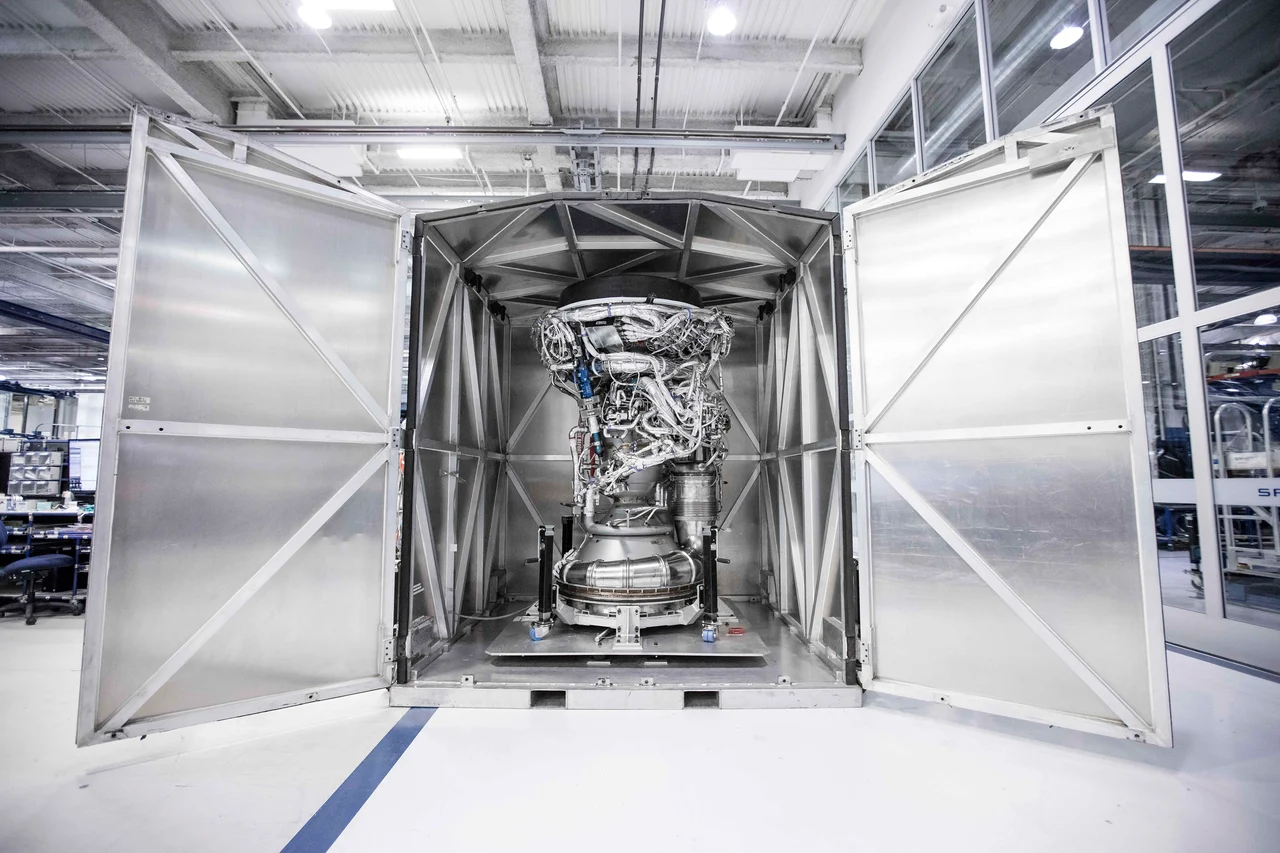
Merlin Vacuum wears an enormous bell. A first-stage engine cannot simply copy it. The reason is a pressure problem you can explore with a working ideal-flow model.