

What “ice giant” means inside Uranus
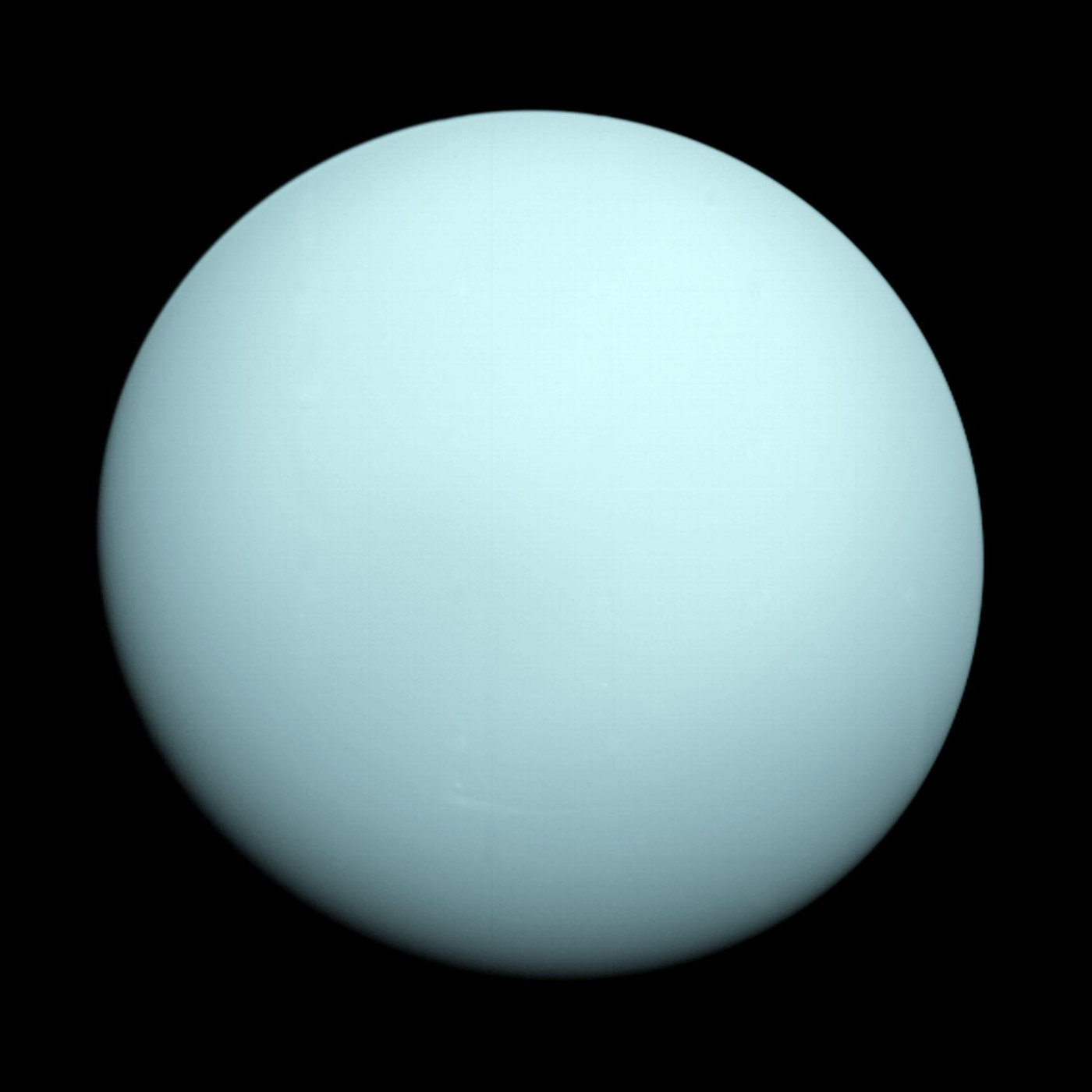
Voyager 2 supplied Uranus’s only close spacecraft survey. Its measurements, combined with later observations, test a planet often called an ice giant. The name describes a compositional family; it does not mean a frozen solid sphere.

An atmospheric colour is not an interior sample
Uranus’s outer atmosphere is mainly hydrogen and helium with methane and other constituents. Methane absorbs red light, contributing to the blue-green appearance. Clouds and hazes alter the spectrum too. The visible colour therefore tells us about the layers that interact with the light, rather than directly revealing the composition of the deep interior. [1]
In planetary terminology, “ices” includes volatile materials such as water, ammonia and methane that could condense in the cold environment where planets formed. Deep inside Uranus, pressure and temperature are very different. Those materials need not remain in the familiar frozen states found in a freezer or on an icy moon. [1]
Models have to satisfy several measurements
Mass and size establish the planet’s average density. Gravity measurements constrain how that mass is distributed, while atmospheric composition and magnetic observations add other information. Researchers combine these constraints with laboratory and theoretical work on matter at extreme pressure. The result is a family of interior models rather than one directly observed cutaway. [2]
A sharp stack of coloured layers can be a useful explanatory diagram, but it should not imply that every boundary is known. Mixing, composition gradients and the behaviour of high-pressure fluids can change the predicted structure. A better measurement of gravity or deep atmospheric composition can eliminate models that currently fit the available data. [2]
Measure the energy entering and leaving
A planet reflects some incoming sunlight and absorbs the rest. It also emits thermal radiation. Comparing absorbed solar energy with emitted heat constrains the contribution from the interior. Voyager-era estimates made Uranus appear unusually deficient in internal heat compared with the other giant planets. [3]
Analyses reported in 2025 used updated observations and modelling to reassess that energy balance. They support a modest internal heat output, while still finding a much smaller excess than Neptune’s. The revision is a reminder that a global energy budget depends on coverage, seasonal geometry and the treatment of reflected light as well as thermal emission. [3]
Why an orbiter and probe would add different information
A long-lived orbiter could revisit the planet and moons under changing geometry, map gravity and magnetic structure in more detail and observe atmospheric variability. An entry probe could directly sample a vertical atmospheric profile. Their measurements would complement each other: one provides repeated global context, the other a local descent through the gas. [2] [4]
Such mission concepts should remain distinct from approved launch records. The atlas’s mission list shows what exists in the production catalog, while this explanation describes the scientific measurements a future investigation could make. Voyager’s brief encounter established the starting constraints; the unresolved interior and energy questions show why more than another photograph is needed. [2] [4]
Sources & image credits
Related reading and objects
The sideways seasons of Uranus
Voyager 2 saw Uranus with its south polar region facing the Sun in 1986. Decades later, telescopes watch the northern hemisphere approach summer. The difference follows from an almost sideways spin axis and a year longer than a human lifetime.
Why one Uranus flyby can mislead
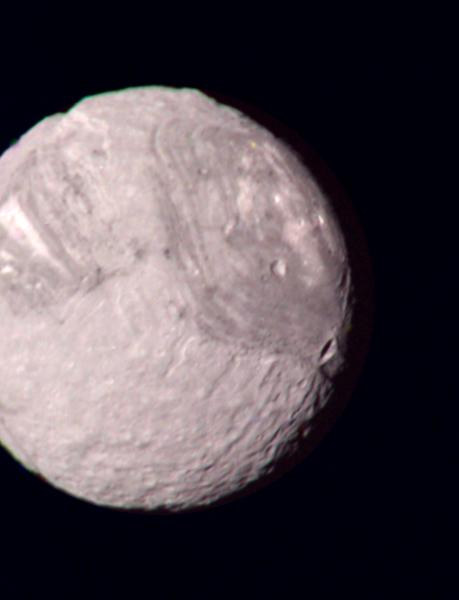
Voyager 2 discovered Uranus’s unusual magnetic environment in 1986. Reanalysis decades later showed why the conditions during that short encounter matter: the solar wind may have compressed the magnetosphere shortly before the spacecraft arrived.