

Why one Uranus flyby can mislead
Voyager 2 discovered Uranus’s unusual magnetic environment in 1986. Reanalysis decades later showed why the conditions during that short encounter matter: the solar wind may have compressed the magnetosphere shortly before the spacecraft arrived.
The magnetic axis does not follow the spin axis
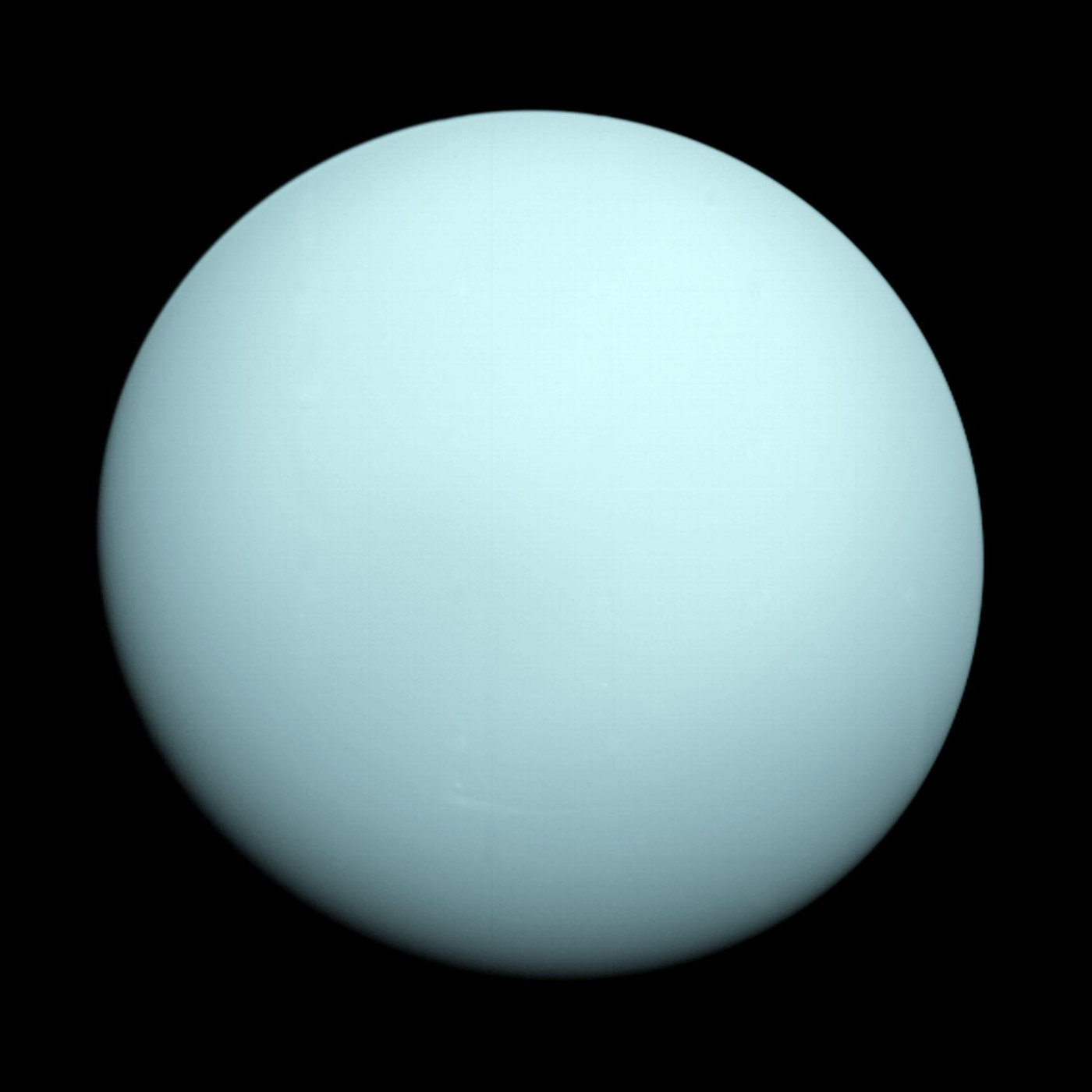
Uranus’s large-scale magnetic field is strongly tilted relative to its rotation axis and is offset from the planet’s centre. This is separate from the tilt of the planet itself. The combination creates a magnetic environment whose orientation toward the solar wind changes in a complicated way as the planet rotates. [1] [2]
A simple bar magnet drawn through the centre of a globe would conceal that geometry. A field model is fitted to measurements of strength and direction along the spacecraft’s path. It can describe the main structure without implying that the magnetosphere is static or perfectly represented by a single ideal dipole. [1] [2]
The Sun changes the boundary conditions
A magnetosphere is the region where a planet’s magnetic field controls the motion of much of the charged material. The solar wind presses against it, transferring energy and changing its boundaries. Stronger external pressure can compress the system and alter the particle population a passing spacecraft encounters. [3] [4]
Voyager measured a striking combination of intense radiation and an unexpectedly sparse plasma environment at Uranus. For years, those observations shaped the picture of the planet. Yet they were taken during a limited interval, and the spacecraft could not return later to see whether the same conditions persisted. [3] [4]
Put the encounter back into its solar-wind context
A study published in 2024 re-examined the solar-wind measurements surrounding the encounter. It argued that a strong compression event just before arrival could explain several unusual features. Under that interpretation, Voyager sampled an exceptional state rather than a representative long-term average. [5] [4]
The study does not erase the measured magnetic tilt or turn the original observations into errors. It changes the interpretation of the environment sampled at that time. Geometry, particle measurements and external forcing answer different questions. Reconnecting them can resolve an apparent contradiction without discarding the data. [5] [4]
An unusual environment affects the moon investigation
The state of the magnetosphere influences how material released by moons spreads and whether a spacecraft can detect it. An unusually depleted plasma environment can therefore complicate inferences about moon activity. A weak detected signal is not always proof that there is no source. [5] [6]
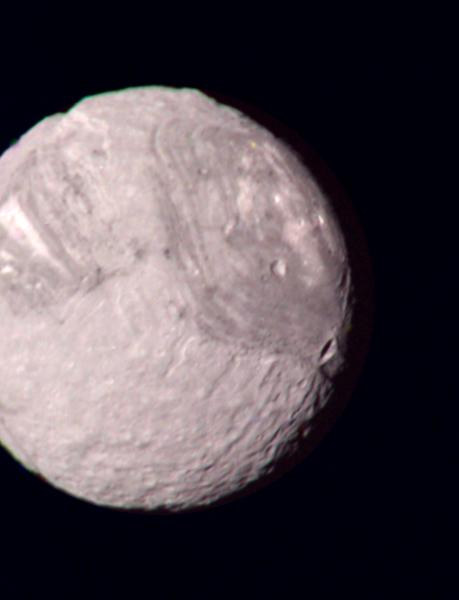
Miranda’s complex terrain, shown here, is independent evidence that at least some Uranian moons have substantial geological histories. Connecting those surfaces to internal activity and the surrounding plasma requires more coverage. Repeated orbits would let researchers compare changing space-weather conditions instead of building every conclusion from one pass through the system. [5] [6]
Sources & image credits
Related reading and objects
The sideways seasons of Uranus
Voyager 2 saw Uranus with its south polar region facing the Sun in 1986. Decades later, telescopes watch the northern hemisphere approach summer. The difference follows from an almost sideways spin axis and a year longer than a human lifetime.
What “ice giant” means inside Uranus
Voyager 2 supplied Uranus’s only close spacecraft survey. Its measurements, combined with later observations, test a planet often called an ice giant. The name describes a compositional family; it does not mean a frozen solid sphere.