

The sideways seasons of Uranus
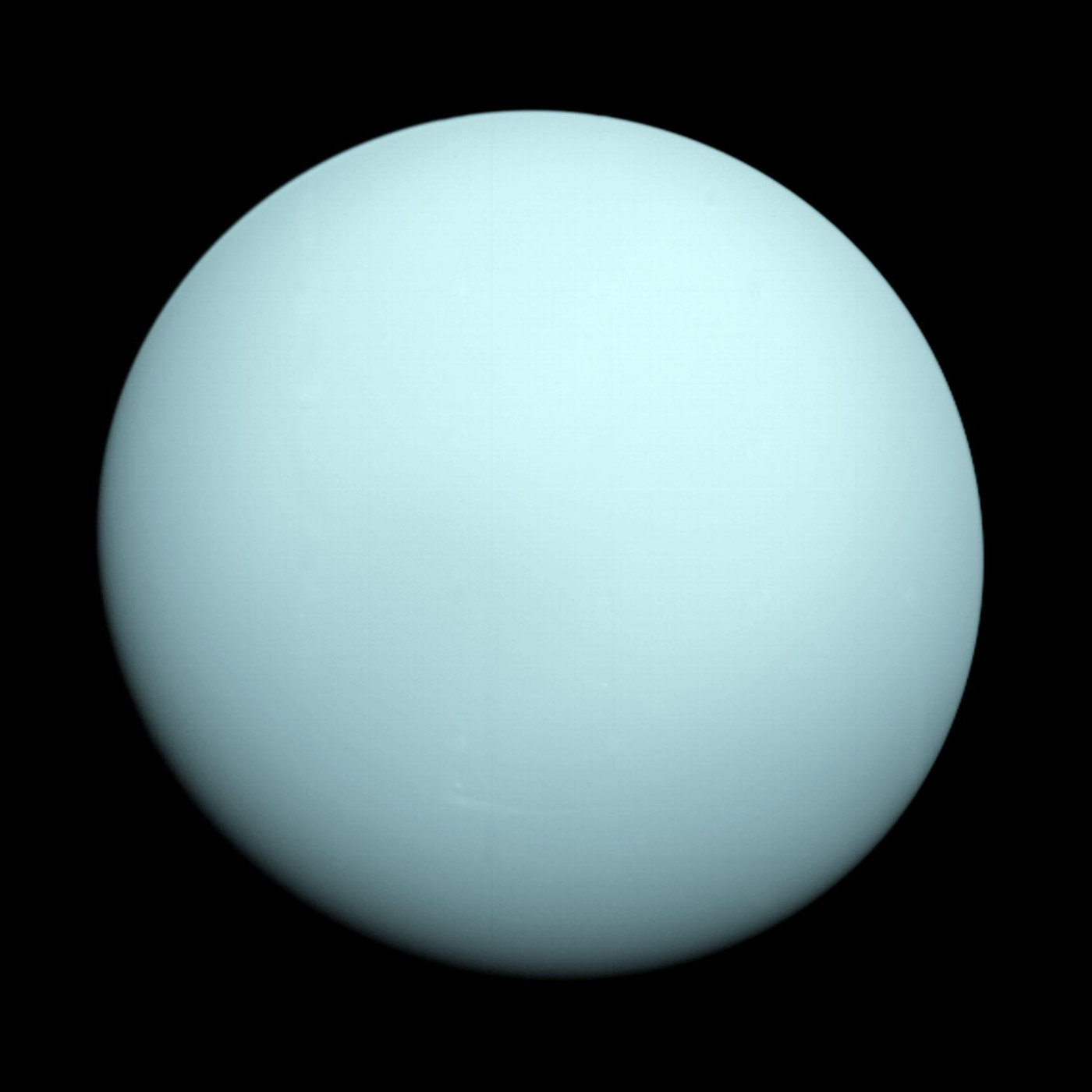
Voyager 2 saw Uranus with its south polar region facing the Sun in 1986. Decades later, telescopes watch the northern hemisphere approach summer. The difference follows from an almost sideways spin axis and a year longer than a human lifetime.
A fast spin does not guarantee a daily sunrise
Uranus turns once in roughly 17 hours, yet some places can remain in darkness for decades. The important geometry is the direction of its spin axis. It is tilted about 97.8 degrees from the upright direction of the orbital plane—slightly beyond a right angle. [1]
Over one orbit, the axis keeps approximately the same direction in space. At one solstice the northern pole points roughly towards the Sun; half an orbit later, the southern pole does. The planet does not need to flip over between them. Moving around the Sun changes the illumination of an already tilted globe. [1]
The tilt also makes the rotation conventionally retrograde. That description concerns its direction of spin. The seasonal pattern concerns where sunlight falls. Keeping those two consequences separate helps explain why “rolling on its side” is a useful first impression but an incomplete account of the motion. [1]
A 21-year season and a 42-year polar day
Uranus takes about 84 Earth years to complete an orbit. Dividing that year into four seasons gives approximately 21 Earth years per season. It is a measure of how long the planet takes to move from an equinox to a solstice, or from a solstice to the next equinox. [1] [2]
Daylight at a pole spans more than one season. From the spring equinox through summer to the autumn equinox, the Sun stays above that pole’s horizon for roughly half the orbit—about 42 Earth years. It remains below the horizon through the other half. A 21-year season therefore should not be mistaken for the complete duration of polar daylight or darkness. [1] [2]
The view is different near the equator, where the Sun can rise and set during the planet’s rapid rotation. Between the equator and the poles, the length of the day changes strongly with season. There is no single Uranian day–night pattern that applies equally to every latitude. [1] [2]
The weather has its own response time
An atmosphere stores heat and moves it between regions. Clouds and hazes need not respond immediately to a change in sunlight, and different depths can respond at different rates. Seasonal illumination establishes the forcing, but the resulting weather also depends on circulation and atmospheric chemistry. [1] [3]
Voyager’s brief 1986 encounter took place near southern summer solstice. It recorded a relatively bland-looking disk in visible light. That observation sampled one season and a particular range of wavelengths; it did not establish that Uranus is always featureless. [1] [3]
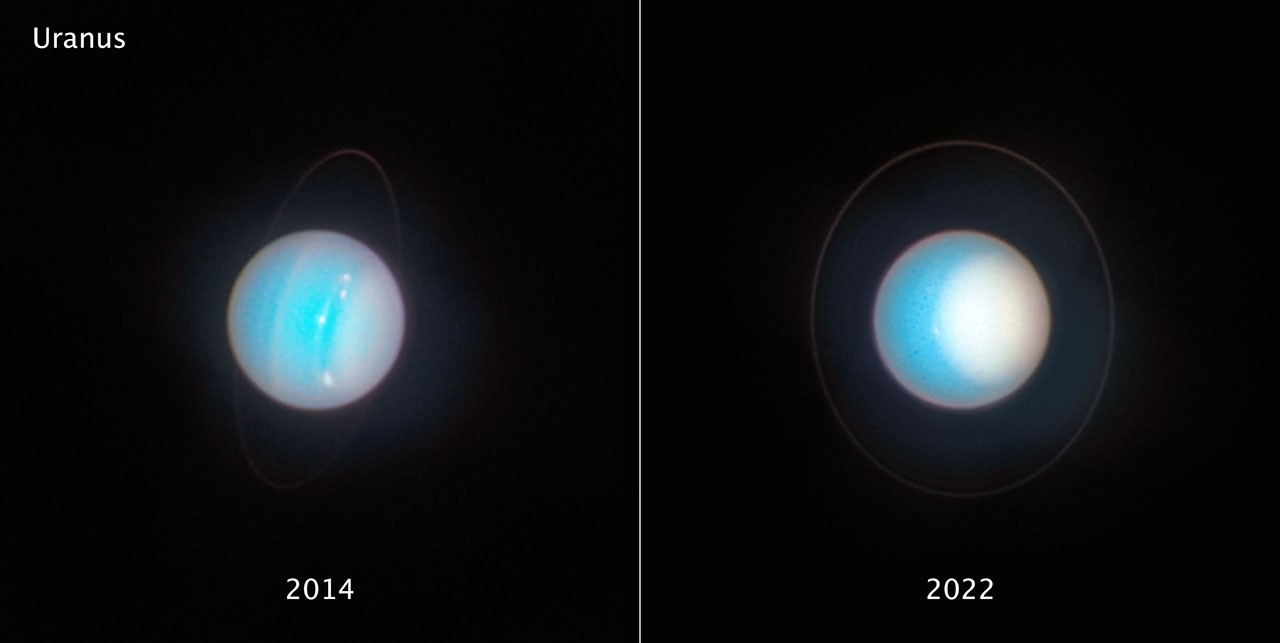
Hubble’s long-term monitoring has followed the northern hemisphere into increasing sunlight. It has resolved clouds and a brightening polar cap. Comparing observations over years allows researchers to investigate the change, while infrared images reveal structures that an ordinary visible-light portrait can conceal. [1] [3]
Compare like with like before reading a change
A pale visible-light disk and a detailed infrared image may look dramatically different even when taken close together. Different wavelengths respond to gases, clouds and hazes differently. To measure seasonal change, researchers compare observations with their dates, filters and processing in view. [3] [4]
Seasonal reflectivity also affects the planet’s energy budget. A 2025 analysis combined decades of observations with atmospheric modelling and found that Uranus emits about 15% more energy than it absorbs from sunlight. That revised the older picture of a planet with almost no measurable internal excess. [3] [4]
The result connects the changing appearance to a deeper question: how much heat remains inside the planet, and how efficiently can it escape? Long monitoring provides information that a single close flyby cannot, even when the flyby supplies much finer spatial detail. [3] [4]
A tilted family preserves clues to an early disruption
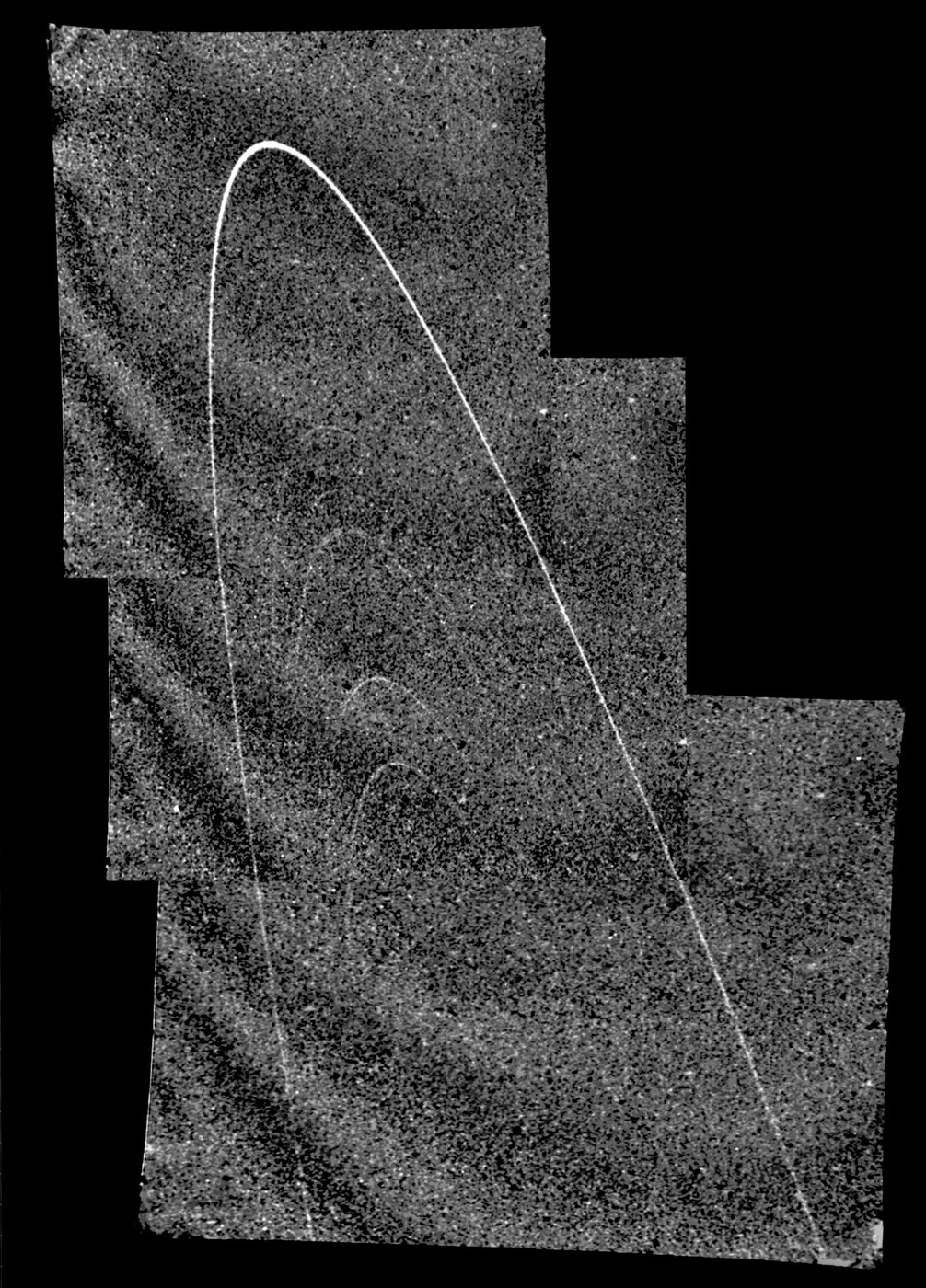
Uranus’s major moons and narrow rings largely follow its strongly tilted equatorial plane. The unusual geometry therefore belongs to a system, not merely to a bright patch on the planet. Any explanation for the tilt must account for the angular momentum and survival or formation of that family. [1] [5]
A major early collision is one proposed route. Other dynamical histories have also been investigated, so the present orientation is not a photograph of a particular impact. Interior structure, moon orbits and ring geometry supply additional tests of those models. [1] [5]
The seasons themselves follow directly from the measured tilt and long orbit. Voyager’s sunlit south pole and Hubble’s increasingly illuminated north are different chapters of that same cycle. They show why understanding Uranus requires watching a whole world change over decades, rather than treating one blue-green snapshot as its permanent appearance. [1] [5]
Sources & image credits
Related reading and objects
What “ice giant” means inside Uranus
Voyager 2 supplied Uranus’s only close spacecraft survey. Its measurements, combined with later observations, test a planet often called an ice giant. The name describes a compositional family; it does not mean a frozen solid sphere.
Why one Uranus flyby can mislead
Voyager 2 discovered Uranus’s unusual magnetic environment in 1986. Reanalysis decades later showed why the conditions during that short encounter matter: the solar wind may have compressed the magnetosphere shortly before the spacecraft arrived.