

How Juno weighs Jupiter’s hidden interior
Juno’s investigation of Jupiter’s interior begins with measurements made outside it. The spacecraft’s changing motion and magnetic environment constrain what lies beneath the clouds, where pressures prevent any conventional lander from surviving.
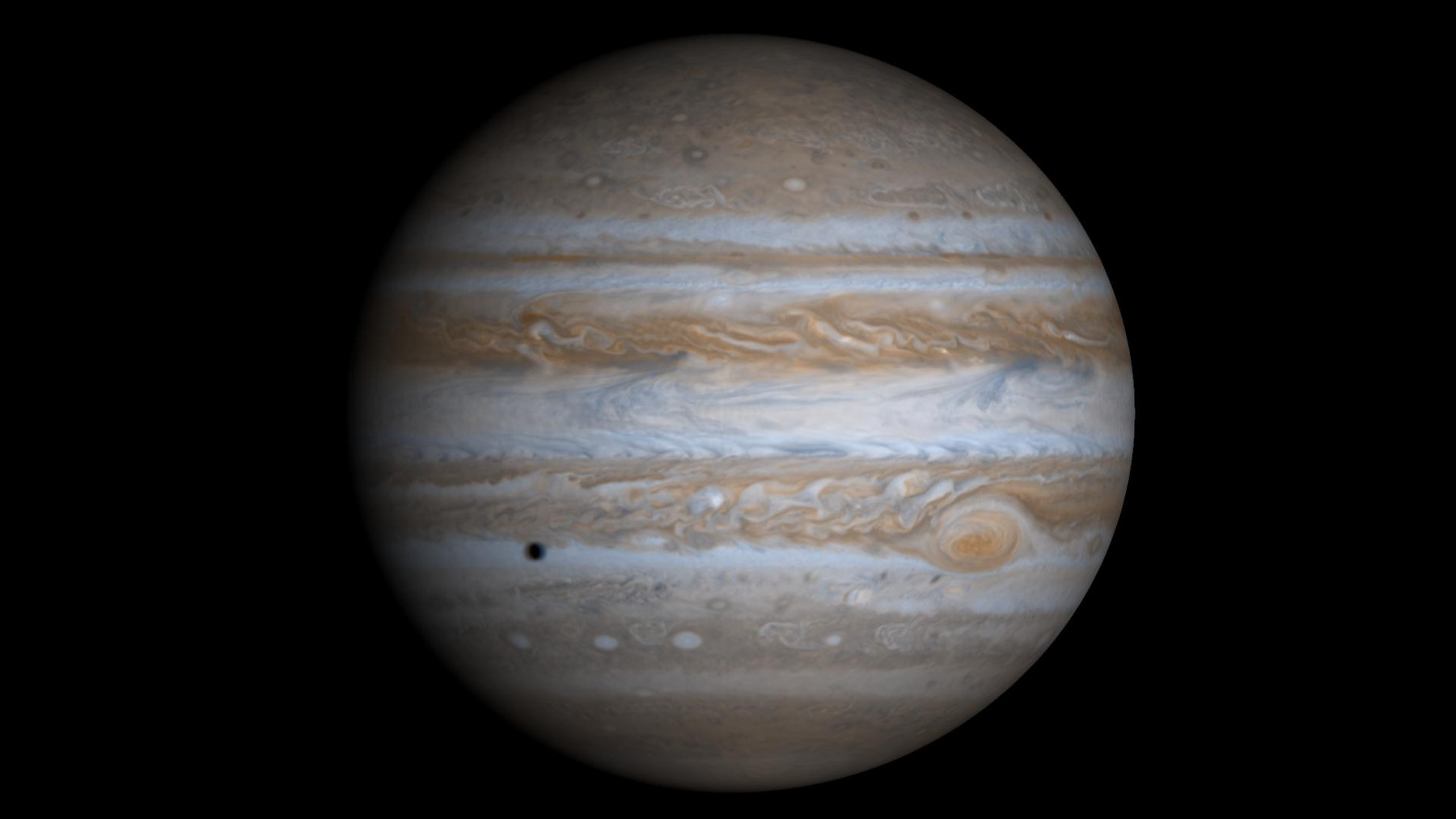
There is no cloud-top ground to stand on
Jupiter’s visible disk is atmosphere. Descending beneath it brings increasing pressure and temperature rather than a sudden encounter with a rocky surface. Hydrogen changes its behaviour at depth, eventually forming a dense, electrically conducting fluid. The familiar distinction between a solid planet and a thin layer of air does not apply. [1]
The radius quoted for a giant planet is tied to a defined atmospheric reference level. Gravity values also refer to a specified level and depend on latitude and rotation. Comparing Jupiter with Earth can establish size and gravitational strength, but it should not imply an accessible surface with a weather station on it. [1]
Measure tiny changes in the orbit
A perfectly spherical, uniformly distributed mass would create a simple external gravity field. Jupiter is rotating, flattened and structured internally. Those departures affect the pull on a passing spacecraft. Ground stations track Juno’s radio signal closely enough to detect small changes in its line-of-sight velocity. [2]
Models of the planet’s density distribution predict different gravity signatures. Researchers compare those predictions with the observations, while accounting for the spacecraft’s trajectory and other influences. The measurement is extremely informative, but it is an inverse problem: several internal structures can sometimes reproduce similar features of the external field. [2]
A core with a gradual boundary
Juno’s results support models in which heavy elements extend through a broad inner region rather than being confined to a compact, sharply bounded solid core. This is often called a dilute core. The term describes a distribution of material, not a photograph of a fuzzy object inside the planet. [3] [4]
The interpretation changes how researchers test Jupiter’s formation and later evolution. A proposed history must produce both the present mass distribution and the observed atmosphere. How much mixing occurred, and when, remains a subject of investigation. A cutaway should therefore distinguish a model constrained by data from a directly observed internal boundary. [3] [4]
A second constraint comes from the field
Motion in electrically conducting material generates Jupiter’s magnetic field. Mapping its strength and structure gives information about the dynamo region and the flows within it. Gravity constrains the distribution of mass; magnetism constrains another part of the physical system. Agreement between independent measurements is especially valuable where direct sampling is impossible. [3] [2]
The interior is thus studied through consequences that reach the spacecraft. Cloud images, microwave emission, radio tracking and magnetic measurements answer different questions. Together they restrict the models more strongly than an attractive cross-section alone could. Their agreement can distinguish an atmospheric effect from a structure that extends into the deep interior. [3] [2]
Sources & image credits
Related reading and objects
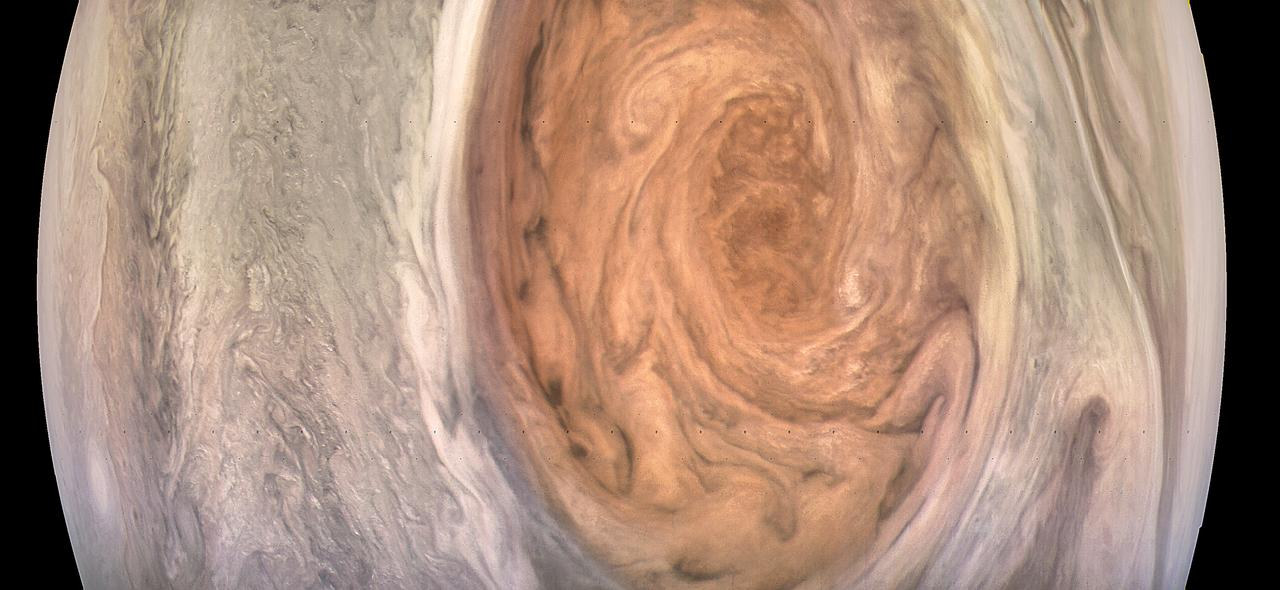
How deep does Jupiter’s Great Red Spot go?
Juno flew over a storm whose outline has been watched for generations. Its cameras could show the top. To measure what lay beneath, the mission needed microwaves, a radio link to Earth and two different ways of investigating hidden atmosphere.
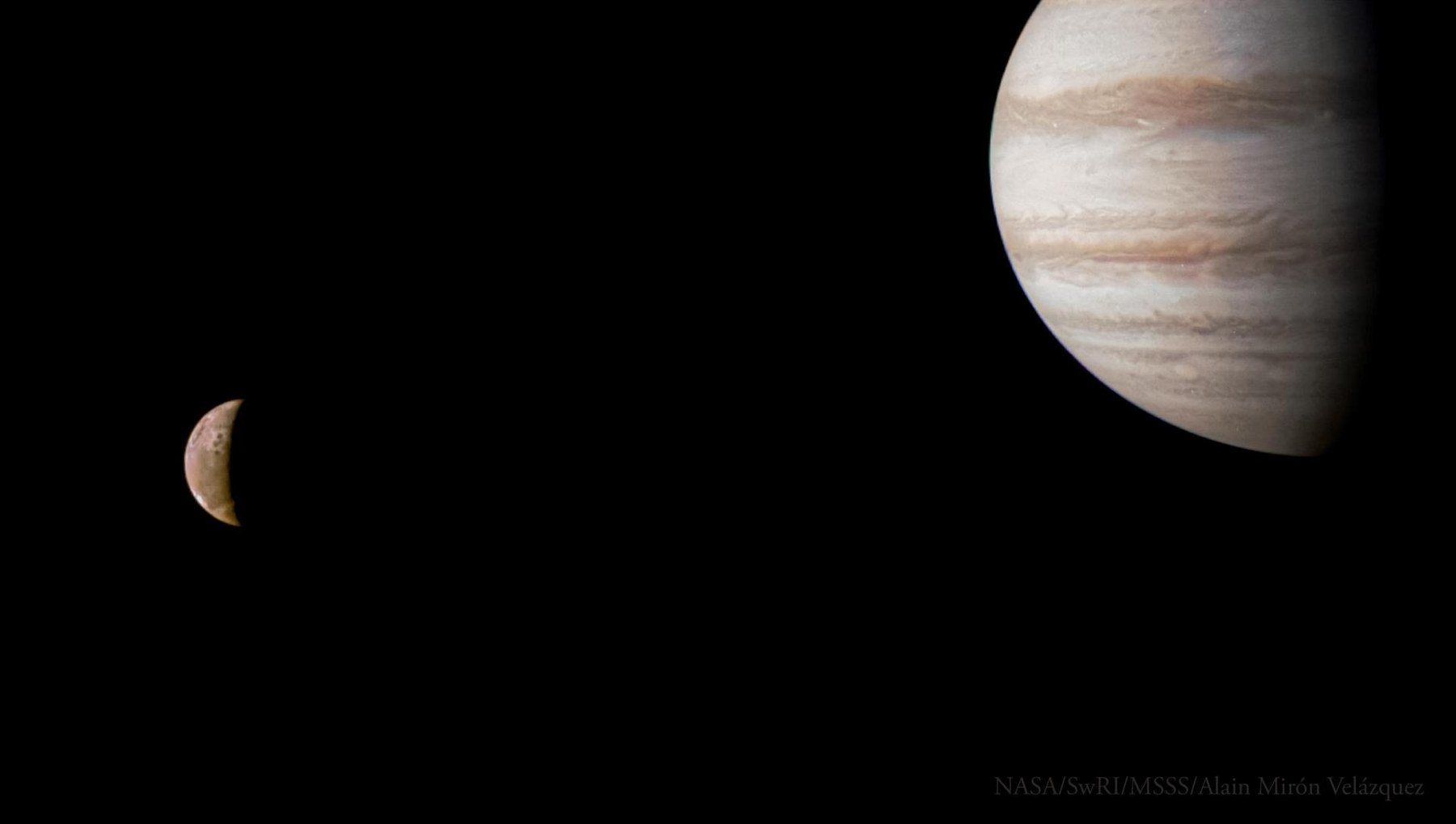
Why Jupiter must be explored with its moons
Juno’s close observations and Galileo’s earlier tour show why a mission to Jupiter is also a mission through a system of moons, rings and charged particles. Each moon follows a different geological history inside the same gravitational and magnetic environment.