

How deep does Jupiter’s Great Red Spot go?
Juno flew over a storm whose outline has been watched for generations. Its cameras could show the top. To measure what lay beneath, the mission needed microwaves, a radio link to Earth and two different ways of investigating hidden atmosphere.
A familiar oval hides an unfamiliar dimension
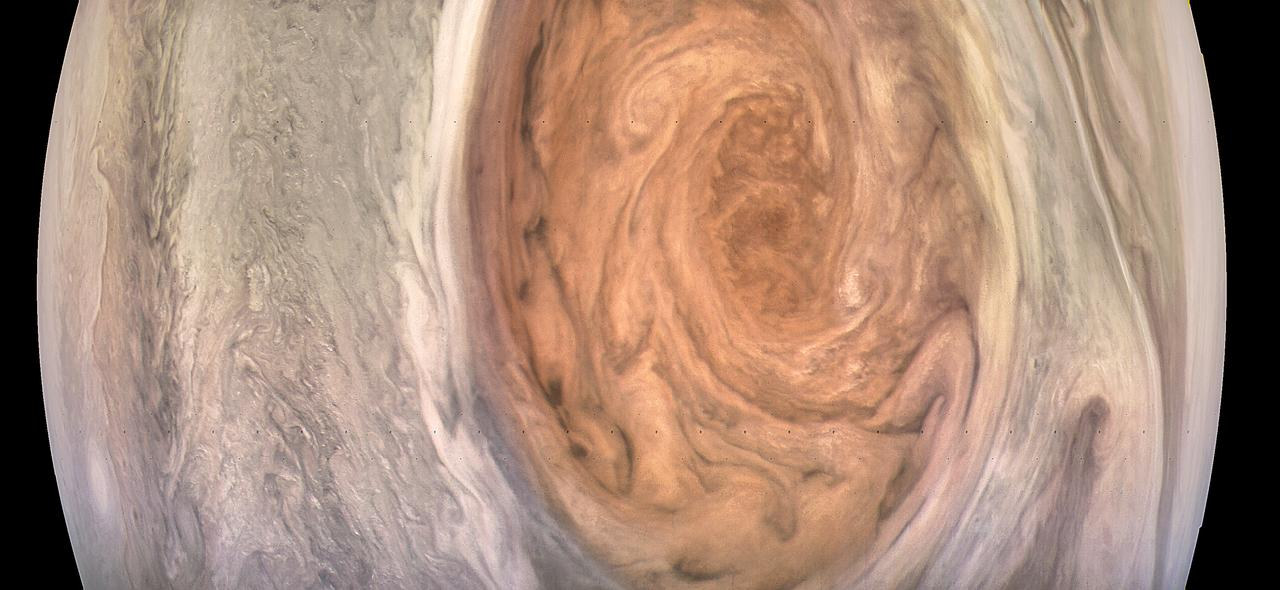
The Great Red Spot is an enormous vortex south of Jupiter’s equator. It circulates within a system of atmospheric bands and powerful east–west jets. Photographs reveal the clouds and hazes from which visible light can escape, including smaller features being drawn around the vortex. [1] [2]
Watching those features over time measures motion across the cloud tops. Comparing properly scaled images also shows that the storm’s horizontal size changes. Neither observation determines how far the circulation extends downwards. A wide oval on a globe could belong to a shallow weather layer or to a much deeper structure. [1] [2]
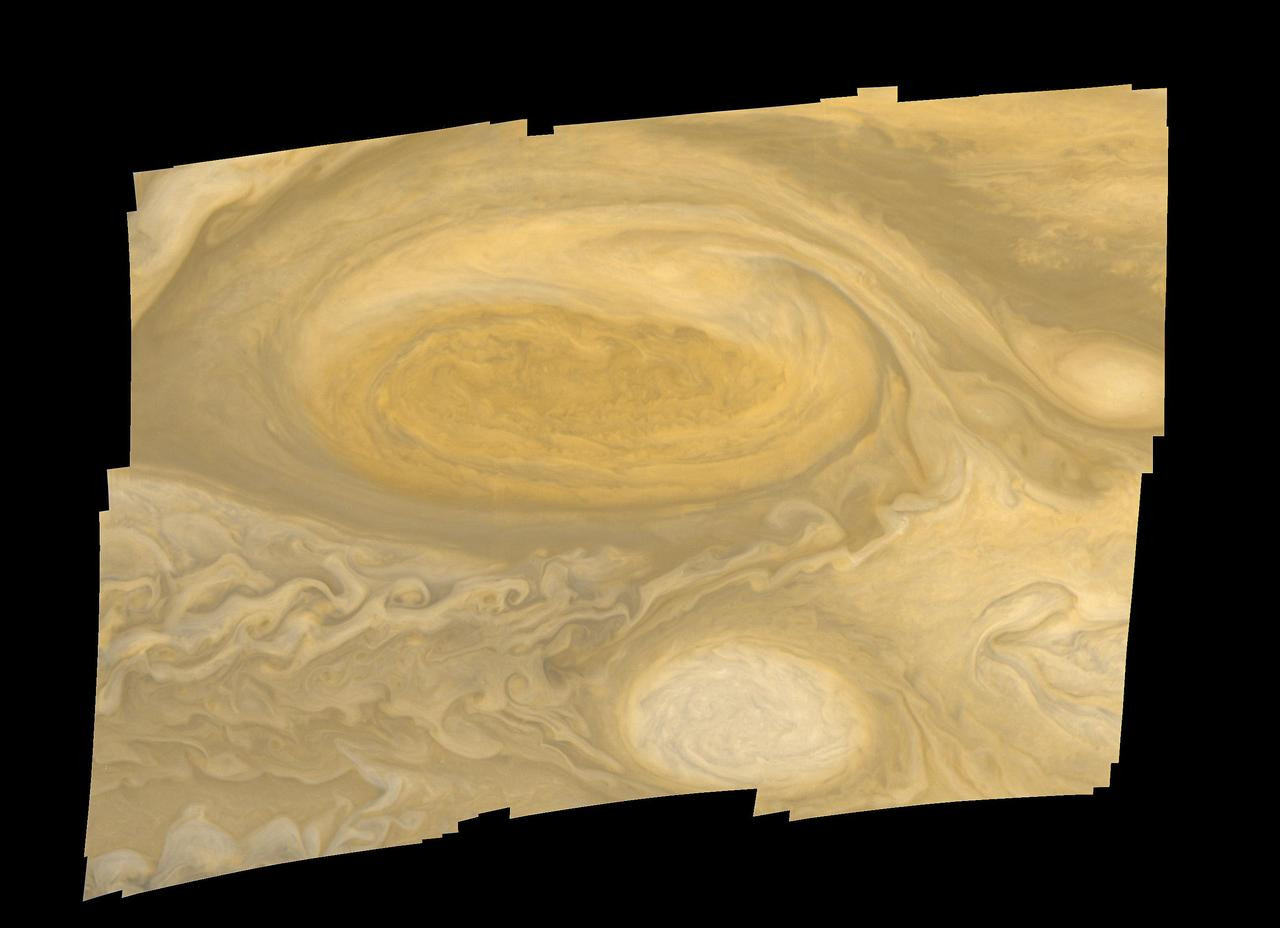
Jupiter supplies no visible solid surface at the bottom of this picture. Its atmosphere continues into progressively denser material. To find the storm’s lower extent, scientists therefore had to identify the storm’s signature within the surrounding atmosphere, rather than look for a boundary resembling the ground beneath an Earth hurricane. [1] [2]
Listen at wavelengths that escape from deeper layers
Juno’s microwave radiometer observes thermal emission in several wavelength channels. The atmosphere absorbs those wavelengths differently, so the channels are sensitive to different depths. They extend the investigation below the clouds seen by a camera. [2] [3]
Interpreting a bright or dark patch requires both temperature and composition. Ammonia affects how microwave radiation travels through the atmosphere; a change in the amount of ammonia can change the signal even without a simple corresponding temperature change. Several channels help researchers distinguish possible atmospheric structures. [2] [3]
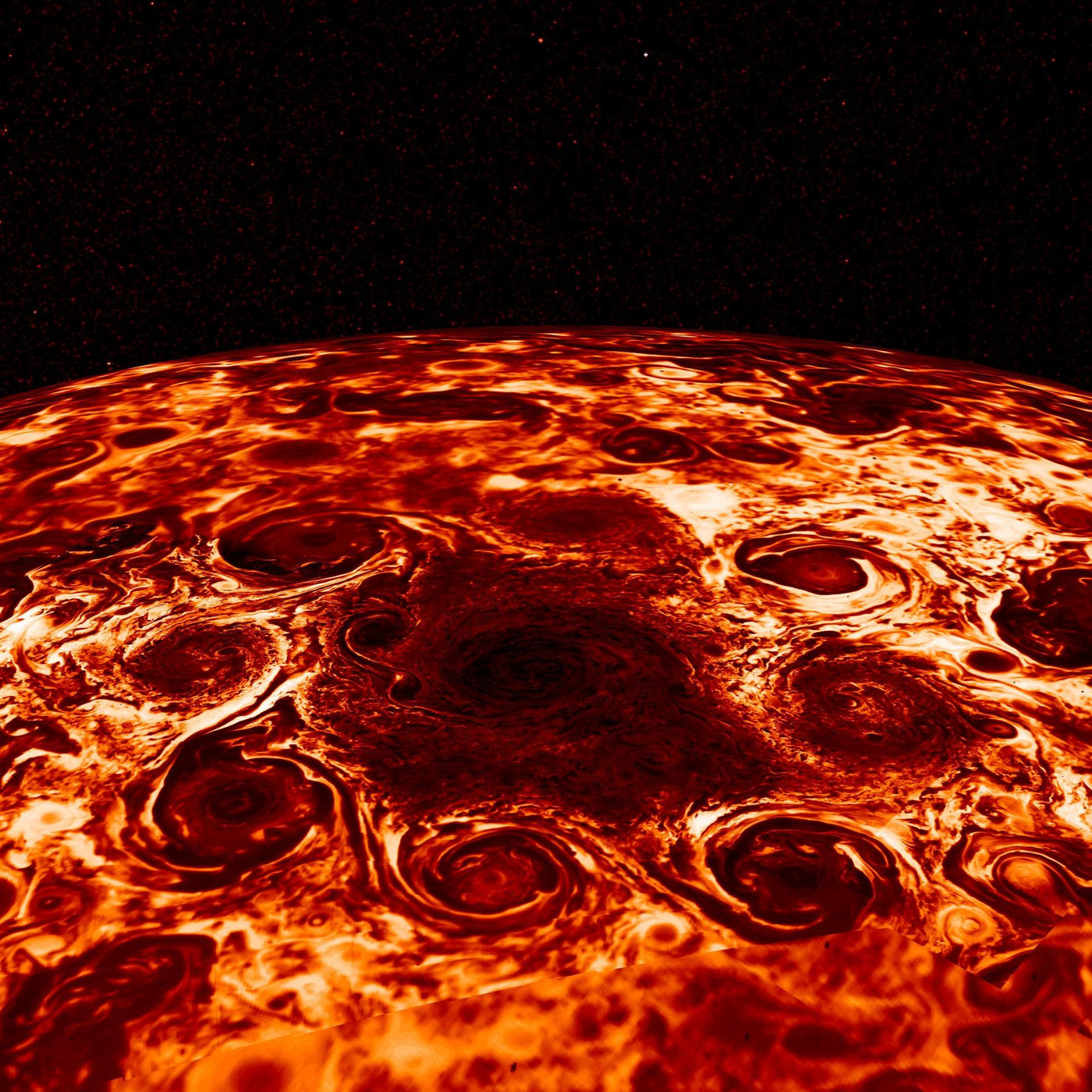
Results reported in 2021 showed that some Jovian vortices extend about 100 kilometres below the cloud tops, while others reach considerably deeper. The Great Red Spot extended beyond roughly 350 kilometres. It continued below the levels where water condenses and sunlight heats the atmosphere, giving the storm a much larger vertical range than its visible cloud texture suggests. [2] [3]
The storm also changes Juno’s motion
A vortex redistributes atmospheric mass. That produces a small gravity signature which affects the trajectory of a passing spacecraft. Juno’s radio link allowed Earth-based tracking to measure minute changes in its motion during close flybys over the Great Red Spot. [2]
The precision was exceptional: NASA described sensitivity to velocity changes of about 0.01 millimetre per second. Scientists compared those observations with models in which the storm extended to different depths. The gravity analysis constrained its extent to approximately 500 kilometres below the cloud tops. [2]
This result complemented the microwave observations, which depend on the propagation of radiation through gas. Gravity instead responds to mass. Agreement between the two approaches sharply reduced the range of plausible vertical structures. A camera, microwave instrument and tracking antenna were investigating different consequences of the same storm. [2]
Hundreds of kilometres can still make a shallow shape
The Great Red Spot is much wider than it is deep. A drawing that uses the same scale horizontally and vertically would show a broad structure, even though its depth is enormous compared with familiar weather on Earth. Stretching the vertical direction can make an explanatory diagram easier to read, but would change that visual impression. [2] [1]
Juno’s measurements also placed some of Jupiter’s surrounding jets at depths of roughly 3,200 kilometres. The vortex and the jets do not share a single lower boundary. That difference matters because the storm exchanges energy and momentum with the circulation around it; its place within the larger atmospheric system helps determine what models can explain its behaviour. [2] [1]
Depth alone does not solve the question of why the Great Red Spot lasts so long. It does supply a demanding test. A successful explanation must describe a huge, comparatively shallow vortex with roots below the sunlit weather layer, embedded in much deeper winds. Juno turned the famous red oval into that three-dimensional problem. [2] [1]
Sources & image credits
Related reading and objects
How Juno weighs Jupiter’s hidden interior
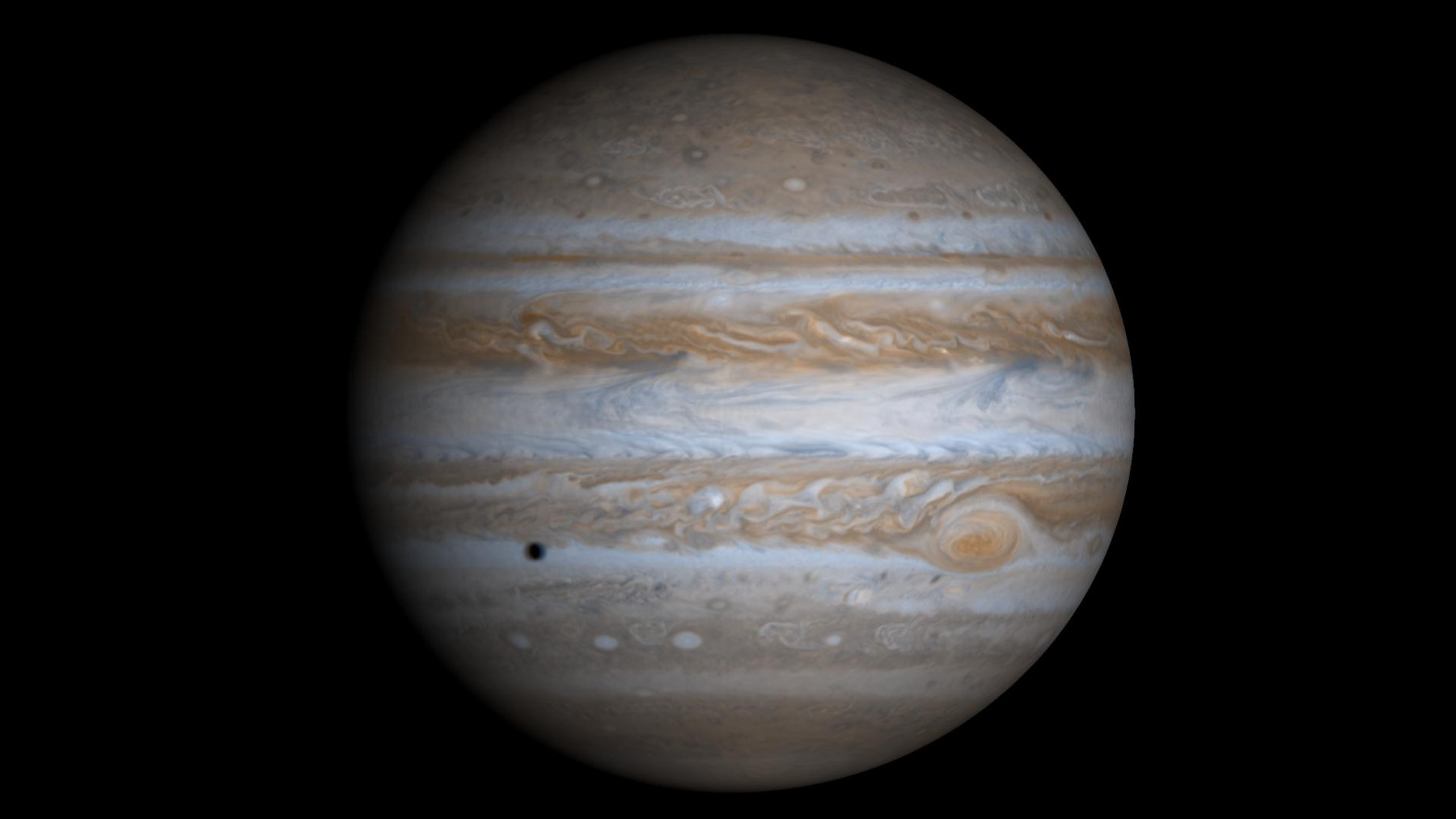
Juno’s investigation of Jupiter’s interior begins with measurements made outside it. The spacecraft’s changing motion and magnetic environment constrain what lies beneath the clouds, where pressures prevent any conventional lander from surviving.
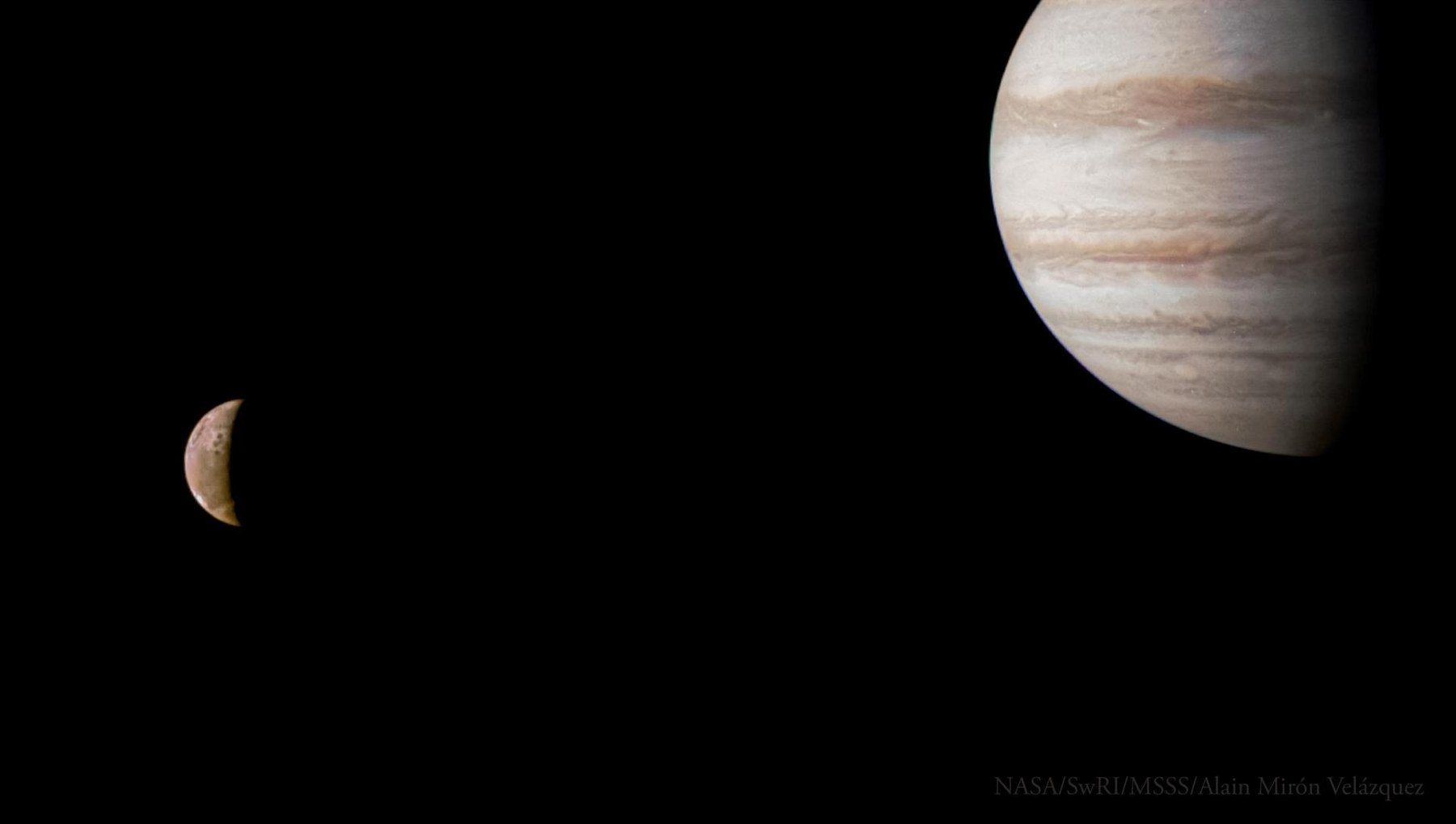
Why Jupiter must be explored with its moons
Juno’s close observations and Galileo’s earlier tour show why a mission to Jupiter is also a mission through a system of moons, rings and charged particles. Each moon follows a different geological history inside the same gravitational and magnetic environment.