

Why is Phobos falling towards Mars?
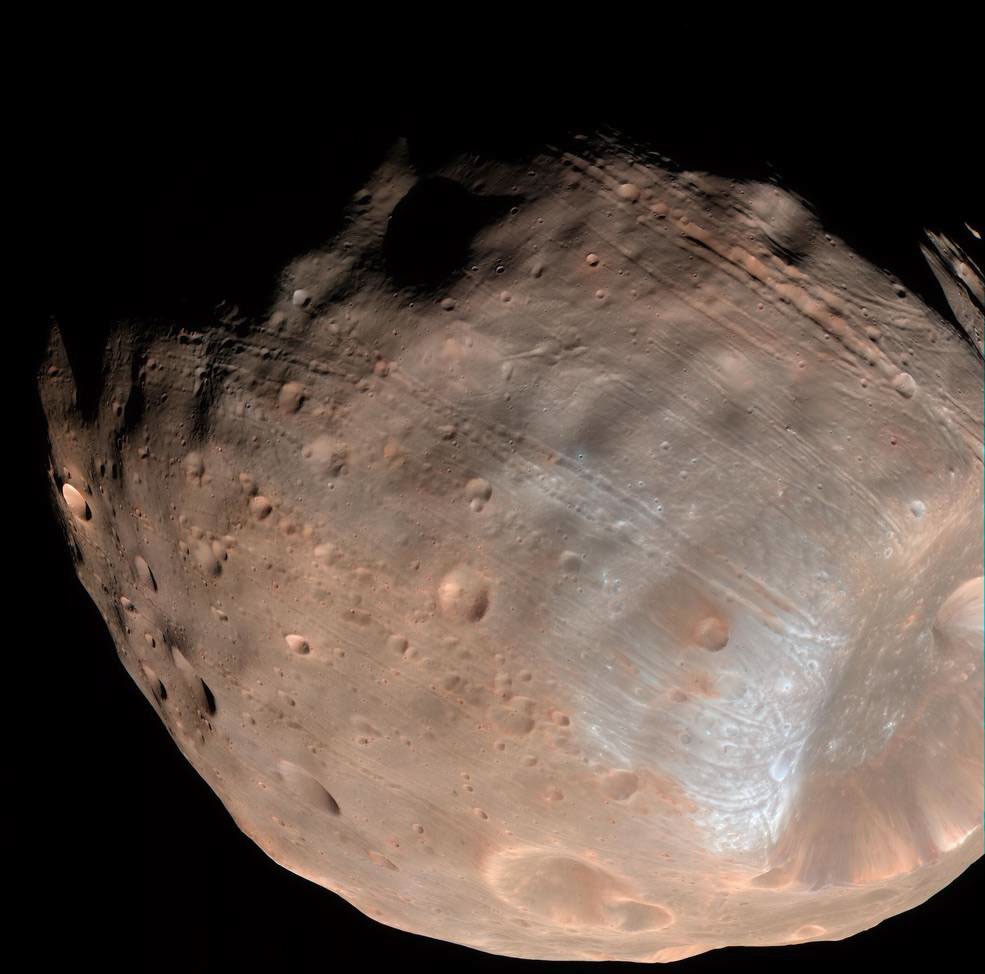
Images from Mars Reconnaissance Orbiter show Phobos as a battered, irregular moon dominated by Stickney crater. Its less visible change is orbital: Phobos is gradually moving closer to Mars because it travels around the planet faster than the planet turns.
The moon overtakes the turning planet
Phobos completes about three orbits of Mars per Earth day. Its orbital period is shorter than the planet’s rotation period, placing it inside the synchronous distance where a circular moon would take one Martian day to complete an orbit. [1]
That relationship determines the direction of the tidal exchange. Phobos raises a small deformation in Mars, but the planet cannot respond as an ideal, frictionless body. The gravitational interaction with the lagging deformation removes orbital angular momentum from the moon and transfers it towards the planet’s rotation. [1]
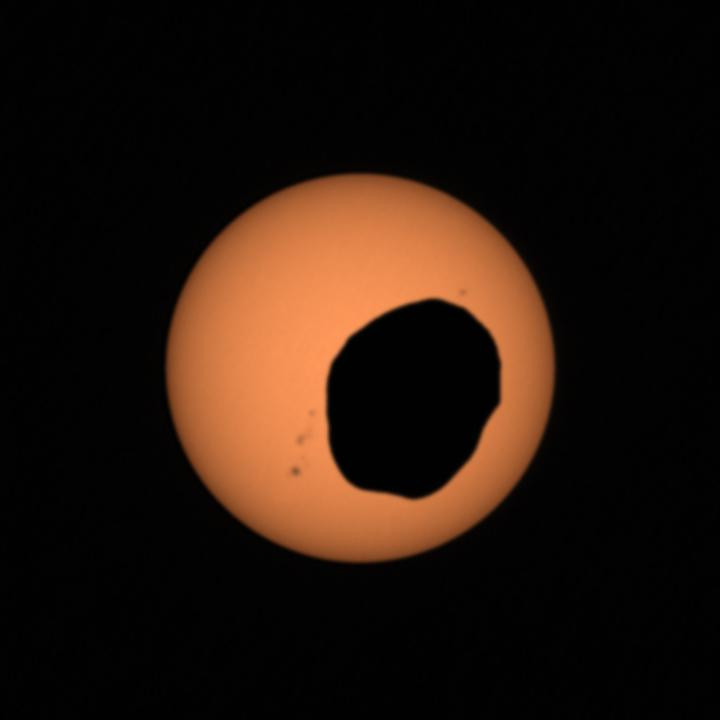
As orbital energy is dissipated and angular momentum is exchanged, Phobos’s orbit shrinks. The same general physics can move another moon outwards if its orbit lies beyond the synchronous distance. Distance alone is therefore not the explanation; the comparison between orbital and rotational rates matters. [1]
A rapid orbit can evolve very slowly
NASA gives the present inward drift as roughly 1.8 metres per century. That is tiny beside the moon’s dimensions or the size of its orbit, but it accumulates over geological time. [1]
A constant-rate extrapolation would be misleading. The strength of the tidal interaction changes as the orbit changes, and a closer moon experiences a stronger difference in Mars’s gravitational pull across its body. Long-term predictions require a dynamical and structural model rather than a straight line drawn from today’s rate. [1]
The expected endpoint is tens of millions of years away. Phobos may strike Mars or be disrupted before reaching the surface, producing debris that could form a temporary ring. The outcome depends in part on how strongly its interior holds together. [1]
Stickney exposes a mechanically complicated moon
Phobos is only about 27 kilometres long along its largest dimension. Stickney crater spans roughly nine kilometres, making the collision a major event for such a small object. Spacecraft photographs show steep slopes, boulders, fine material and numerous grooves. [1]
Those features record a body repeatedly damaged and rearranged by impacts. They do not uniquely establish whether Phobos is a captured asteroid or material assembled after a collision involving Mars. Surface appearance and orbital evolution are related research questions, but neither supplies a complete origin story on its own. [1]
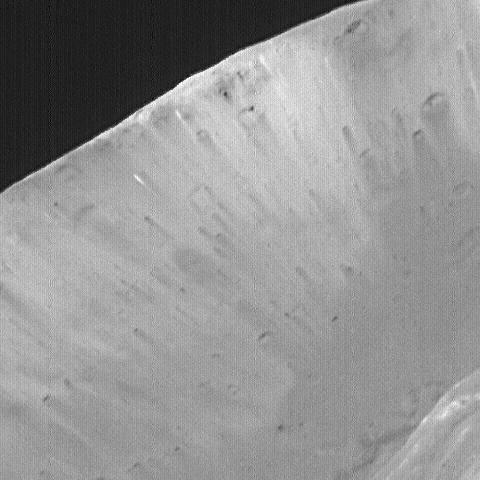
Fine surface material also affects temperatures. A dusty layer can heat and cool quickly because it conducts and stores heat differently from a solid block. Thermal observations therefore help characterise the surface encountered by a lander or sampling device. [1]
Deimos supplies the comparison
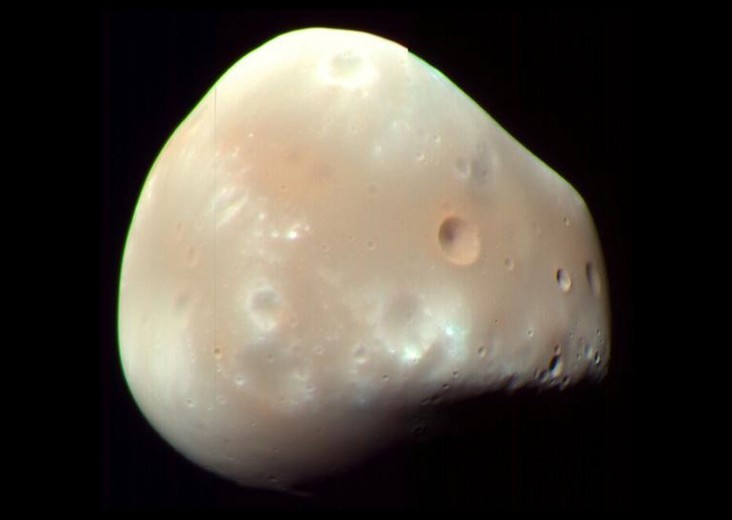
Deimos lies farther out and takes about 30 hours to orbit Mars. It is smaller than Phobos and has a smoother-looking surface where fine material partly fills craters. The moons share their host planet while occupying different orbital and surface environments. [1] [2]
That comparison prevents an easy shortcut: both are irregular and dark, but those traits do not prove that they arrived in the same way. A convincing origin model must also account for their orbits and measured composition. [1] [2]
What returned grains could decide
JAXA’s MMX mission combines remote observations of the Martian moons with a planned sample return from Phobos. NASA’s contributions include measurements of surface composition and sampling support. Laboratory analysis can investigate minerals and chemical signatures in ways that remote images cannot. [3]
The strongest test will join those grains to their geological setting and orbital history. Phobos’s future is being shaped by tides today; its material may retain evidence of how it entered the Mars system in the first place. Explaining the moon requires both ends of that history. [3]
Sources & image credits
Related reading and objects
Why is the origin of Mars’s moons still uncertain?
Mars Reconnaissance Orbiter photographed a dusty, cratered Deimos in February 2009. Its small, irregular shape resembles an asteroid. Explaining how that object ended up on a nearly circular orbit around Mars is harder than identifying the resemblance.
Where did the water on Mars go?
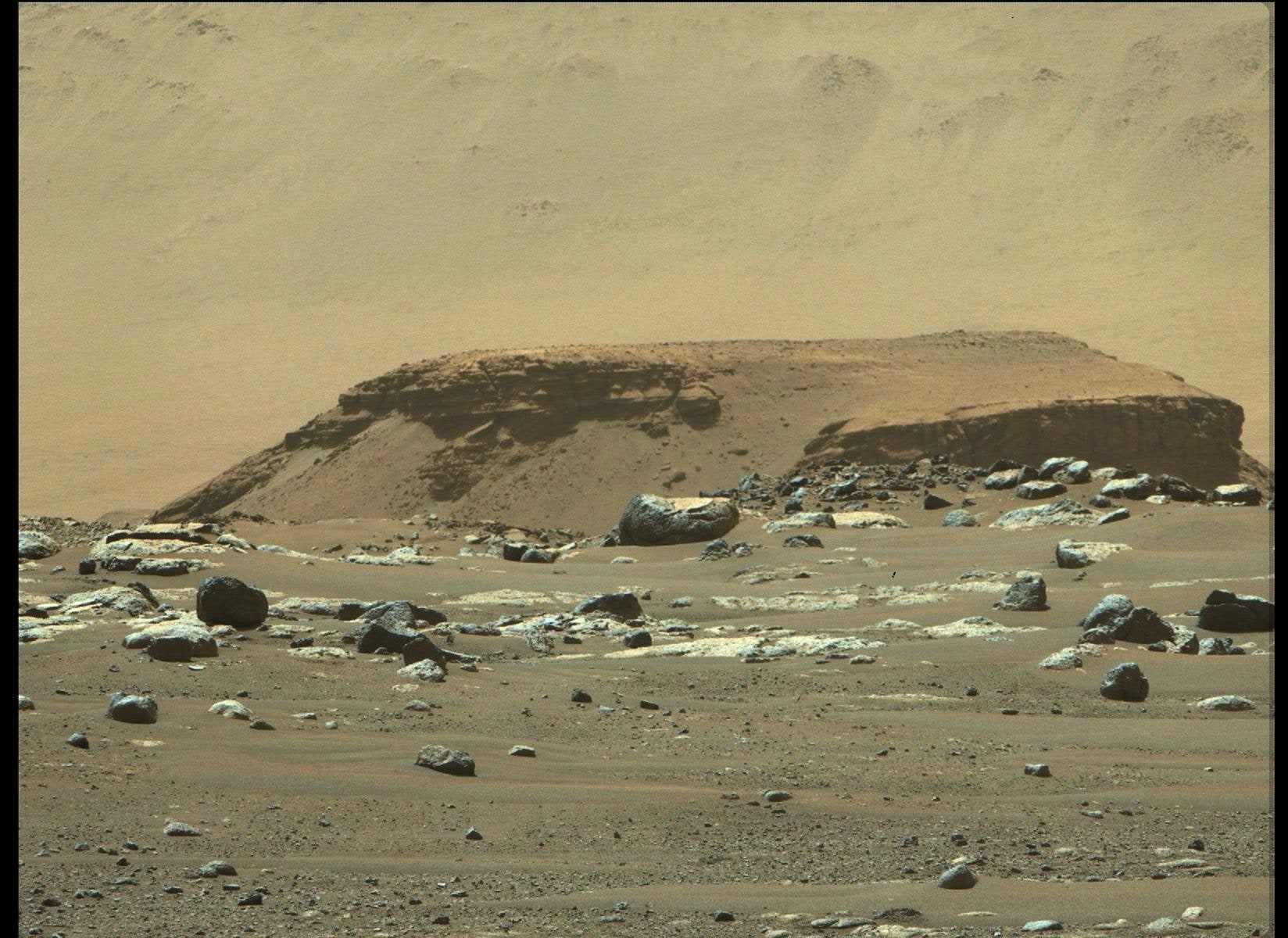
The planned Rosalind Franklin rover will investigate ancient Martian environments with samples from the surface and below it. Those measurements address a problem already visible at Jezero: rivers and lakes left rocks behind, but much of their water is missing.